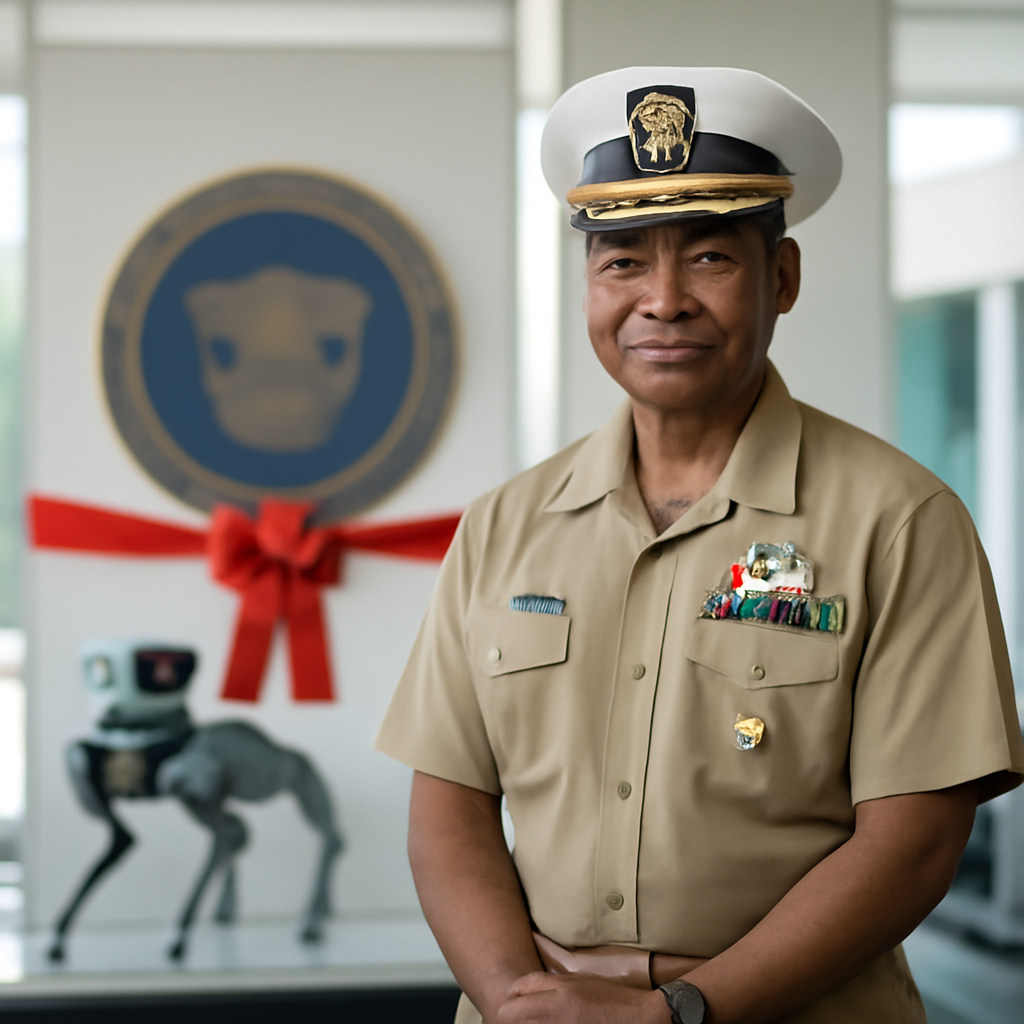
“RASWDC will draw on expertise from across the Navy — and across the country — in places that may not always be associated with naval power, but will be increasingly important to it,” Rear Adm. Melvin Smith said during a ribbon-cutting establishing the new command.
Rear Adm. Melvin Smith and the center’s declared mission
The newly established Robotics and Autonomous Systems Warfighting Development Center (RASWDC) opened in Virginia Beach with a clear, service-stated remit: develop the tactics, techniques and procedures for unmanned systems in the Navy and oversee their operational employment. In prepared remarks at the ribbon-cutting, RASWDC Commander Rear Adm. Melvin Smith said the command’s purpose is not to replace existing expertise but to “connect it” — ensuring work in one part of the Fleet informs work elsewhere and keeping sailors and operators “at the center of the conversation.”
Headquarters at Joint Expeditionary Base Little Creek–Fort Story and the phased plan
RASWDC is headquartered at Joint Expeditionary Base Little Creek–Fort Story in Virginia. The center is developing a phased implementation plan that, according to the Navy announcement, will address concrete organizational questions such as command structure, mission relationships and resource requirements. The plan is intended to transition RAS efforts from dispersed projects into a coherent operational enterprise.

Audit-ready is a season. It shouldn't be.
Evidence in spreadsheets, controls drifting between audits, frameworks multiplying on flat headcount. Nubivance runs continuous compliance on Rapid7 Cyber GRC - SOC 2, HIPAA, ISO 27001, PCI, CMMC.
End the scrambleWorking in lockstep with the Direct Reporting Portfolio Manager for Robotic and Autonomous Systems (DRPM RAS)
The establishment of RASWDC coincides with the creation in August of the Direct Reporting Portfolio Manager for Robotic and Autonomous Systems (DRPM RAS). The Navy said the two organizations are designed to operate together: RASWDC will run testing and training that produce information to support the DRPM RAS’s work advancing RAS acquisition and fielding across the Navy and Marine Corps. The service framed this pairing as a pipeline from development and test into fielding and operational employment.
Chief of Naval Operations Adm. Daryl Caudle’s strategic framing and the “Fighting Instructions”
Chief of Naval Operations Adm. Daryl Caudle has publicly advocated for a warfighting and development center for RAS for months, saying the Navy must move unmanned capabilities out of isolated programs and into composite mission sets similar to existing communities such as aviation, surface and mine warfighting. In a statement attached to the RASWDC announcement, Caudle said, “To maintain our decisive maritime advantage, we must rapidly integrate robotic and autonomous systems into how we operate, train, and deploy.”
Caudle characterized RASWDC as “the critical bridge between capability development and operational employment,” adding that “by forging a direct feedback loop, we are accelerating the delivery of unmanned capabilities from the foundry directly to the Fleet, ensuring our forces are postured to meet any challenge.” His push follows the release in February of the “Fighting Instructions” framework, which included a “hedge force strategy” pairing unmanned systems with traditionally manned platforms to create tailored options for combatant commanders.
The February guidance also directed the Navy to establish how fleet commanders and the joint force will integrate RAS into “service decisions like strategic laydown, dispersal, and global force management,” noting that no model for RAS capabilities exists yet and that such integration must be defined.
What this means for the Fleet, the DRPM RAS, and combatant commanders
- The Fleet: Sailors and operators can expect a centralized effort to translate testing and tactics into operational doctrine and training, with RASWDC positioned to coordinate lessons learned across disparate units so that local experimentation informs broader operational employment.
- The Direct Reporting Portfolio Manager for Robotic and Autonomous Systems (DRPM RAS): The DRPM RAS will rely on RASWDC’s testing and training outputs to inform acquisition and fielding schedules—linking development decisions to operational feedback as the service advances RAS capabilities.
- Combatant commanders: The Navy’s February “Fighting Instructions” tasked the service to define how RAS will factor into strategic laydown, dispersal, and global force management; commanders will therefore be watching how RASWDC sets command relationships and integrates unmanned systems into composite mission sets and deployment planning.
RASWDC’s opening formalizes a previously diffuse effort into a named center with responsibility for doctrine, testing and operational employment; it will work hand-in-glove with the DRPM RAS to move systems from development into the Fleet. The next practical milestones — the phased implementation plan’s decisions on command structure, mission relationships and resource allocation — will determine whether the center becomes a genuine bridge between laboratory innovation and everyday naval operations, and how RAS will be folded into the service decisions named in the “Fighting Instructions.”