“It is certainly a significant development,” said Bradley Martin, framing a carrier strike group sailing with a Seahawk medium unmanned surface vessel (MUSV) as more than experiment and squarely into operations.
The Roosevelt deployment as an operational milestone
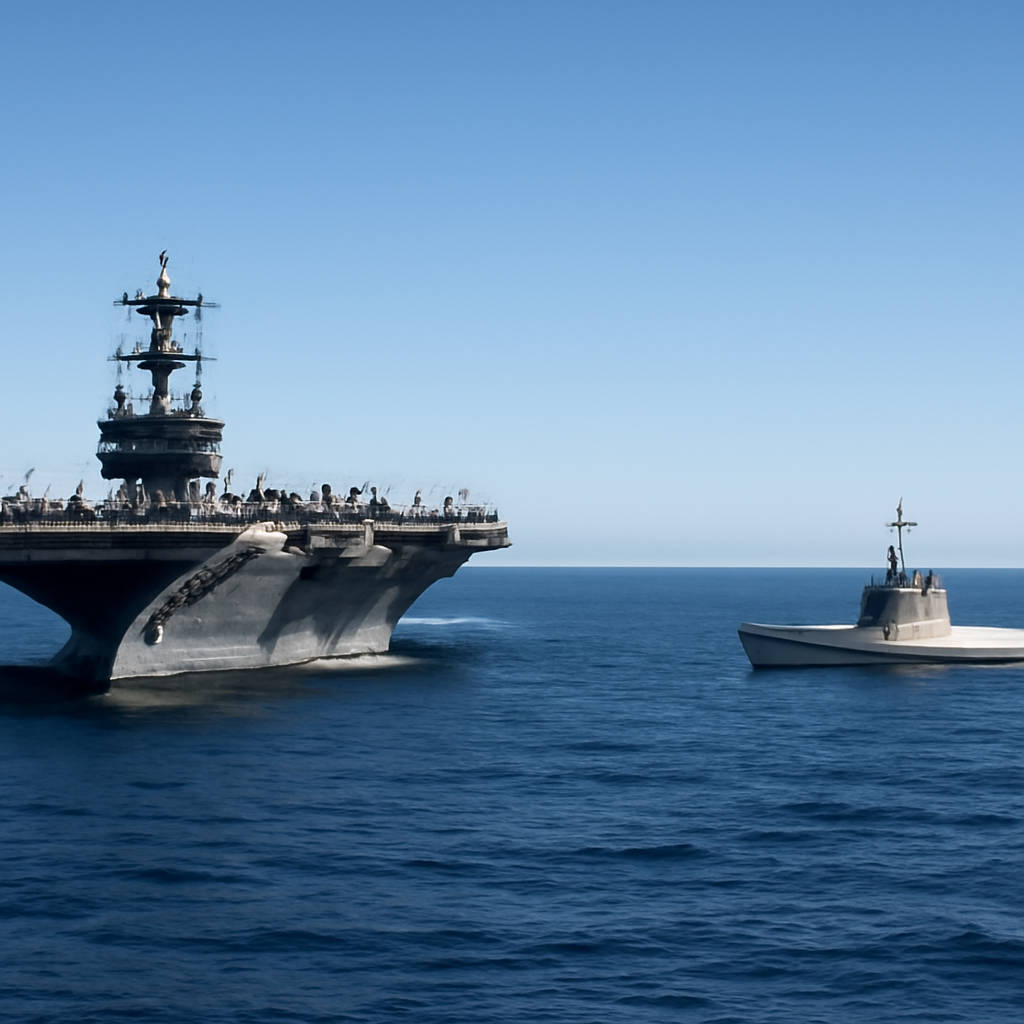
The aircraft carrier Theodore Roosevelt is preparing to deploy with a Seahawk MUSV as part of its carrier strike group, a first for a regularly scheduled carrier deployment, according to reporting by Breaking Defense. The Navy announced the planned pairing at the Sea Air Space exposition in April, but did not provide precise sailing dates or detailed aims when asked by reporters.
Analysts characterized the deployment as the signal transition of the MUSV from testing toward operational integration. Bryan Clark, a retired submarine officer and senior fellow at the Hudson Institute, said the move shows MUSVs have “progressed from science project to become part of the operational fleet.” Bradley Martin, a retired Navy captain and senior policy researcher at RAND, and Stacie Pettyjohn, a senior fellow at the Center for a New American Security, likewise described the voyage as an early but important step toward defining how unmanned vessels will work alongside crewed ships.
What the Seahawk is and what it can do
The Seahawk is Leidos’ upgraded design of the Sea Hunter autonomous vessel and stems from a Defense Advanced Research Projects Agency initiative. The MUSV supports anti-submarine warfare and maritime domain awareness and carries sensor suites that experts say can provide intelligence, surveillance, and reconnaissance (ISR) capabilities similar to those of a helicopter, but with longer persistence and greater communications bandwidth.
Analysts expect the Seahawk on the Roosevelt deployment to conduct ISR, possibly electronic warfare missions, and to test a range of payloads. Bryan Clark noted the platform’s long endurance but lower speed relative to carriers, flagging a tactical challenge: how to station the MUSV so it neither lags behind faster transits nor becomes a logistical burden. Bradley Martin said the Navy will evaluate command-and-control arrangements, refueling and logistics needs, and the vessel’s proper stationing—whether close in or over the horizon. Pettyjohn added countermine warfare as a likely mission area under evaluation, given recent mine-clearance operations in the Middle East.

The cyber insurance questionnaire just landed. Now what?
SOC 2, HIPAA, insurance renewals - someone has to own security strategy. Nubivance provides fractional CISO leadership without the full-time salary.
Get a security leadAdm. Daryl Caudle’s 'Fighting Instructions' and the unmanned dilemma
In February, the Navy’s top officer, Chief of Naval Operations Adm. Daryl Caudle, released a “Fighting Instructions” framework that directs development of a “hedge force strategy” leveraging unmanned systems and tailored force packages beyond the traditional carrier strike group model. Caudle instructed the Navy to detail how fleet commanders and the joint force will integrate robotic autonomous systems (RAS) into strategic laydown, dispersal, and global force management. He has described the issue as an “unmanned dilemma” over how to organize RAS capabilities fleetwide and has floated establishing a RAS Warfighting Development Center and even a RAS commander to coordinate across domains.
Martin cautioned that creating a separate RAS type commander risks siloing and recommended letting established communities work with RAS to build familiarity. Pettyjohn said the Navy likely already has some CONOPS and will develop more through deployments like the Roosevelt’s, but she emphasized CONOPS should remain living documents that change with technology, adversary adaptation, and operational experience.
MUSV marketplace, acquisition shifts, and industry roles
To accelerate procurement, the Navy in March replaced the Modular Attack Surface Craft (MASC) program with a MUSV marketplace designed to attract production-ready, mission-capable platforms through performance-based requirements. In May the Navy selected seven designs to advance to prototype testing; Leidos — builder of the Seahawk — is among those selected. The Navy plans at-sea demonstrations later this year and aims to have vessels available to lease or procure in fiscal year 2027.
Industry voices endorsed the flexible approach. Michael Robbins, president and CEO at the Association for Uncrewed Vehicle Systems International, said performance-based, geographically flexible requirements allow the warfighter to obtain MUSVs suited to different combatant commands’ needs. Analysts also say the Roosevelt deployment could shape procurement choices: it may reveal which parameters — endurance, speed, payload flexibility — matter most, or expose logistical limits such as more frequent refueling needs that could complicate escort and oiler vulnerability.
What this means for the House Armed Services Committee, fleet commanders, and procurement leaders
- House Armed Services Committee and Congress: The committee’s chairman’s mark of the National Defense Authorization Act released in May would require the Navy to verify to congressional defense committees that CONOPS for unmanned systems exist before accepting a USV, and would require the secretary of the Navy to craft and execute a USV integration strategy.
- Fleet commanders and warfighters: Commanders will be watching how the Seahawk integrates into carrier operations, how it is tasked for ISR, electronic warfare, and countermine missions, and what command-and-control arrangements and stationing concepts prove viable at sea.
- Procurement leaders and industry (Leidos and MUSV marketplace participants): The Roosevelt deployment and the May selections for prototype testing could directly influence which designs move to production and the pace of purchases ahead of the Navy’s target to have platforms available in FY2027.
The Roosevelt deployment will not settle every question. The Navy declined to specify deployment timing, which CONOPS will be exercised, or when an overarching unmanned strategy will be published. Still, analysts across think tanks agree: the carrier’s time at sea with a Seahawk will be a defining early experiment — a practical, operational laboratory shaping CONOPS, acquisition tradeoffs, and the organizational arrangements the Navy chooses to govern unmanned systems.