“Airborne missions at NASA use cutting-edge instruments to explore and understand our home planet,” explained Derek Rutovic, program manager for the Airborne Science Program at NASA Headquarters in Washington, in a press release.
L3Harris and Yulista completed structural work in Waco
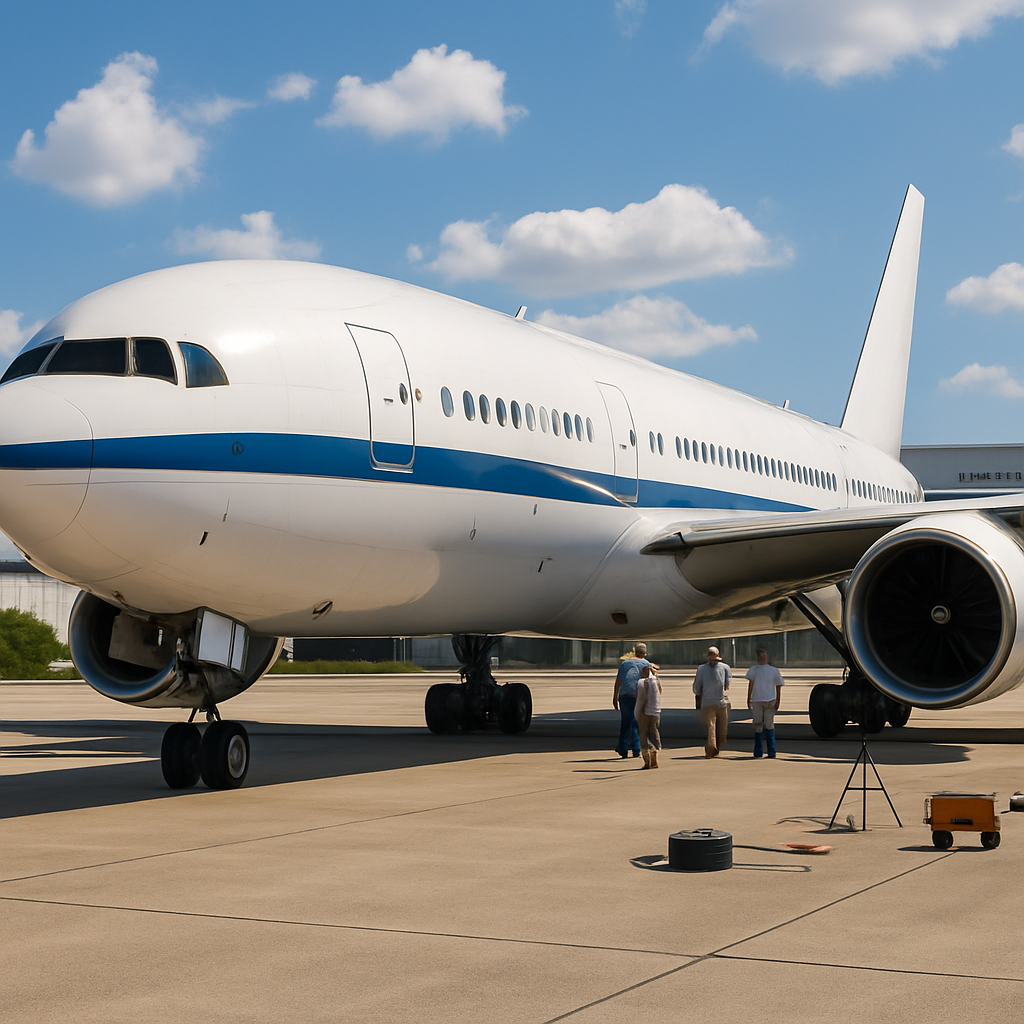
The ex-commercial Boeing 777-200ER that NASA purchased in December 2022 for less than $30 million arrived at NASA’s Langley Research Center in Hampton, Virginia, on April 22, 2026, after a check flight and a three-hour transit from Waco, Texas. L3Harris told TWZ that it “completed extensive structural modifications” and delivered the aircraft ahead of schedule, using advanced engineering techniques such as 3D scanning and specialized installation tooling. The company confirmed it partnered with Yulista on the modification work; Yulista’s website describes the firm as providing “integrated modernization, sustainment, readiness, and mission support for defense and aerospace customers.”
Interior outfitting at Langley by NASA and HII
Major structural conversion work occurred in Waco, but the 777 will undergo a full interior revamp at NASA’s Langley Research Center. Research station and wiring upgrades in the cabin are being performed by NASA and HII. While at Waco, the 777 received dedicated research stations and extensive wiring: wiring harnesses were routed through the fuselage so onboard workstations can communicate with sensors such as LIDAR and infrared imaging spectrometers. Temporary fasteners were used to map out hole patterns through four layers of reinforcement, and nearly 35,000 precision holes were drilled into the aircraft’s belly to support instrument installations.

This site is the portfolio.
OSINTSights runs on Cloudflare Workers, D1, R2, and Vectorize, with an AI pipeline on Hetzner ARM. Nubivance designed, built, and operates it. We do the same for clients.
See what we buildPhysical changes: viewports, ports, power and data
Structural modifications included enlarged cabin windows and ports installed in the bottom of the fuselage to mount remote-sensing instruments. The jet received new power, data, and communications systems and accommodations for instrument operators. L3Harris highlighted the installation of viewports in the 777 aircraft cargo bay that will house advanced scientific instruments. Those widened windows and belly ports are intended to host a variety of remote-sensing sensors and provide line-of-sight for airborne instruments during missions.
Performance and capacity compared with the DC-8
As NASA’s largest airborne research platform, the 777 will replace the agency’s retired Douglas DC-8. The 777 can accommodate between 50 and 100 onboard operators, compared with the 45 researchers and flight crew that typically flew aboard the 1969‑vintage DC-8. Payload capacity also rises significantly: the 777 offers a useful payload of 75,000 pounds versus the DC-8’s 30,000 pounds for scientific instruments and equipment. Endurance and altitude expand as well — the Boeing 777 will conduct missions of up to 18 hours at a maximum altitude of 43,000 feet, while DC-8 missions typically lasted between six and 10 hours. The DC-8 returned to NASA’s Armstrong Flight Research Center in Palmdale, California, on April 1, 2024, after completing its final test mission.
NURTURE: first science mission planned for January 2027
The 777 is expected to fly its first science mission in January 2027 as part of the North American Upstream Feature-Resolving and Tropopause Uncertainty Reconnaissance Experiment (NURTURE). That campaign will task the aircraft with studying high-impact winter weather events — including severe cold air outbreaks, wind, snow and ice storms, and hazardous seas — across North America, Europe, Greenland, and the Arctic and North Atlantic Oceans. The NURTURE payload has been installed alongside the general modification work, positioning the aircraft to begin campaign-specific operations once the interior revamp at Langley is complete.
What this means for NASA, instrument teams, and atmospheric researchers
- NASA program managers: The 777 expands capacity for multi-instrument, multi-partner campaigns and, as Kirsten Boogaard, the NASA 777 program manager at Langley, put it, “gives us the ability to bring together more partners, more educational opportunities, and more instruments.” The platform becomes a central asset in the agency’s airborne science toolbox.
- Instrument teams and avionics integrators: Increased payload (75,000 pounds) and extended flight duration (up to 18 hours) enable larger, heavier, or more power-hungry sensor suites and longer continuous observation windows, but they also require coordination on power, data, and communications infrastructure now being installed.
- Atmospheric and Earth scientists: Longer endurance, higher ceiling and expanded sensor mounting options (enlarged windows and belly ports) allow campaigns such as NURTURE to collect denser, higher-resolution observations over broad regions, including polar and oceanic domains identified for the January 2027 mission.
The arrival of the 777 marks a deliberate modernization of NASA’s airborne research fleet: larger capacity, longer endurance, and updated avionics and payload accommodations. With structural work complete and the NURTURE payload already installed, attention now turns to the interior revamp at Langley and the first science flights scheduled for January 2027 — a tangible next step in replacing the legacy DC-8's role in airborne Earth science.
Source: TWZ — NASA’s 777 Flying Laboratory Touches Down At Langley