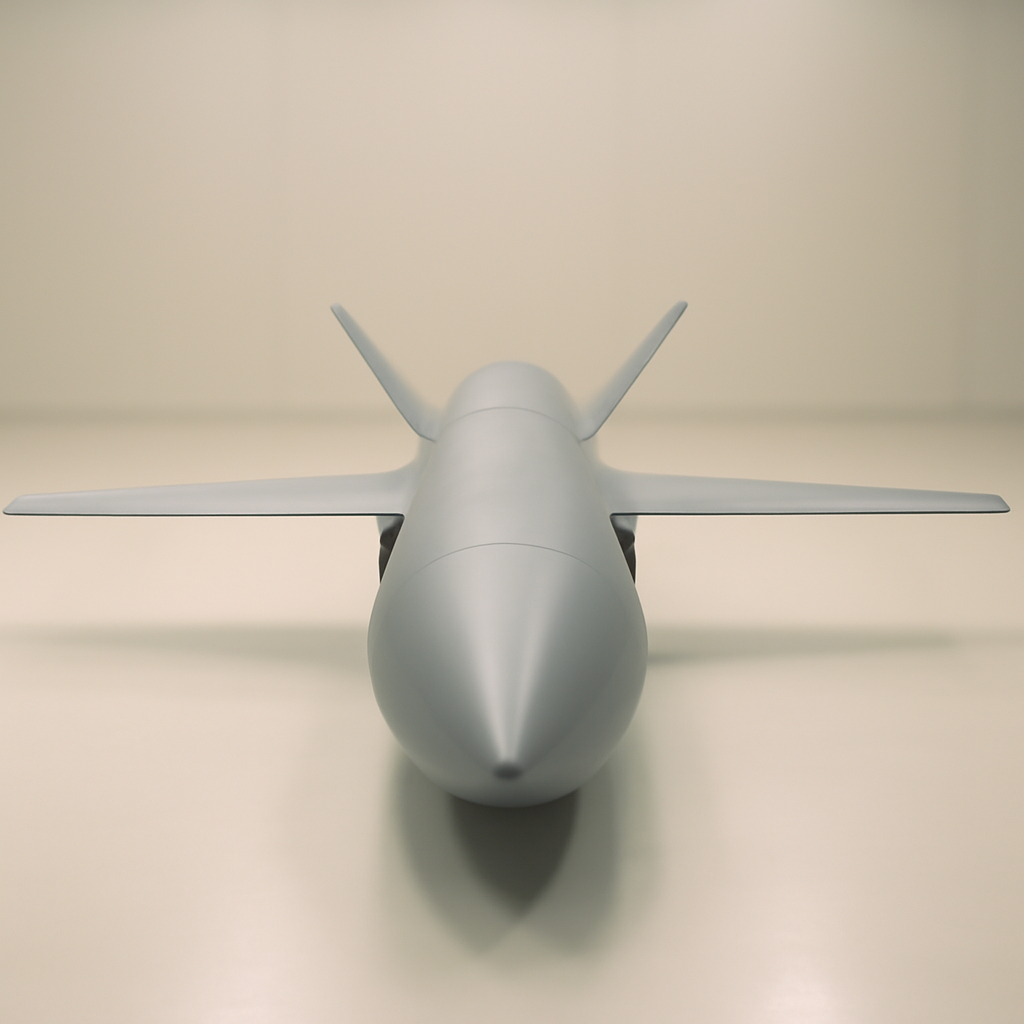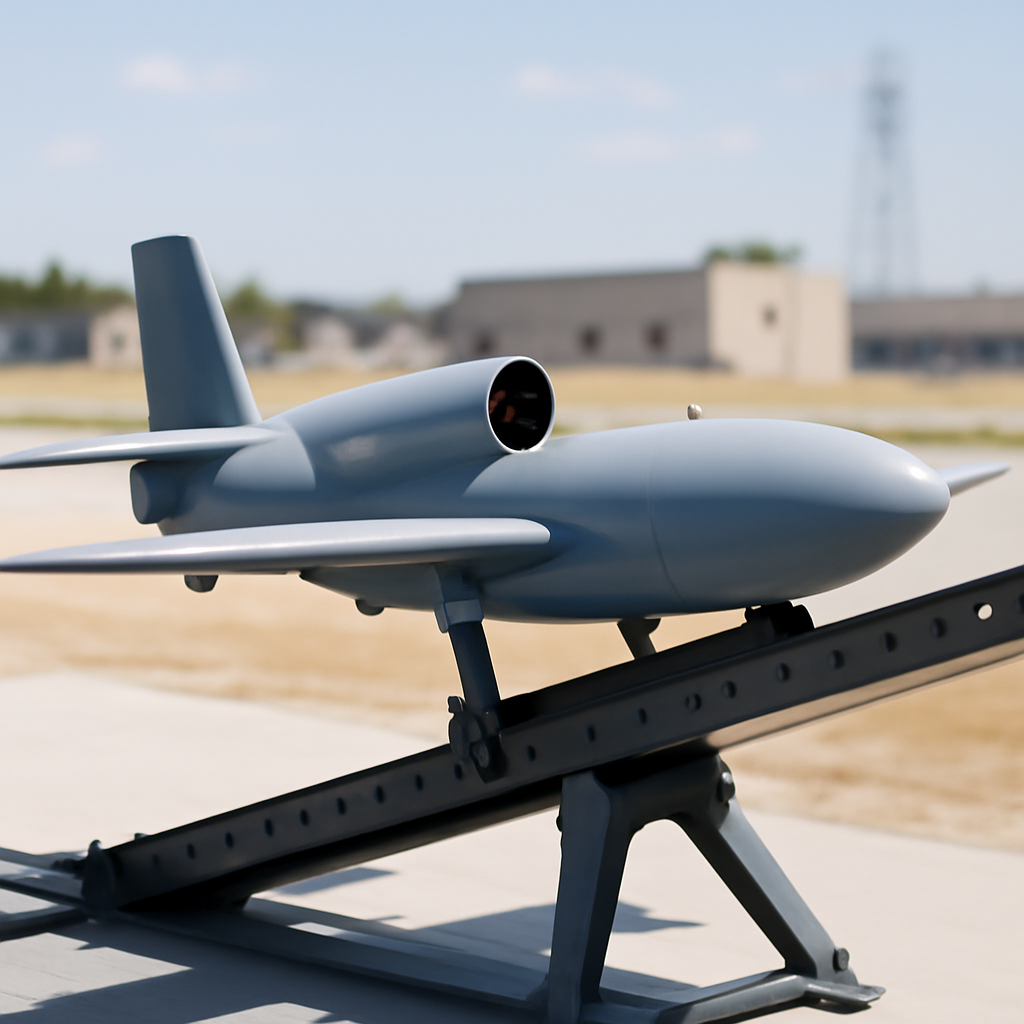
“saturation effects against defended targets and air defence systems,” reads MBDA’s Deluge product page — a terse description that doubles as a mission statement for a new munition built around cheapness and numbers rather than stealth or single-shot precision.
What the MBDA Deluge is designed to do
MBDA Deluge is a ground‑launched, turbojet-powered one‑way attack drone intended for coordinated, massed strikes at fixed coordinates. MBDA describes Deluge as a “one-way effector” — a munition of attrition meant to generate saturation effects against defended targets and air‑defence systems. It is explicitly not a loitering munition: Deluge flies to preset coordinates on a mid‑altitude cruise with no disclosed seeker or datalink and performs no orbit-and-search phase.
Capabilities on record — and where accounts diverge
MBDA gives Deluge a cruise speed of approximately 400 km/h and a range “up to 500 km,” with other outlets rendering range as “more than 500 km.” Reported warhead mass varies: MBDA states a “50 kg class payload,” while Zone Militaire, The Defense Post and Army Technology report about 40 kg, and Theatrum Belli specifies 40 kg of blast and fragmentation. Physical dimensions are inconsistent across sources: a three‑metre wingspan is quoted by MBDA, The Defense Post reports 3.3 m and Theatrum Belli 3.9 m; reported length alternates between 3 m and 2.5 m.
At the Paris unveiling Breaking Defense reported GNSS‑denied operation, though the method of navigation in GNSS‑denied environments has not been described publicly. Those differences — range, payload, dimensions and navigation technique — are material because they change the tactical role Deluge would play and the platforms or defences it might overwhelm.

Audit-ready is a season. It shouldn't be.
Evidence in spreadsheets, controls drifting between audits, frameworks multiplying on flat headcount. Nubivance runs continuous compliance on Rapid7 Cyber GRC - SOC 2, HIPAA, ISO 27001, PCI, CMMC.
End the scrambleIndustrial model: civilian lines, mass production claims
Where Deluge departs from many conventional missiles is in MBDA’s chosen manufacturing route. MBDA says it is routing Deluge “around its own missile‑grade supply chain into civil mass production,” explicitly partnering “with civilian industries, notably the mass production sector.” Named partners include French UAV maker Aviation Design and an unnamed automotive manufacturer. MBDA has not said which national MBDA entity leads the programme; MBDA France is a weak inference tied to the French customer and Aviation Design but not confirmed by the company.
Claims about achievable volume vary sharply. Hugo Coqueret, MBDA’s battlefield domain business development manager, said in Paris in June 2025 that output could reach 1,000 units a month. By contrast, The Defense Post reported an initial rate near 100 a year. MBDA has not published what would trigger a surge to higher production rates or how unit cost scales with volume.
Programme status, contract milestones and ownership
Deluge was designated ONE WAY EFFECTOR until MBDA renamed it Deluge in June 2026. France’s Direction Générale de l’Armement (DGA) signed the first contract for Deluge on 22 January 2026, and MBDA anticipates deliveries from 2027. The system is in development and is not in service; France is the only confirmed customer. MBDA is owned by Airbus and BAE Systems at 37.5% each, with Leonardo holding 25%. MBDA has not disclosed unit cost, contract value, ordered quantities, export customers, or which MBDA national entity leads the programme.
What this means for the DGA, procurement planners, and potential adversaries
- The DGA: With a signed contract on 22 January 2026 and deliveries slated from 2027, the DGA will receive its first Deluge units on a timetable defined by MBDA — but will still lack public clarity on quantity, cost and exact capability details such as warhead mass and GNSS‑denied navigation.
- Procurement planners: The switch to civilian mass production and widely differing volume claims (from roughly 100 a year to 1,000 a month) will force buyers to seek clarity on production surge triggers, lifecycle costs, and supply‑chain resilience versus traditional missile manufacturing.
- Potential adversaries: Deluge is designed as a saturation munition rather than a precision loiterer; defenders facing coordinated salvoes will need to account for reach (MBDA’s “up to 500 km” figure) and the reported ability to operate in GNSS‑denied conditions, even though the navigation method and accuracy remain undisclosed.
The MBDA Deluge is a study in contrasts: a weapon pitched on scale and cost, backed by an industrial pivot toward civilian manufacturing, yet described publicly with conflicting technical figures and limited detail on the most consequential capabilities. With a French DGA contract in place and deliveries expected from 2027, the unanswered specifics — true range, warhead mass, production tempo, unit cost and navigation methods in contested environments — will determine whether Deluge reshapes saturation‑strike thinking or remains a contested promise on paper.
Original reporting: https://quwa.org/europe/profile-mbda-deluge-one-way-effector/