"If you continue to architect your data flows around that, you never remove this fundamental dependency that, if two edge nodes need to communicate and have to go to and from a server—and that server is not available—there's no communication," said Eric Hanft, Ditto’s senior vice president for public sector.
Ditto's pitch: turn phones, radios and drones into a peer-to-peer mesh
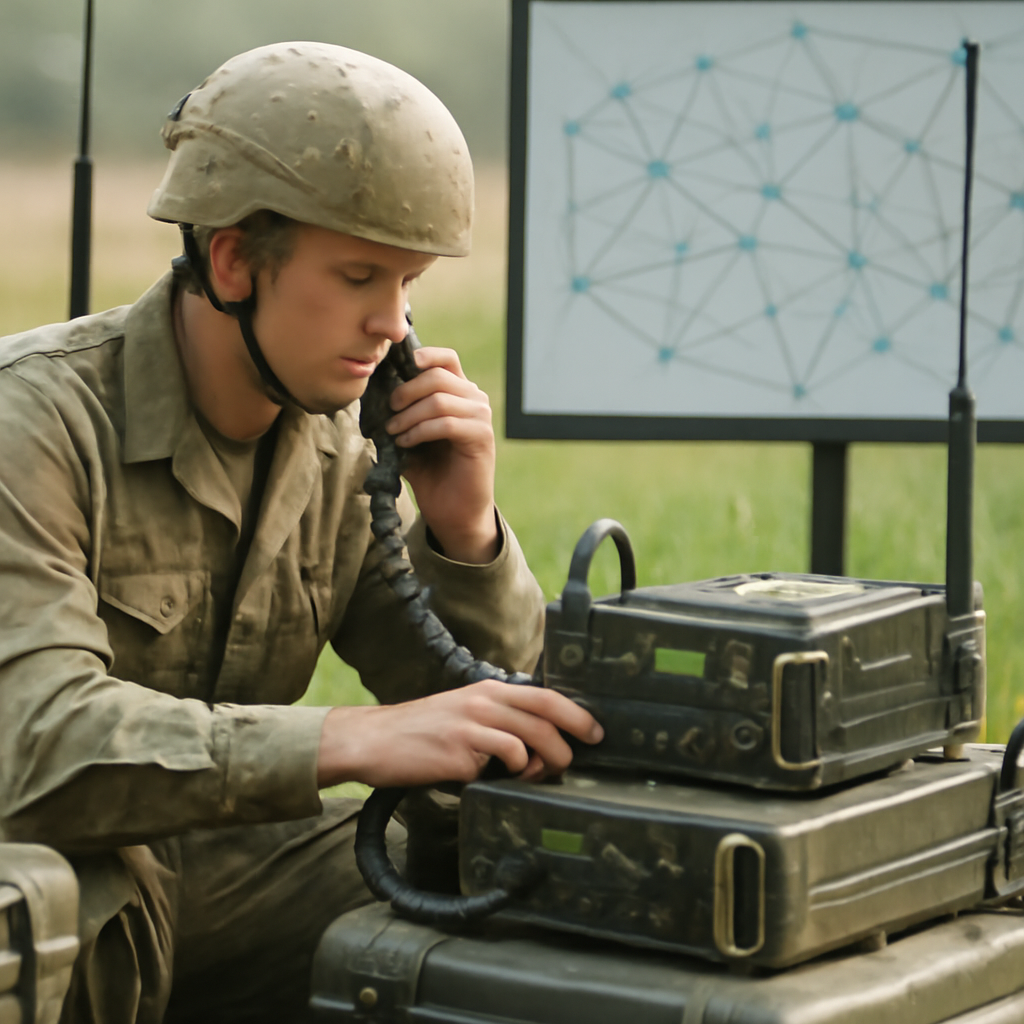
Ditto, a software company founded eight years ago, is proposing a software-first approach to keep battlefield computing alive when cloud links die. The company says it can "create a peer-to-peer data mesh with no new hardware," using "whatever transports the customer brings"—for example, the radios built into commercial phones—and handling Bluetooth and Wi‑Fi to let devices share data directly.
Hanft framed the problem as architectural: Ditto "do[es] not leverage a server-client model," he said, arguing that server-dependent designs leave edge nodes unable to exchange data when that server is unreachable. The company's offering is thus aimed at preserving data flows locally so that on-device AI tools keep working even when broader cloud connectivity is denied.
Project Dynamis and the Marines' place in JADC2 experimentation
Project Dynamis is the Marine Corps' contribution to the Pentagon’s joint all-domain command and control effort (JADC2). Marine Corps documents about these efforts note testing in conditions where communication is "degraded or denied." The Marines have also explicitly tied cloud implementation to those ambitions: "Implementing cloud on our networks is the critical requirement for CJADC2. Without cloud, JADC2 just is not going to come to fruition," Col. Jason Quinter, who led Project Dynamis as commanding officer of Marine Air Control Group 38, said in 2024.
Against that backdrop, the Marines have added a specific Dynamis goal: testing assured communication technologies. Ditto will announce that Project Dynamis will evaluate their technology, signaling the service intends to examine alternatives to continuous cloud dependency as part of its research and testing cycle.

This site is the portfolio.
OSINTSights runs on Cloudflare Workers, D1, R2, and Vectorize, with an AI pipeline on Hetzner ARM. Nubivance designed, built, and operates it. We do the same for clients.
See what we buildCloud reliance, AI model behavior, and contested environments
The Marines and Pentagon planners face an operational tension: as sensors proliferate—on the ground, in the air, and in orbit—large AI models and centralized cloud services offer powerful ways to turn that sensed data into decisions. But the same cloud dependency can become a single point of failure in contested environments.
The source cites Ukraine's experience against Russian electronic warfare as an example of adversaries attacking communications infrastructure. And that vulnerability is surfacing in conversations about AI models: Anthropic argues that transformer models may "hallucinate" missing pieces when data are wrong or absent, a lower-stakes problem in a classroom but "a high-stakes issue in war," the source reports. OpenAI, the story states, announced in March that its own military contracts "would not permit powering fully autonomous weapons, as this would require edge deployment." The Pentagon's response, according to the reporting, is to explore models and architectures that are less error-prone on the edge and to test assured-communications technologies under Project Dynamis.
Early experiments, partners, and the forthcoming evaluation
Hanft said Ditto has already run experiments with U.S. special operations elements and with Nordic military forces. He declined to say whether Ditto had worked directly with Ukraine, but acknowledged the company had "worked in the past with organizations that are operating within those boundaries."
Ditto's outreach and testing are being integrated into the Marines' iterative development approach. "One of the greatest strengths of Project Dynamis is in its methodology. For the last several months we’ve been in a continuous cycle of designing, testing, and refining warfighting solutions—Marines and industry engineers side-by-side—so we can find best-of-breed solutions and get them into the hands of our Marines,” said Col. Arlon Smith, the current director of Project Dynamis, in an early version of Ditto's press release. The company is set to announce the formal evaluation by Project Dynamis on Monday.
What this means for the Marine Corps, AI vendors, and Ditto/industry partners
- Marine Corps: The service is explicitly testing assured communication technologies within Project Dynamis as it pursues JADC2 objectives and recognizes cloud implementation as a critical requirement, but is also seeking ways to preserve operations when cloud links are cut.
- AI vendors (Anthropic, OpenAI): The reporting records vendor concerns about model behavior when data are missing or unreliable—Anthropic's point about hallucination and OpenAI's March caveat about edge deployment—pushing the Pentagon to look for models and deployment patterns that can tolerate degraded connectivity.
- Ditto and procurement/industry partners: Ditto's commercial-first pitch—leveraging existing radios, phones and consumer networking without new hardware—aligns with Pentagon preferences for commercially available or dual-use solutions and will be tested in the Marines' evaluation cycle.
The coming evaluation will test whether a software mesh built on heterogeneous, commercial transports can sustain the local data flows that on-device AI needs. If Ditto's approach performs as promised, Project Dynamis will have a concrete alternative to server-centric, cloud-dependent architectures. If it falls short, the Marines' push to bind sensors, platforms and people into a resilient data web will remain a work in progress.