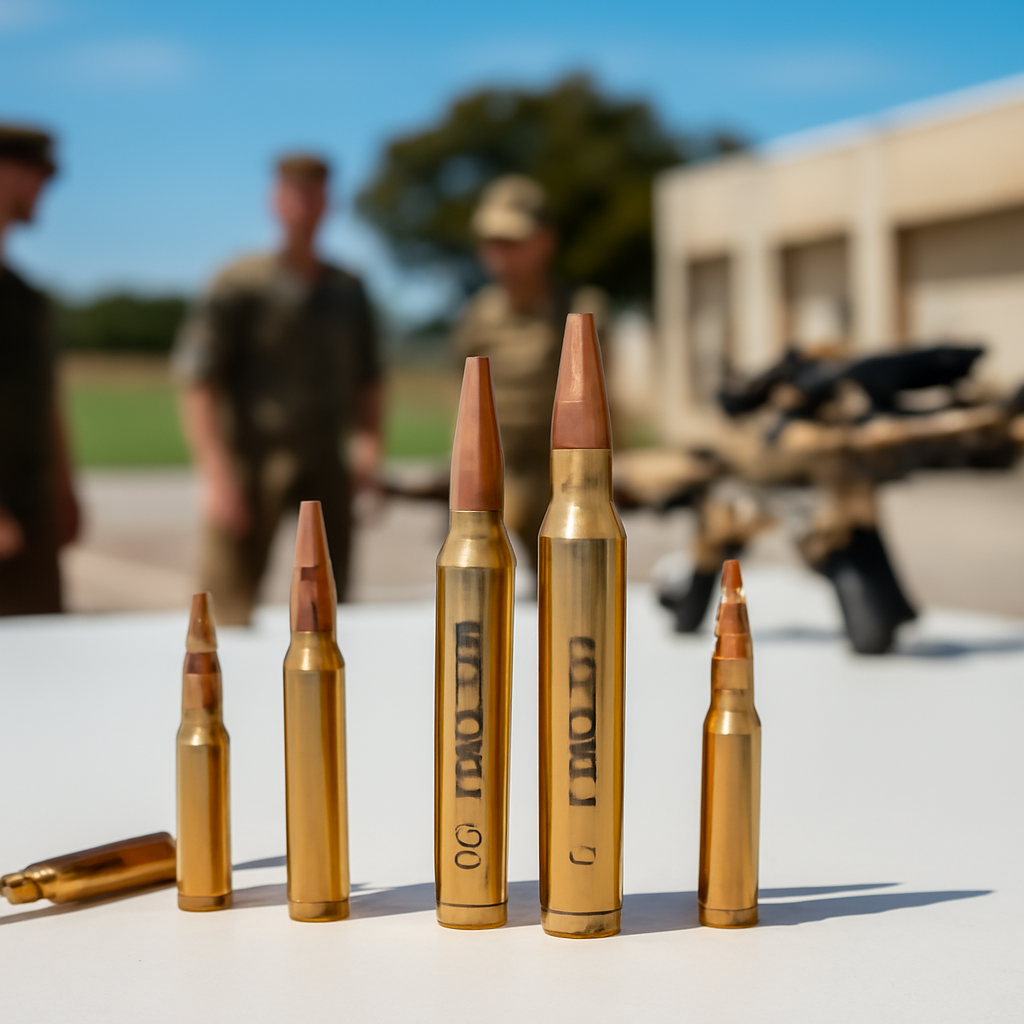
"The 5.56mm Drone Round 'L Variant' is the only kinetic munition currently available in the commercial or defense marketplace that meets the Marine Corps’ strict minimum capability requirements for immediate c-sUAS [counter-small uncrewed aerial systems] defense," an accompanying document justifying a sole‑source deal says.
MARCORSYSCOM's sole‑source plan and timeline
Marine Corps Systems Command (MARCORSYSCOM) has announced its intent to buy an unspecified number of 5.56x45mm L Variant cartridges from Drone Round through a sole‑source contract, with a projected award date of December 2026. The justification posted online stresses the round's unique fit for current Marine requirements: it offers "drop‑in" compatibility with existing 5.56mm weapons such as the M27, M4, and M4A1 and "requires zero additional New Equipment Training or specialized occupational specialties." The document warns bluntly that "Failure to deliver this capability places an unnecessary risk to Marines and could lead to mission failure and loss of life."
Drone Round's L and K Variants: design, capabilities, and variants
Drone Round markets two 5.56x45mm types: the L Variant and the K Variant. The L Variant's projectile is designed to break into five segments; the K Variant splits into eight. Drone Round states the effective ranges demonstrated so far are roughly 328 feet (100 meters) for the L Variant and 164 feet (50 meters) for the K Variant. The company also says these rounds are "full‑auto and suppressor capable" and require no special weapon modifications.
Work has continued on other calibers inside Drone Round: 7.62x51mm L and K Variants exist but remain in testing, and development is underway on 6.8x51mm versions that the company says could be fired from the U.S. Army’s new M7 rifles, M8 carbines, and M250 light machine guns.

This site is the portfolio.
OSINTSights runs on Cloudflare Workers, D1, R2, and Vectorize, with an AI pipeline on Hetzner ARM. Nubivance designed, built, and operates it. We do the same for clients.
See what we buildTesting, parallel programs, and battlefield precedents
Some U.S. Army units have already evaluated the 5.56x45mm L Variant, and there are reports Ukrainian forces have done so as well. Internally developed alternatives are also in play: the Naval Surface Warfare Center, Crane Division (NSWC Crane) unveiled multiple Drone Killer Cartridge (DKC) designs in 5.56x45mm, 7.62x51mm, and .50 caliber. A Navy press release stated that during a demonstration at Camp Atterbury in Edinburgh, Indiana, DKC achieved a 92% success rate against drone targets.
Multi‑projectile small arms cartridges are not new. The U.S. Army explored similar concepts in the 1950s and 1960s, and armed forces elsewhere have pursued pellet‑filled and split‑projectile rounds over decades. Recent years have seen both locally fabricated designs in Ukraine — including 3D‑printed sabots loaded with commercial metal BBs — and mass‑production offerings from established firms such as the Kalashnikov Group. High‑Precision Complexes Holding has begun rolling out triplex C‑sUAS rounds in 5.45×39 and 7.62×39 calibers, with claims of improved hit probability at longer distances.
Range, tactics, and the trade‑offs of small‑arms C‑sUAS
The key selling point for multi‑projectile cartridges is a higher hit probability against small, fast, maneuvering drones, and their ability to be fired from standard service rifles without modification. But range remains a constraint: Drone Round's demonstrated effective range for its 5.56 types is about 100 meters for the L Variant, versus a cited M4 effective range of roughly 500 meters "according to the Army." Shorter engagement distances reduce reaction time and limit options for maneuver.
Operational trade‑offs extend beyond physics. Shotguns firing multi‑pellet loads have been widely used on battlefields in Ukraine for C‑sUAS, but their range is limited; specialized rifle cartridges aim to push that boundary outward. A contemporary Russian counter‑drone manual quoted in reporting notes that "When shooting you are static, which makes it easier for the operator to aim the drone," underscoring a tactical vulnerability when defenders rely on small arms. Managing multiple ammunition types in the heat of engagement, and uncertainty about these rounds' performance against traditional targets, are additional practical considerations raised by the available reporting.
What this means for the Marine Corps, the U.S. Army, and Ukrainian forces
- The Marine Corps: MARCORSYSCOM's sole‑source push shows a near‑term effort to field a "drop‑in" kinetic option for every Marine armed with a 5.56mm rifle, emphasizing immediate issueability and minimal training overhead.
- U.S. Army units: Some Army formations have already evaluated the L Variant and will likely watch the maturation of 6.8x51mm work that could tie into new Army rifles and light machine guns.
- Ukrainian forces: Reporting that Ukrainian units have evaluated similar cartridges fits a broader pattern on that battlefield, where both improvised and mass‑produced multi‑projectile rounds and regular use of shotguns for C‑sUAS have been documented.
Specialized counter‑drone 5.56x45mm ammunition is now positioned to be part of a layered approach to small‑UAS defense: a suite of options that ranges from computer‑assisted optics and automated aiming stocks to novel ammunition types and shotgun loads. MARCORSYSCOM's December 2026 procurement timeline and the government's assertion that the L Variant uniquely meets immediate needs make clear that, at least for now, the Marines are betting on a drop‑in kinetic fix to augment existing weapons on the ground.