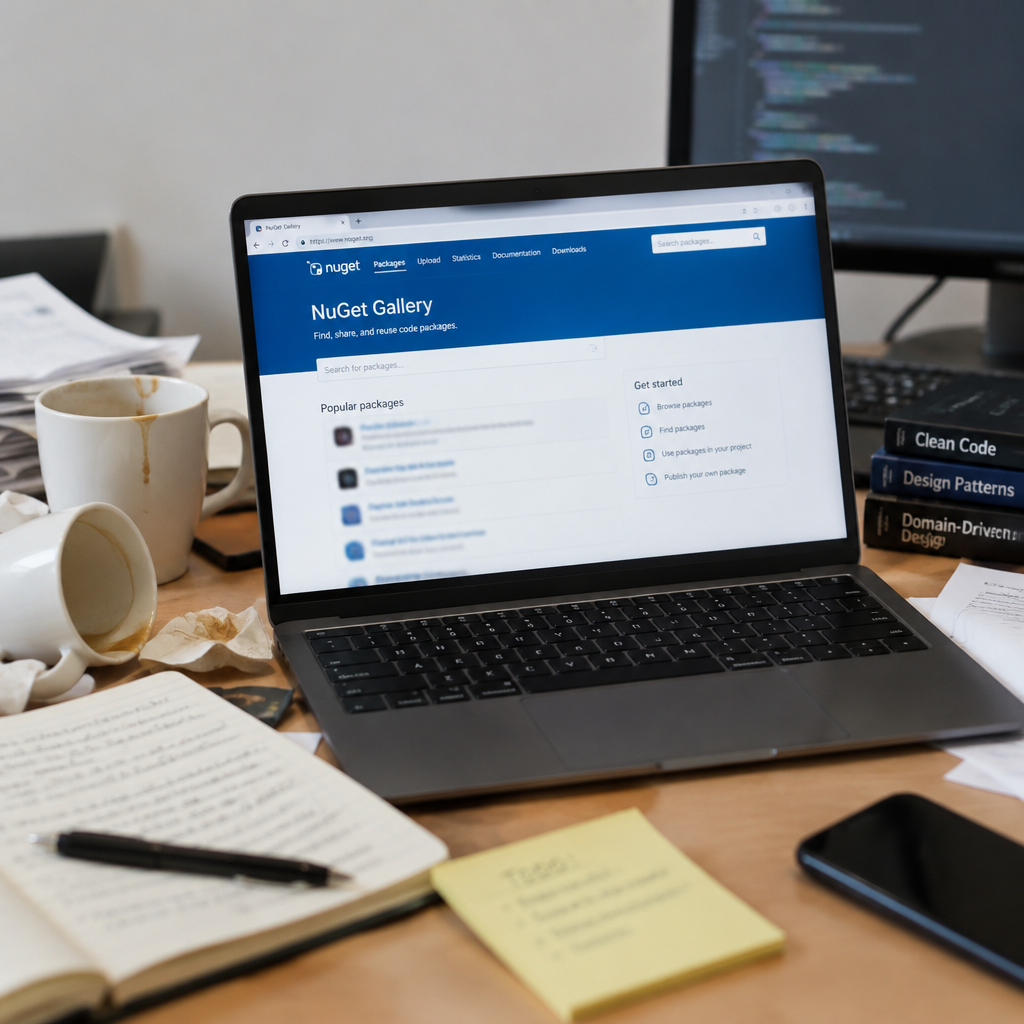
"Most of the packages pose as WinUI 3 and WPF [Windows Presentation Foundation] button controls," Socket security researcher Kush Pandya said in a technical write-up.
Socket's findings on the NuGet lure and the 13 packages
Security researchers at Socket uncovered 13 malicious NuGet packages that impersonated common UI controls and development helpers to target Windows .NET developers via a fake take‑home job assessment. All 13 packages had been removed from the NuGet gallery at the time of Socket's write‑up. The packages are:
- WinUI.Button
- VS_Builder.MSBuildAnalyzer
- VS_Builder.WinUI3Controls
- HappyOne.MSBuildAnalyzer
- HappyOne.WinUI3Controls
- Web3TotalButton
- RevertButtonIcon
- WinUI3IconButton
- WindowsAccentColorName
- SetButtonColor
- InitializeCustomButton
- StyledAppButton
- StyledComponent
How the malicious packages delivered code: MSBuild targets, DLL sideloading, and a Launcher
Socket's analysis shows the campaign used standard developer tooling mechanisms to run attacker code during normal build or runtime activity. VS_Builder.MSBuildAnalyzer (later republished as HappyOne.MSBuildAnalyzer) contained an MSBuild targets file, build/VS_Builder.MsBuildAnalyzer.targets, that executes a bundled DLL (MSBuildAnalyzer.dll) after every build. In the versions analyzed, that DLL downloads a file from GitHub to %LOCALAPPDATA%\\osk\\OskSupport.dll and copies C:\\Windows\\System32\\osk.exe next to it.
VS_Builder.WinUI3Controls then invokes the copied binary via a FileButton control that routes clicks to Windows files and folders, triggering DLL execution by DLL sideloading. Separately, the WinUI.Button package's lib/net8.0-windows10.0.19041/WinUI.Button.dll was observed starting a background routine that downloads an executable named "avast.exe" from the Carol-White-Super/cloud repository using an embedded GitHub access token, saves it as %TEMP%\\Launcher.exe, and runs it.

Nobody's watching your logs at 2 AM.
Full SOC coverage without building one. Nubivance deploys and manages Rapid7 InsightIDR and MDR for organizations that need detection and response, not another dashboard.
Get coverageGitHub repositories, fake Axios packages, and additional payloads
Socket identified a cluster of malicious GitHub repositories and npm packages tied to the operation. The attack's starting point appears to be a repository named stevenleedig-ux/WinUI3_Home_Assessment, created on November 3, 2026, which offers a three- to four-hour take‑home assessment focused on enhancing a FileButton control. The repository's README permits use of AI assistants like GitHub Copilot, ChatGPT, or Claude but warns against blindly copying the project into such tools.
Two bogus repositories that impersonated the axios JavaScript library — jason-code-super/axios and stevenleedig-ux/axios-http — were flagged as copies of a malicious Node.js library called axios-test-one. Those repositories included Windows binaries (lib/env/axios.csproj) and, according to Socket, their commit histories contained multiple payloads: a loader (updater.exe and msedgewebview2.exe) that used James-White-Super/React_prj as a two‑way command‑and‑control; a PyInstaller program that stole Google Chrome profiles and uploaded them to gabsantosbus-star/EngineeringRepository; and a "WeapF" payload that reported computer name, user name, time zone, and CPU model to an attacker‑controlled Telegram bot.
Related npm packages, LaborX job listing, and the attacker persona
Socket linked axios-test-one to a set of six npm packages published between July 14 and 23, 2026 — axios-test-one, telemetry-metrics, telemetry-axios, axios-native, fs-extra-core, and vitest-axios — distributed across three npm accounts (gsanbus, jasonsuperstar, and jasonsayman). Socket reported that telemetry-metrics and telemetry-axios download and run a Windows executable from ThoSuperstarDev/axios-http, while fs-extra-core downloads one from jason-code-super/axios and saves it as msedgewebview2.exe. The axios clones pull in those packages.
Socket also found the lure advertised on the Web3 freelance marketplace LaborX on November 7, 2026, under a persona posing as a "detail-oriented client" seeking a C# WPF developer for a lightweight desktop app that inventories crypto wallet software. The $8,500–10,000 listing remains accessible. The persona's X profile described them as a "blockchain and DeFi specialist" and a "cryptocurrency expert" based in Miami, Florida, while the profile's "About this account" stated a location in Korea; the account was created in July 2026.
What this means for .NET developers, freelancing platforms, and security teams
.NET developers: Take‑home assessments and third‑party controls can be attack vectors. The assessment repository referenced VS_Builder.WinUI3Controls version 1.0.7 (and another package at version 1.2.7), and building the project executed code that downloaded binaries and set up DLL side‑loading. Developers should treat unvetted sample packages and repositories with suspicion.
Freelancing platforms and recruiters: The campaign used a LaborX job posting with a sizable budget to attract candidates. Platforms should watch for high‑value listings that link to external codebases and consider steps to verify client identities and review linked materials.
Security teams: The operation relied on MSBuild targets, embedded GitHub tokens, and standard sideloading techniques. Detection and controls that inspect build targets, scanning of dependency manifests, and monitoring for suspicious GitHub API usage could catch similar tactics.
Socket's analysis did not attribute the campaign to a named actor. "We found no indicator or code shared with any published Contagious Interview or other North Korean campaign, none of the malware families publicly tied to Contagious Interview (such as BeaverTail, InvisibleFerret, and OtterCookie) in the stages we recovered, and no publicly documented family that matches the loader," Pandya wrote, while noting the tradecraft shares similarities with prior recruitment‑themed campaigns attributed elsewhere.
The record Socket lays out is precise on technique and timeline — multiple malicious packages appearing on NuGet from July through November 2026, a GitHub assessment repository posted November 3, a LaborX advertisement on November 7, and follow‑on artifacts and releases through November 13. What remains is how targets were steered to the assessment and whether other decoy projects are active; until that link is clarified, deceptively packaged developer tooling will remain an attractive channel for attackers.