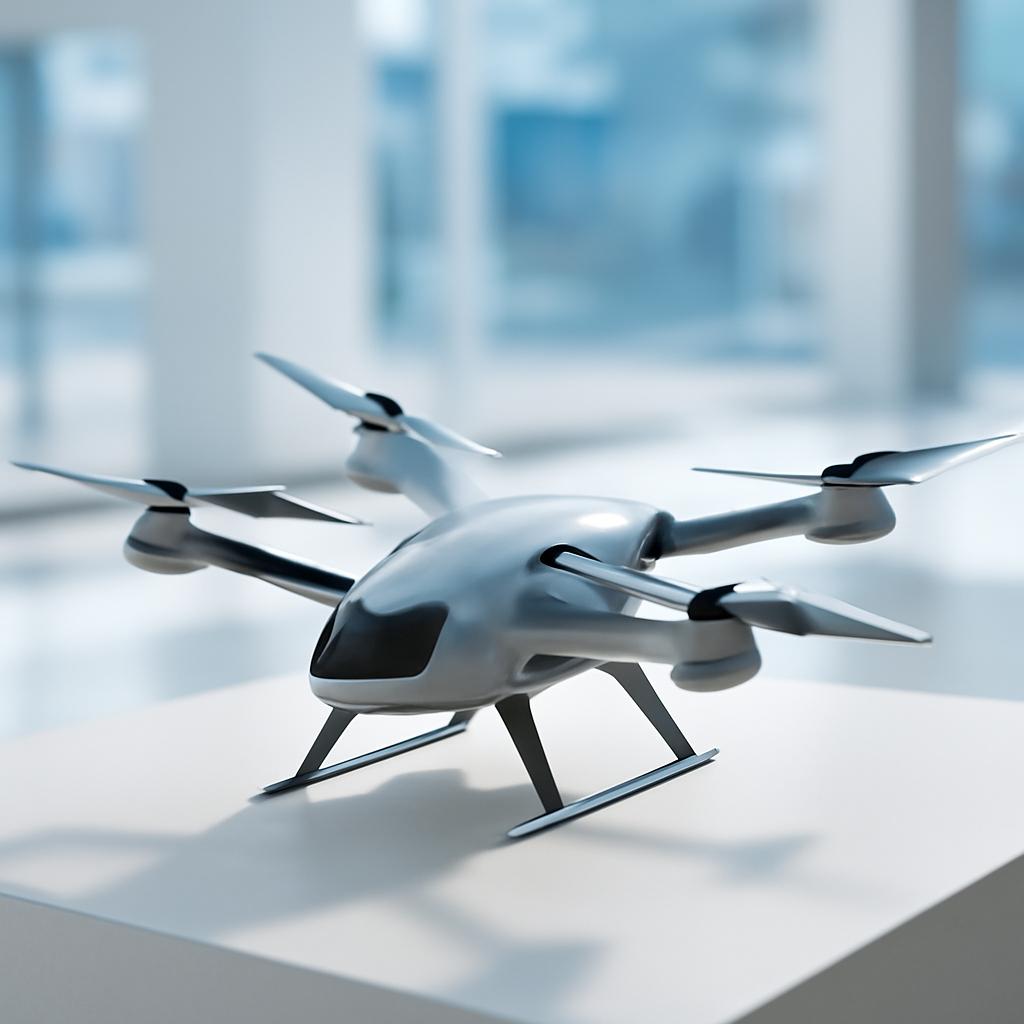
“Counter-UAS is a hot topic around the world. We took MORFIUS to the Farnborough Airshow; every single person was interested in understanding the technology, the availability, the production rates,” Jason Reynolds, Lockheed Martin’s Vice President of Integrated Air & Missile Defense, told TWZ at the Space and Missile Defense Symposium in Huntsville, Alabama.
Lockheed Martin's MORFIUS X‑Rotor: design and claimed role
Lockheed Martin recently unveiled the MORFIUS X‑Rotor as a counter‑UAS (unmanned aircraft system) platform intended to address both single drones and complex swarms. Company statements say MORFIUS carries a High Power Microwave (HPM) payload and uses an active radio‑frequency seeker together with proprietary algorithms to locate and “hunt and kill” enemy drones. Lockheed says the system can reportedly neutralize more than 50 adversary drones during a single sortie.
High Power Microwave payload and engagement model
The MORFIUS concept centers on an HPM payload rather than kinetic impact. According to Lockheed’s account, the microwave effect enables a single, reusable platform to disable or destroy multiple targets during one mission. The announcement highlights this as a practical contrast to many current interceptor drones, which are described as self‑sacrificing because they expend themselves to achieve a single intercept. Lockheed characterizes MORFIUS’s principal advantage as repeatable use: “can kill a lot of drones and be reused to kill more over and over.”

Audit-ready is a season. It shouldn't be.
Evidence in spreadsheets, controls drifting between audits, frameworks multiplying on flat headcount. Nubivance runs continuous compliance on Rapid7 Cyber GRC - SOC 2, HIPAA, ISO 27001, PCI, CMMC.
End the scrambleOperational design: cross‑wing VTOL, field recovery, and reuse
The X‑Rotor employs a cross‑wing configuration that allows vertical takeoff and landing (VTOL), and the design is said to be optimized for field recovery and rapid turnaround. That operational profile — VTOL launch and recovery at dispersed locations plus an emphasis on reuse — is presented as central to the platform’s intended role defending “critical assets, critical sites, and defend[ing] what matters most,” in Reynolds’s words.
Testing, production, and market interest
Lockheed reports it has completed live‑fire testing of MORFIUS and is accelerating production to meet demand. Reynolds told TWZ that demonstrations and public displays, including a showing at the Farnborough Airshow, generated strong interest in the technology, availability, and production rates. The company frames counter‑UAS as a global priority and expects MORFIUS to be “proliferated” to meet requirements for defending against both single threats and swarms.
What this means for technologists and security teams, policymakers and regulators, and procurement leaders
- Technologists and security teams will likely focus on the integration points Lockheed highlights: the active radio‑frequency seeker, the proprietary engagement algorithms, and the HPM payload. In operational terms they will want data from the live‑fire tests that Lockheed says it completed to evaluate effectiveness across different drone types and swarm behaviours.
- Policymakers and regulators will receive a product pitched explicitly for protecting “critical assets” and for broad proliferation; questions about rules of engagement, electromagnetic effects in shared operational spaces, and export or procurement policy will follow as production ramps up, according to Lockheed’s stated push to accelerate supply.
- Procurement leaders and end users will weigh the stated reuse model against incumbent expendable interceptors. Lockheed’s emphasis on field recovery, rapid reuse, and interest from international audiences at events such as Farnborough frames the product as one that procurement authorities will assess both on unit availability and lifecycle cost implications.
Lockheed’s account ties three concrete claims together: an HPM‑based effect, a reusable VTOL interceptor configured for field recovery, and completed live‑fire testing paired with plans to accelerate production. The company’s framing — that counter‑UAS is “a hot topic” and that MORFIUS can meet demand for defending critical sites against swarms and single drones — establishes its intended market position. Whether operational results and production cadence will match the level of interest Lockheed reports remains the next demonstrable milestone to watch.
Source: TWZ — Meet MORFIUS: The Drone Designed To Zap Other Drones