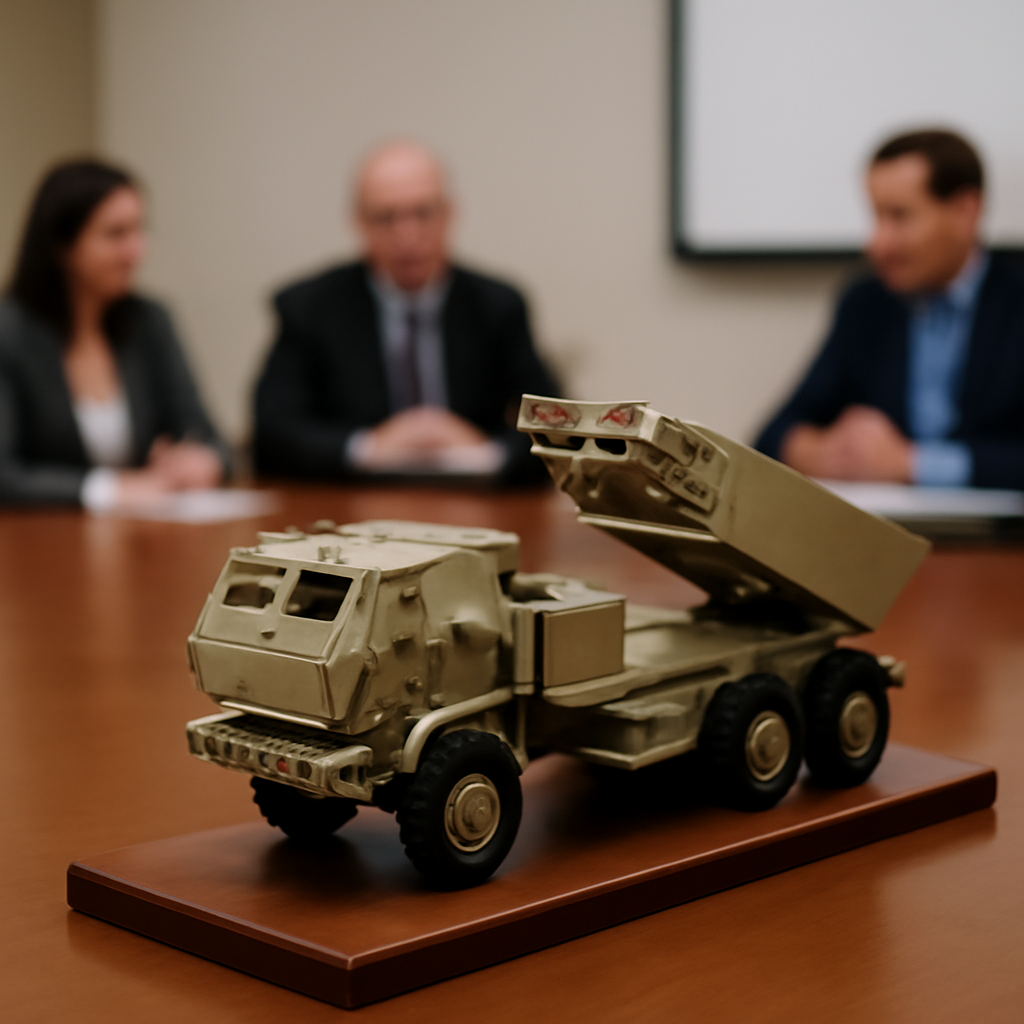
Lockheed Martin has offered to deliver HIMARS to France within 18 months if Paris signs a contract, and proposed transferring a significant portion of launchers to arrive in 2028, according to sources close to the matter.
What Lockheed says it can deliver and on what timetable
Company officials, speaking through intermediaries cited by reporting, have presented a formal offer to France for the HIMARS multiple-launch rocket system. The proposal — which Lockheed framed as the result of internal investments intended to speed procurement — included a pledge of an 18-month delivery timeline if Paris puts the systems on contract. The American plan further envisions transferring a significant portion of the launchers to France in 2028 and notes those launchers could use the same GMLRS rockets already employed by France’s legacy LRU systems.
The sources say the offer was made in consultation with Washington. The French Ministry of Defense told Breaking Defense that the US government responded “in early 2026” to France’s request for pricing and delivery schedules regarding the acquisition of HIMARS.
The FLP‑T program, budget and the looming LRU retirement
France launched the Frappe Longue Portée – Terre (FLP‑T) program in 2023 to replace its aging LRU multiple-launch rocket systems. The country allocated approximately €600 million ($692 million) in its 2024‑2030 Military Programming Act for that program. The LRU fleet is slated to be retired “as early as 2027,” creating a hard operational deadline that frames Paris’s procurement choices.

The cyber insurance questionnaire just landed. Now what?
SOC 2, HIPAA, insurance renewals - someone has to own security strategy. Nubivance provides fractional CISO leadership without the full-time salary.
Get a security leadFrench consortia, live-fire testing and off‑the‑shelf assessments
The French Ministry of Defense said it has evaluated two French solutions through an “innovative partnership” that pitted two temporary consortia against each other: Safran/MBDA and Thales/Arianne Group. At the same time, it has been assessing various off‑the‑shelf solutions. As part of FLP‑T work, Thales conducted the first live‑fire test of its new X‑Fire launcher “last month” as part of the program.
IFRI, Chunmoo and the production gap highlighted by researchers
A recent study by the French Institute français des relations internationales (IFRI) recommended the South Korean K239 Chunmoo, produced by Hanwha Aerospace, as the preferred off‑the‑shelf interim alternative for France’s long‑range rocket artillery requirements. Léo Péria‑Peigné, head of the defense research unit at IFRI, told reporters that French‑developed systems tested last month “are still under development and not yet fully available — the risk is that this creates a problematic capability gap in long‑range fires for France.”
Péria‑Peigné also framed the strategic dilemma plainly: France is “caught between its desire to opt for a fully French‑made system — so as to avoid the constraints that Washington may impose on the use of its weapons — and the urgency to move quickly.” He said he expects “significant push‑back” against selecting HIMARS and observed that the most likely institutional supporters for an American system would be the DGA, the procurement arm of the French MoD, and “certain stakeholders wanting to solve the problem and move on.”
What this means for the DGA, the French Ministry of Defense, and French manufacturers
- DGA, the procurement arm of the French MoD: The DGA is positioned as a likely internal advocate for a rapid off‑the‑shelf acquisition if it believes HIMARS closes the capability gap before LRU retirement.
- The French Ministry of Defense and policymakers: The MoD is balancing budgeted domestic programs, live‑testing timelines and responses from foreign suppliers; it has publicly confirmed evaluating both French consortia and off‑the‑shelf options and received a US response “in early 2026” on pricing and schedules.
- French manufacturers and temporary consortia (Safran/MBDA and Thales/Arianne Group): These parties are still developing and testing candidate systems — including Thales’s X‑Fire — and face pressure from timelines and the IFRI assessment that domestic systems are not yet in production.
Several questions remain central to the decision: the exact size and cost of Lockheed’s offer are unknown; it is unclear whether a US supply deal would let France leapfrog existing HIMARS customers — “which would naturally ruffle feathers in those capitals” — and French domestic systems remain in development while the LRU retirement date approaches. Paris must weigh procurement speed against industrial sovereignty and operational constraints imposed by a foreign supply relationship.
For further reading, see the original Breaking Defense report: Lockheed pitches HIMARS for France, with 18-month timeline offer.