"Every formation we have today is underpowered," Brig. Gen. Troy Denomy told GVSETS this past summer—words Sion Power CTO Job Rijssenbeek invoked to frame why battery chemistry matters now more than ever for unmanned systems.
Job Rijssenbeek and Sion Power’s lithium‑metal approach
Rijssenbeek told Breaking Defense that lithium‑ion “will remain the right choice for many applications,” but that replacing the graphite anode with lithium metal changes the physics for weight‑sensitive missions. Sion Power, he said, has worked on lithium‑metal batteries for more than 25 years and spent the last 15 building intellectual property around high‑energy cells for electric vehicles. That work, Rijssenbeek explained, yielded lithium anode production methods, electrolyte formulations, cell designs, and packaging the company now applies to aerospace and defense use.
Licerion Strike: 500 Wh/kg and a live demo on a Freefly Astro Max
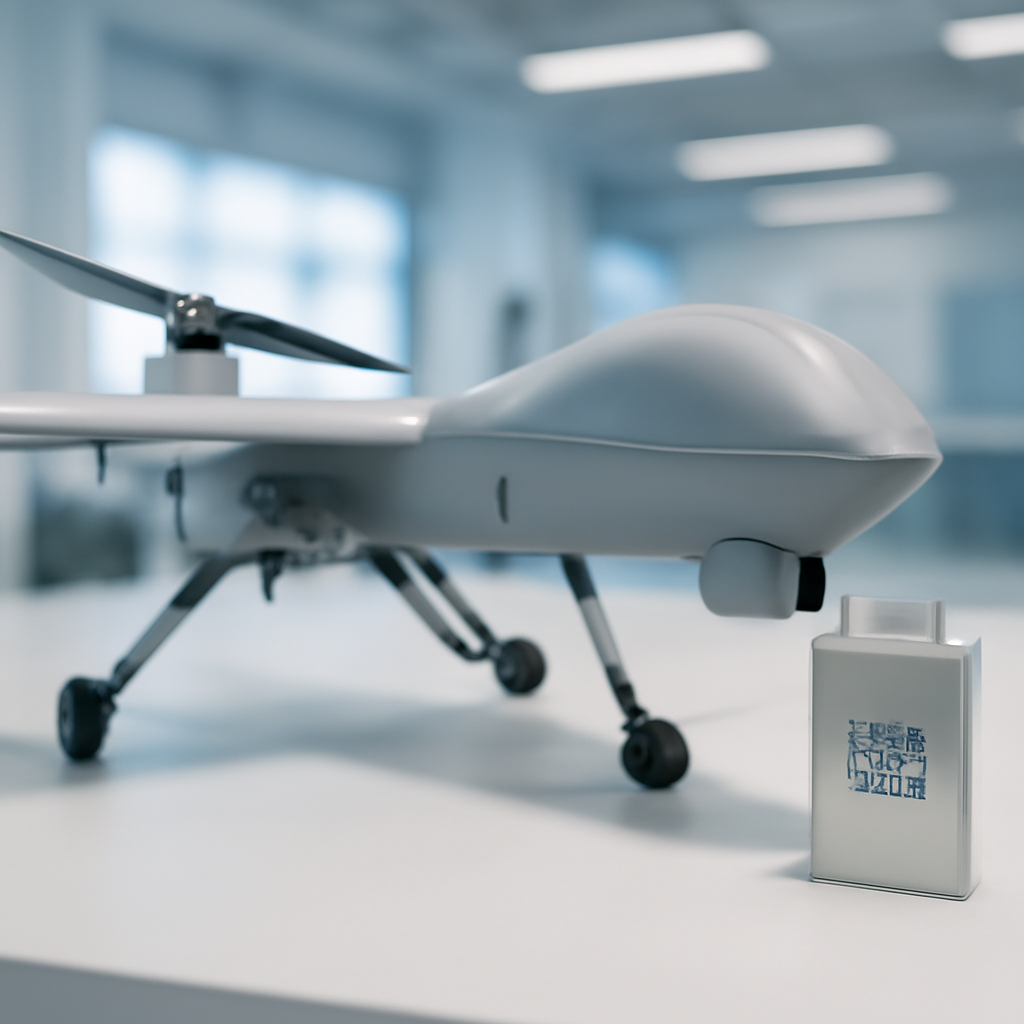
Sion’s maximum‑energy Licerion Strike cell is designed to deliver up to 500 Wh/kg at the cell level—about double the roughly 250 Wh/kg Rijssenbeek identified as typical for today’s standard lithium‑ion drone batteries. In a demonstrator test earlier this year, Sion fitted a Licerion Strike pack into a commercially available Freefly Astro Max drone, replacing two conventional lithium‑ion batteries. The pack, Rijssenbeek said, increased onboard energy by more than 50 percent, reduced pack weight by nearly 30 percent, and used the same mechanical footprint. The aircraft’s flight time rose from 33 minutes to 60 minutes.
Rijssenbeek spelled out the operational implication: if a target area is 15 minutes away, a 33‑minute aircraft has roughly three minutes on station; at 60 minutes of endurance, that becomes about 30 minutes. He added that drones are being asked to carry ever larger electronic payloads—communications, jamming, autonomous guidance—that can draw hundreds of watts continuously, and higher energy density allows those capabilities without sacrificing endurance.

Audit-ready is a season. It shouldn't be.
Evidence in spreadsheets, controls drifting between audits, frameworks multiplying on flat headcount. Nubivance runs continuous compliance on Rapid7 Cyber GRC - SOC 2, HIPAA, ISO 27001, PCI, CMMC.
End the scrambleSafety testing and U.S. manufacturing in Tucson
Sion emphasizes safety as central to making higher energy density practical. Rijssenbeek described a Tucson facility with approximately 2,000 test channels and a 5,300‑square‑foot safety and abuse laboratory used for extreme temperature exposures, vibration, nail penetration, and forced discharge. He said Sion is already shipping cells from Tucson and ramping 10–20 MWh of pilot‑line capacity, with plans to expand to 100–200 MWh and beyond as demand grows. Sion Power, Rijssenbeek added, manufactures its batteries “100 percent” in the United States and has a relatively low dependence on China‑made materials; the lithium‑metal anode removes the need for graphite, which reduces one input dependency in the bill of materials.
Rechargeability, cycles, and product families: Licerion Echo and automotive lineage
Addressing whether lithium‑metal can be rechargeable, Rijssenbeek pointed to Sion’s automotive work: the company developed large‑format 400 Wh/kg Licerion pouch cells that achieve 800 charge‑discharge cycles and were fast‑charge capable and validated by global OEMs. He contrasted that with Licerion Strike, which is aimed at maximum energy density, and Licerion Echo, a rechargeable solution intended to deliver high energy density with over 150 cycles. Those distinctions reflect different tradeoffs between one‑way maximum energy and reusable cycle life.
What this means for defense customers, procurement leaders, and operators
- Defense customers: Higher energy density translates into extended range, greater time on station, or additional payload capacity—capabilities Rijssenbeek framed as directly enabling more demanding missions.
- Procurement leaders: Sion’s stated ramp from 10–20 MWh pilot lines toward 100–200 MWh and its claim of 100 percent U.S. manufacturing speak to scaling and supply‑chain considerations; removing graphite from the anode reduces one material dependence Sion highlighted.
- Operators: The demonstrator’s jump from 33 to 60 minutes highlights concrete operational gains—longer reach, more on‑target time, and the space to carry power‑hungry electronics without trading away endurance.
Rijssenbeek framed the larger shift not as a single chemical silver bullet but as a systems question: “The bigger change will come when batteries and unmanned systems are increasingly co‑designed,” he said. Sion’s technical performance claims, its safety testing, and its manufacturing ramp are aimed at proving that lithium‑metal can be both higher energy and operationally practical. The company’s roadmap—from one‑way, maximum‑energy Licerion Strike to rechargeable Licerion Echo and earlier automotive cells—maps the tradeoffs operators and procurement officials will have to weigh as higher‑density chemistries move from lab to field.
Whether those tradeoffs drive a wholesale rethinking of how drones and batteries are procured and designed will depend on the pace of scale‑up, demonstrated reliability in diverse operational environments, and the appetite of defense customers to co‑spec systems rather than buying components separately. For now, Sion’s tests and early production set a tangible technical benchmark: more energy per kilogram, rigorous abuse testing, and a U.S. manufacturing plan intended to match rising demand.