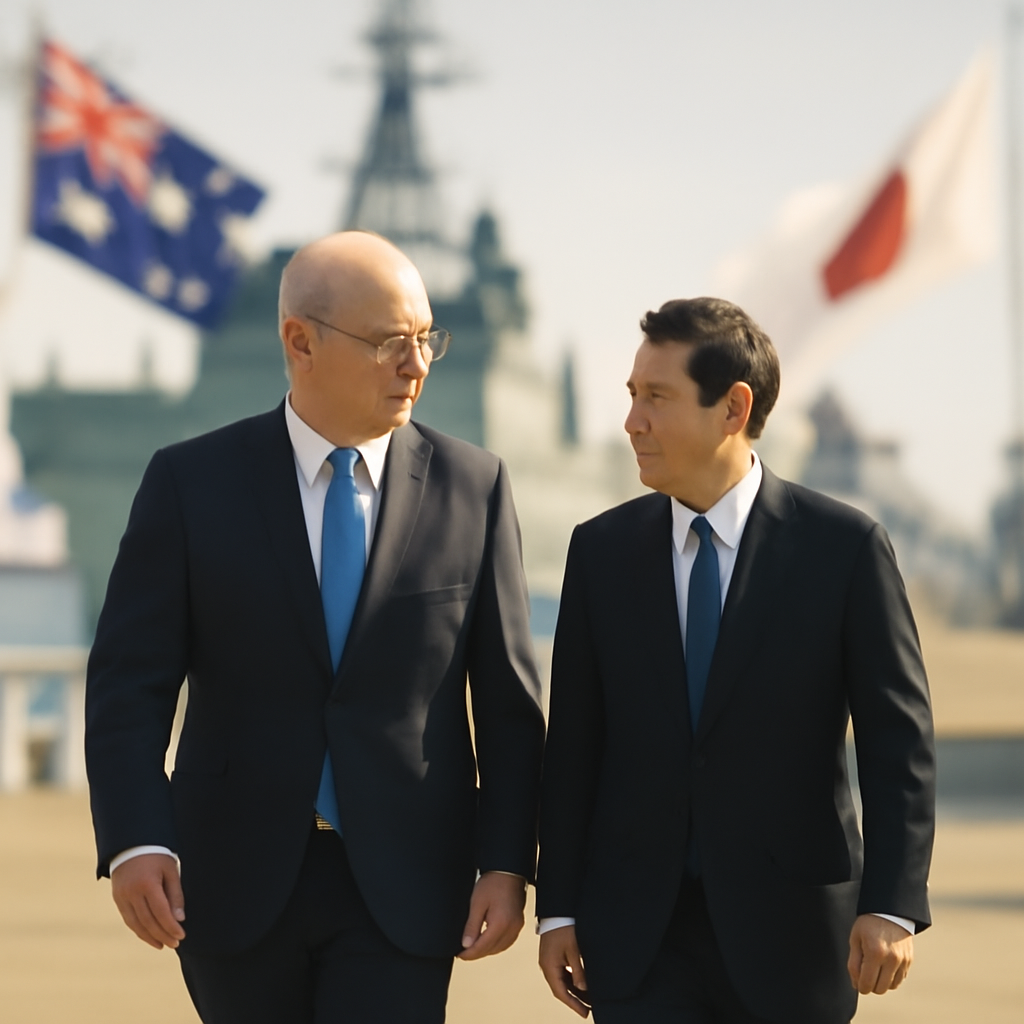
"There is no country in the world with whom we have a greater strategic alignment than Japan," Defence Minister Richard Marles said in April, a sentence that now frames this week's talks as Shinjiro Koizumi returns to Australia for a second visit in four months.
Shinjiro Koizumi’s return and ministerial momentum
Japan’s defence minister is in Australia again this week, underlining a pattern of frequent senior-level engagement between Canberra and Tokyo. Koizumi’s previous visit in April produced a landmark procurement decision: the defence ministers signed a deal for the first three of up to 11 Upgraded Mogami frigates that Australia has agreed to buy. That agreement is one visible reason for the surge in ministerial travel — and it anchors the relationship in concrete capability cooperation rather than solely in rhetoric.
Upgraded Mogami frigates, Perth, and industrial ties
The Upgraded Mogami, developed from Japan’s Mogami class already in service, is central to the practical deepening of ties. The source states that Australia may acquire up to 11 of the class, and that the initial three were formally signed during Koizumi’s April visit. Perth is identified as the likely construction and sustainment hub: "Perth, where most of Australia’s Upgraded Mogamis are to be built, could become an operational and sustainment hub for several countries operating Japanese weaponry." That industrial footprint is explicitly linked to potential future transfers of older Japanese warships to the Philippines and Indonesia, and to training opportunities in Australia’s testing ranges.

Audit-ready is a season. It shouldn't be.
Evidence in spreadsheets, controls drifting between audits, frameworks multiplying on flat headcount. Nubivance runs continuous compliance on Rapid7 Cyber GRC - SOC 2, HIPAA, ISO 27001, PCI, CMMC.
End the scrambleStrategic convergence on China, US reliance, and shared deterrence goals
Both Canberra and Tokyo are described as recognising "that China is the main threat to regional stability," and both accept that US hard power remains indispensable. The Takaichi administration has been "more willing to say so out loud," while Australian responses to events such as China's testing of a submarine-launched nuclear-capable ballistic missile have signalled Canberra's renewed willingness to speak publicly for deterrence and awareness. Ministers Marles and Koizumi have room to "cut to the chase" in private — from contingencies in the Strait of Hormuz to shaping American thinking ahead of the expected meeting of presidents Donald Trump and Xi Jinping.
Trilateral prospects, New Zealand’s disruption, and the Quad context
Momentum toward broader trilateral coordination has been uneven. The first trilateral meeting of the defence ministers of Australia, Japan and New Zealand took place at the Shangri-La Dialogue in Singapore in May. A planned follow-up in Canberra this week was probably spoiled by an "unexpected change of New Zealand’s defence minister last week," the source says. Koizumi’s itinerary will take him to India after Australia; with "US-India relations under strain," the piece argues a role for Australia and Japan in keeping the Quad moving in the right direction.
What this means for Australia, Japan, and regional partners
- Australia (policymakers and defence planners): Expect an expanding industrial and logistics base around the Upgraded Mogami program, with Perth emerging as a sustainment and operational hub for Japanese-origin equipment and associated training activities in Australian testing areas.
- Japan (defence industry and strategists): The transfer of equipment and the creation of sustainment links in Australia deepen Japan’s ability to project strategic depth, including stockpiling and industrial placement beyond the home islands as routes like the Strait of Malacca could be contested.
- Philippines and Indonesia (potential operators): If they receive older Japanese warships, these countries could join training and sustainment arrangements in Australia and align operations around Japanese platforms.
Several institutional moves underpin the practical cooperation. Marles and Koizumi committed to consultations when they "established a new framework for strategic defence coordination last December," and Marles visited Tokyo just before publication of Australia’s 2026 National Defence Strategy. Japan’s updates to its National Defense Strategy and Defence Buildup program are on the agenda for briefing this week.
The source argues that the semantics of alliance should follow the facts on the ground: Australia and Japan do not yet share a collective-defence treaty, and Japan is "unready to sign one," but Australia has recently signed collective-defence treaties with Papua New Guinea and Fiji, showing such agreements can be negotiated rapidly. The author suggests that fear of Beijing’s response should not deter Canberra from calling Tokyo an ally — "quasi or otherwise" — because reluctance can become a self-fulfilling trigger for pressure.
Koizumi’s visit will test how far Canberra and Tokyo are willing to formalise the cooperation they have already built: naval procurement, industrial co-location in Perth, coordinated contingency planning, and a shared public posture on strategic threats. Whether ministers will publicly drop qualifiers and call each other allies remains an open, politically charged question — but the practical indicators on shipbuilding, sustainment and ministerial coordination make the relationship functionally closer to an alliance than to the informal partnerships of the past.



