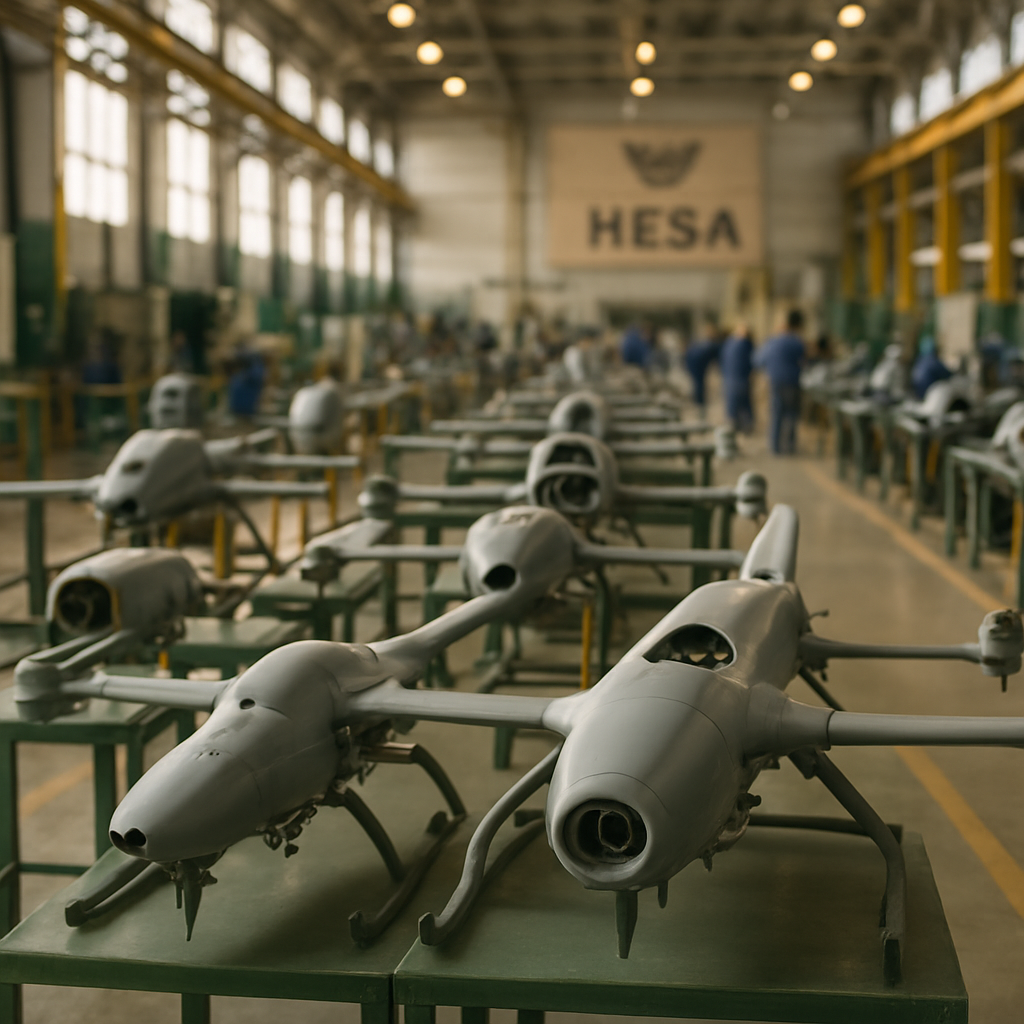
Total monthly production capacity likely approaches 400–500 airframes, a scale that has turned one-way attack drones from nuisance weapons into the defining attrition weapon of the 2026 US‑Iran war.
Production Scale: HESA in Isfahan and Yelabuga in Tatarstan
The Shahed programme combines Iranian domestic production with licensed manufacture in Russia. The Islamic Republic of Iran Aircraft Manufacturing Industries Corporation (HESA), operating under the IRGC‑ASF, has scaled output of Shahed variants to rates that “appear to exceed 200 units per month from Iranian facilities alone.” When combined with output from the Yelabuga Special Economic Zone in Russia’s Tatarstan — where the Geran‑2 (the Russian‑designated export variant) is manufactured under licence — total monthly capacity likely approaches 400–500 airframes. Yelabuga was established under a 2023 agreement and was designed to produce 6,000 Geran‑2 airframes annually, roughly 500 per month, though whether it has reached full-rate production is unclear.
Technical evolution: Shahed‑136, Shahed‑238, and guidance advances
The Shahed family spans cheap harassment munitions to faster, more precise attack drones. The Shahed‑136 (Geran‑2) is a mass‑production workhorse with a 2.5 m wingspan, 2,000–2,500 km range, and a 40–50 kg warhead; it uses INS with GLONASS correction and later added terrain‑contour‑matching and, in some recovered airframes, electro‑optical terminal seekers. The Shahed‑238, operational since late 2025, replaces the piston propeller with a compact turbojet (likely derived from the Toloue‑10 family or engines drawing on PBS TJ150 / Chinese Telefly equivalents) and cruises at 500–600 km/h versus the Shahed‑136’s ~180–185 km/h. That speed compresses defender reaction timelines and complicates CIWS interception. A separate Shahed‑149 Gaza MALE variant performs ISR, supplying targeting data that improves strike effectiveness for the attack variants.

The cyber insurance questionnaire just landed. Now what?
SOC 2, HIPAA, insurance renewals - someone has to own security strategy. Nubivance provides fractional CISO leadership without the full-time salary.
Get a security leadSupply chains and the engine bottleneck
Component tracing shows a mix of indigenous work and foreign inputs. The Shahed‑136’s MD550 piston engine and Shahed‑238’s turbojet lineage draw on designs acquired via grey‑market and foreign suppliers, including Czech PBS TJ150 and Chinese Telefly sources. Recovered airframes also contained Western microprocessors from Intel and Texas Instruments, introduced through intermediary jurisdictions. Open‑source tracing by Conflict Armament Research (CAR) and RUSI indicates sanctioned Western chips arrive via UAE, Turkey, and Central Asian states. The programme’s dependence on relatively small numbers of dual‑use chips and on imported or reverse‑engineered engines creates some vulnerability, but analysts cited an 18–24 month timeline for sanctions to meaningfully constrain production — longer than the conflict’s first six months.
Operational impact on CENTCOM air defences
In the initial post‑March 2026 campaigns, IRGC‑ASF launched mixed salvos combining Shahed‑136 with Fattah hypersonic ballistic missiles, forcing CENTCOM’s Integrated Air and Missile Defence (IAMD) to engage multiple speed regimes. Prince Sultan Air Base absorbed repeated swarms of 30–50 airframes per wave; CENTCOM’s layered defences (Patriot PAC‑3, THAAD, Stinger, C‑RAM) achieved published interception rates of 87–93% per wave. But saturation matters: at volumes of 40+ drones per wave, even a 90% interception rate leaves multiple penetrations. IRGC‑ASF has launched multi‑axis attacks from Iran, proxy positions in Iraq, and maritime platforms, and mixed Shahed‑136 and ‑238 within salvos to deplete missiles and exploit compressed reaction windows.
Cost‑exchange arithmetic: $20–100k drones vs $4.1–12.7m interceptors
The strategic logic is stark. A Shahed‑136 costs an estimated $20,000–$50,000; a Shahed‑238 likely costs $70,000–$100,000. A Patriot PAC‑3 MSE interceptor costs approximately $4.1 million; a THAAD interceptor costs $12.7 million. At observed launch rates, the arithmetic favours attrition: Iran can produce 200 Shaheds per month at a total cost of roughly $4–10 million while forcing CENTCOM to expend interceptors valued in the hundreds of millions to billions. CENTCOM reportedly implemented tiered engagement protocols to conserve PAC‑3 stocks, shifting lower‑cost SHORAD to drone defence, and Ukraine‑developed interceptor drones (STING) costing $2,000–$5,000 are being introduced to invert the cost‑exchange ratio.
What this means for CENTCOM, Gulf air bases, and defence planners
- CENTCOM: must balance interceptor conservation against ballistic missile defence, manage logistics for forward resupply of expensive interceptors, and deploy new lower‑cost shooters — including STING‑type interceptor drones and gun‑based SHORAD — to sustain air defence under attrition.
- Gulf air bases (Prince Sultan, Al Dhafra): have experienced damage to fuel storage and temporary runway and shelter closures, and must harden, disperse, and conceal rear‑area logistics and air assets to reduce vulnerability to 40–50 kg‑warhead impacts.
- Defence planners and procurement authorities: face a structural lesson — a modestly resourced state with access to COTS electronics can field OWAs that impose billions in defensive costs; the rapid fielding of low‑cost kinetic and directed‑energy options, plus autonomous interceptors, will reshape procurement priorities.
Six months into the campaign, Shahed strikes have not decisively broken CENTCOM’s operational posture, but they have imposed the doctrinal objective Iran set out to achieve: interceptor depletion and cost imposition. The deeper legacy may be structural — a demonstration that within a 5–7 year development window, an adversary can build an OWA programme that forces a superpower to change its air‑defence architecture and procurement calculus. Whether defensive technology — autonomous interceptors, directed energy, and AI‑enabled sensor fusion — can close that cost‑exchange gap before the next conflict arrives remains the central, unresolved question.