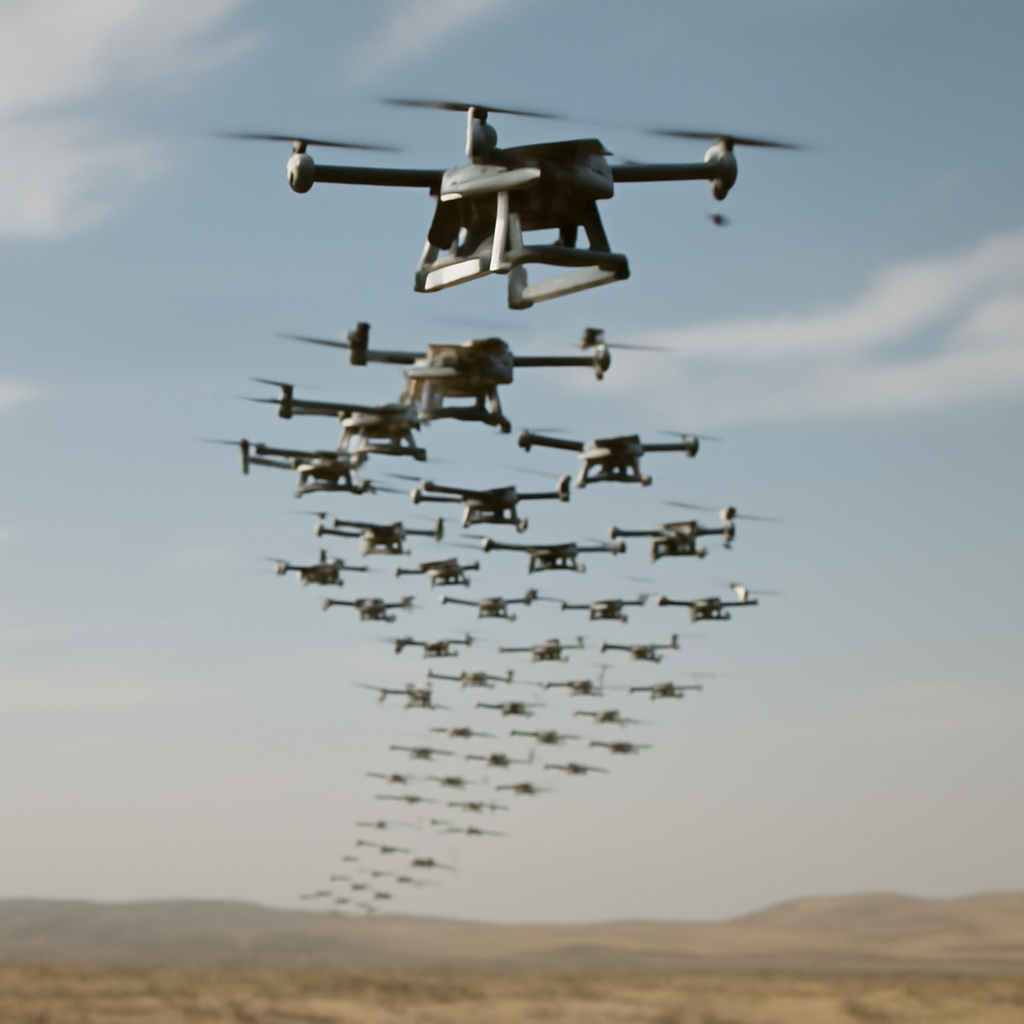
"Multiple Iranian drones hovering in the air, moving as one, in a formation that resembled a jellyfish," according to CNN, was how an F-15E pilot described what he saw moments before ejecting from his stricken jet, four unnamed sources told the news outlet.
CNN’s account of the pilot’s testimony
CNN reported the pilot’s post-incident debriefing was the source of a striking description: “multiple drones interconnected and moving as one with smaller drones below the bigger drones like legs. Real alien shit,” a turn of phrase the article says came from one of the sources familiar with the account. The report is based on statements from four unnamed sources and — the outlet and subsequent commentary stress — should be treated cautiously. CNN also said only the pilot reported the sighting; the Weapon Systems Officer’s (WSO) account was not described in the same way.
The pilot suffered a concussion during the incident, and, per CNN, U.S. intelligence officials who reviewed the debrief disagreed about how to interpret the pilot’s testimony and whether the witness could recount the event clearly. The same pilot was reported by The High Side and CBS News to have been downed previously in March during a friendly‑fire incident that left three Strike Eagles downed over Kuwait.
Physical possibilities raised in the reporting: swarm, screen, or “minefield”
The new reporting sketches three broad physical interpretations drawn from the pilot’s language and analyst commentary. One is a true cooperative swarm — drones linked, communicating, and acting in concert. Another is a less sophisticated “screen” or barrier: a deliberately arranged group of drones deployed to create a physical or explosive hazard that an aircraft might strike or trigger, described in the piece as analogous to a modern, mobile “barrage balloon.” CNN’s sources also quoted the pilot calling the scene a “minefield of drones,” language that could be figurative but that analysts in the source said would match a tactic designed to deny airspace or inflict damage by proximity detonations or entangling cables.
The reporting notes there is no publicly available evidence that a swarm directly participated in the shootdown, and that such interpretations remain speculative in the absence of corroborating sensor or forensic data.

Audit-ready is a season. It shouldn't be.
Evidence in spreadsheets, controls drifting between audits, frameworks multiplying on flat headcount. Nubivance runs continuous compliance on Rapid7 Cyber GRC - SOC 2, HIPAA, ISO 27001, PCI, CMMC.
End the scrambleWhat “swarm” means here, and the state of related capabilities cited in the report
The article offers a working definition: swarms are groups of vehicles or guided munitions interconnected via datalink that cooperate to accomplish objectives, with autonomy and communications architecture determining how advanced the swarm is. The piece distinguishes such cooperative swarms from groups of drones sent together without real-time cooperative decision-making — the latter are described as formations or “flocks” that rely on preprogrammed routes rather than interactive behavior.
TWZ’s reporting also linked this incident to a wider technological landscape. It noted China and Russia — both named as providers of military assistance to Iran in the article — are focused on swarming. The piece referenced China’s repeated demonstrations of loitering munitions in swarm formations and cited TWZ coverage of DARPA research into containerized systems and autonomous constellations capable of supporting up to 500 drones.
The rescue, other actors in the area, and competing accounts of the shootdown
The broader incident narrative in the reporting places the sighting inside a chaotic engagement and a large rescue effort. The U.S. pilot was rescued within hours; the WSO remained hidden and was recovered about 50 hours after ejection. The extraction, per the article, involved hundreds of troops, scores of aircraft, and diversion operations across more than half a dozen parts of Iran. The operation included losses: a second aircraft, an A‑10, went down in the air, and two MC‑130J Commando II special operations cargo planes and several H‑6 Little Bird helicopters were destroyed on the ground; TWZ illustrated the claim with imagery from Iranian state media.
On the cause of the F‑15E loss, the reporting quotes NBC News sources saying the jet “was probably struck by a Chinese‑made shoulder‑launched missile” and that the engagement may have been supported by a “long‑range early‑warning radar” Iran received “in the early days” of the war. The article also says U.S. President Donald Trump reportedly described a shoulder‑fired missile and commented “they got lucky.” During the rescue, Air Force Gen. Dan Caine, chairman of the Joint Chiefs of Staff, is quoted as saying “A‑10s and […] drones and other tactical aircraft were violently suppressing and engaging the enemy” to protect the rescue force, and CENTCOM imagery is noted showing U.S. use of one‑way LUCAS attack munitions in the theater.
What this means for the U.S. military, Iran, and technology developers
- U.S. military: The article documents internal debate in the intelligence community over how to interpret the pilot’s account and notes the pilot’s concussion — details that, according to the reporting, will shape after‑action analysis of sensors, debrief procedures, and counter‑swarm or counter‑screen tactics.
- Iran: The piece says Iran has fielded “loitering” surface‑to‑air missiles and has used small drones in searches for the missing WSO; if the reported screen or “minefield” concept is accurate, it would fit into the unconventional concepts Iran has already demonstrated, per TWZ.
- Technology developers and allied militaries: The article places the sighting against continuing work by China, Russia, and U.S. research agencies on cooperative drones and launched effects — a reminder in the reporting that swarming concepts are moving from tests and demonstrations to operational discussion.
For now, the “jellyfish‑like” sighting remains an intriguing, unverified element in a larger episode: a pilot’s vivid description, competing technical theories, and ongoing debate inside the intelligence community. The facts reported so far leave open whether the formation was a cooperative swarm, a deployed drone screen, friendly or allied systems, or a misidentified phenomenon — and the reporting invites close scrutiny of sensor data and forensic evidence yet to be made public.