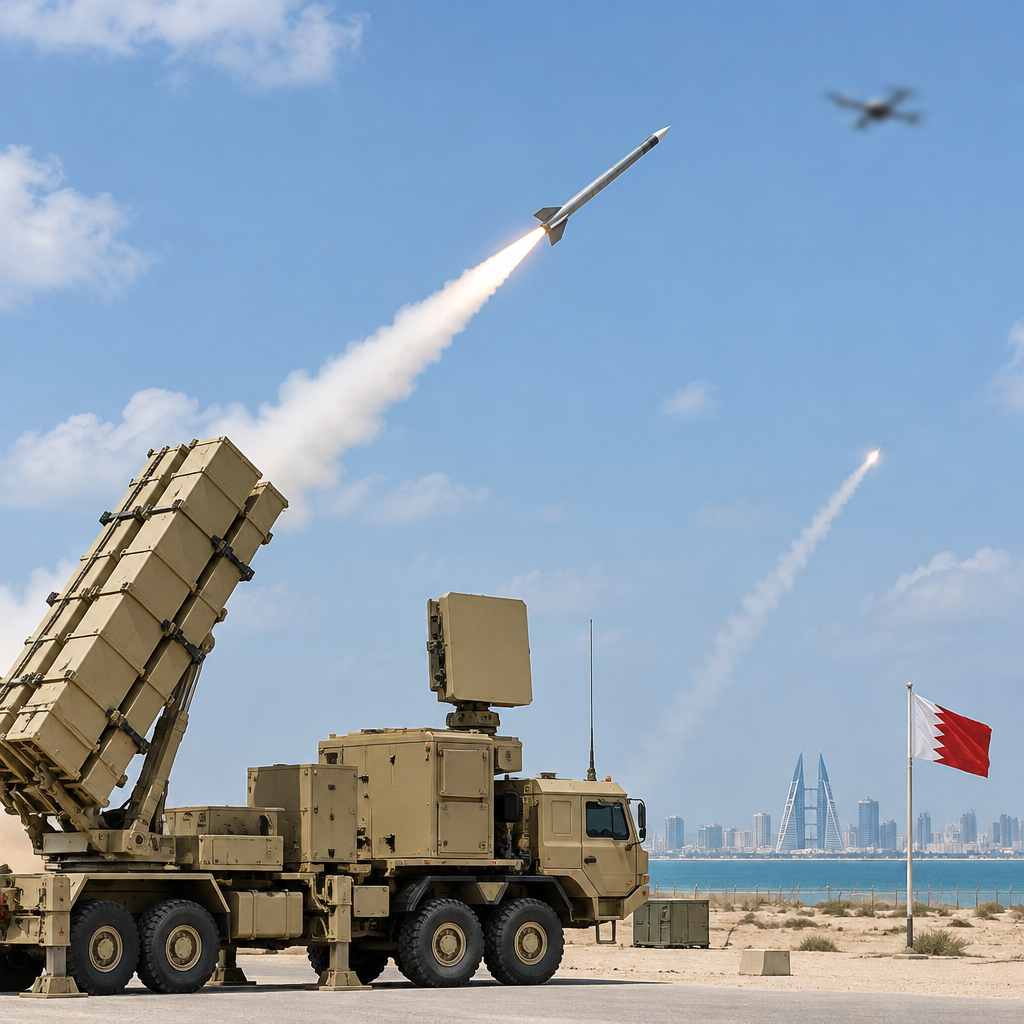
"Kuwaiti air defenses are currently countering hostile drone attacks," the Kuwaiti Army posted on X early Wednesday morning local time.
Kuwait and Bahrain report interceptions after U.S. strike on Qeshm Island
On Wednesday, both Kuwait and Bahrain said their air defenses intercepted strikes following a U.S. attack on Iran’s Qeshm Island the previous day. The Kuwaiti Army’s X post warned that any explosion sounds “are the result of air defense systems intercepting hostile attacks” and urged the public to follow security instructions. The Bahrain Defense Force announced on Instagram that “the air defense systems of the Bahrain Defense Force (BDF) responded to a number of Iranian air attacks on Wednesday, November 18, 2026,” while accusing Iran of continuing “its systematic hostile approach.”
Iranian claims via Tasnim and the pattern of assertions
The Iranian Army, speaking through the IRGC-affiliated Tasnim news agency, claimed that “its combat drones have targeted Patriot air defense systems and drone and missile launch platforms at the US Ali Al-Salem Air Base in Kuwait early Wednesday.” Tasnim offered no visual proof of an attack on Ali Al-Salem, and the report notes that no social-media evidence has emerged. The source material points out that Iran has “frequently made claims that proved to be false” about successful strikes on U.S. assets, and CENTCOM swiftly disputed a separate IRGC claim that a radar system at a base in Bahrain had been hit on Tuesday.

The cyber insurance questionnaire just landed. Now what?
SOC 2, HIPAA, insurance renewals - someone has to own security strategy. Nubivance provides fractional CISO leadership without the full-time salary.
Get a security leadCENTCOM, Pentagon statistics, and confusion over medevac reporting
U.S. Central Command (CENTCOM) posted on X that claims of injured U.S. personnel and medical evacuation were false: “No U.S. personnel have been injured in any attempted Iranian attacks this week.” That denial followed open-source speculation that an unscheduled C-17 Globemaster III medical-evacuation flight bound for Ramstein Air Base might have been carrying wounded troops after the strikes; the speculation was sparked by a post from TheIntelFrog. An earlier U.S. official told reporters there had been “zero impacts” on U.S. facilities from recent Iranian attacks. Pentagon statistics cited in the reporting show that since Operation Epic Fury began on Feb. 28, 23 U.S. troops have died in the Middle East and 868 troops have been wounded.
Qeshm Island strike, shifting tactics, and expert commentary
Several media outlets reported the U.S. carried out airstrikes on Qeshm Island in the Strait of Hormuz on Tuesday. A U.S. official described the strikes as “a defensive response to Iranian forces ‘targeting U.S. personnel and assets’ in the region,” and The Associated Press reported the Qeshm action was in retaliation for a claimed Iranian attack on an American radar installation in Bahrain. Analysts cited in the reporting see a pattern and potential shift in conduct. Hamidreza Azizi, senior Iran analyst at the Crisis Group, noted on X that unlike prior night-time strikes, this Qeshm action was carried out in broad daylight, which “could signal a change in the pattern of U.S. military operations against Iran.” Danny Citrinowicz, a researcher at Israel’s Institute for National Security Studies, characterized Tehran’s approach as “deliberate, calibrated escalation” intended to ratchet up the costs of the U.S.-led naval blockade without necessarily provoking full-scale war.
What this means for the Pentagon, Kuwait and Bahrain, and regional commerce
- Pentagon and CENTCOM: CENTCOM’s public denials suggest a priority on preventing panic and countering online speculation; the Pentagon’s casualty figures underline that U.S. forces have already sustained losses and injuries since February.
- Kuwait and Bahrain: Both countries — hosts to American bases — will be focused on force protection, public messaging about air-defense success, and verifying Iran’s claims, given Tasnim provided no visual proof of the alleged Ali Al-Salem strike.
- Commercial shipping and regional actors: The reporting links attacks against tankers in the Strait of Hormuz and operations against vessels at anchor to a broader Iranian campaign; commentators see a widening set of targets that could raise costs and risks for ships transiting the region.
The recent exchanges are layered: U.S. strikes on Iranian coastal targets, Iranian actions against Gulf hosts and shipping, public denials by U.S. commands, and competing claims from Tehran’s media outlets. Domestic politics also figure into the calculus: reporting notes that one of three U.S. carrier strike groups left the CENTCOM region after USS Theodore Roosevelt joined two other carriers on Nov. 15, and that the USS George Washington subsequently departed; meanwhile, political leaders are already speaking about ending the war. Senate Democratic Leader Chuck Schumer said Senate Democrats would press to “end the war” and might use the “power of the purse” to push for a swift conclusion once his party takes control on Jan. 3.
For now, analysts quoted in the reporting argue the situation is inherently unstable: a naval blockade remains in place, Iranian operations are widening geographically and in method, and both overt strikes and public messaging are changing. The facts presented here leave open a consequential question: can a negotiated agreement be reached — or will the dynamic of incremental escalation continue to produce sudden, dangerous spikes in conflict?
Source: TWZ — Tehran Widens Attacks On Gulf Nations After Latest U.S. Strike On Iranian Island