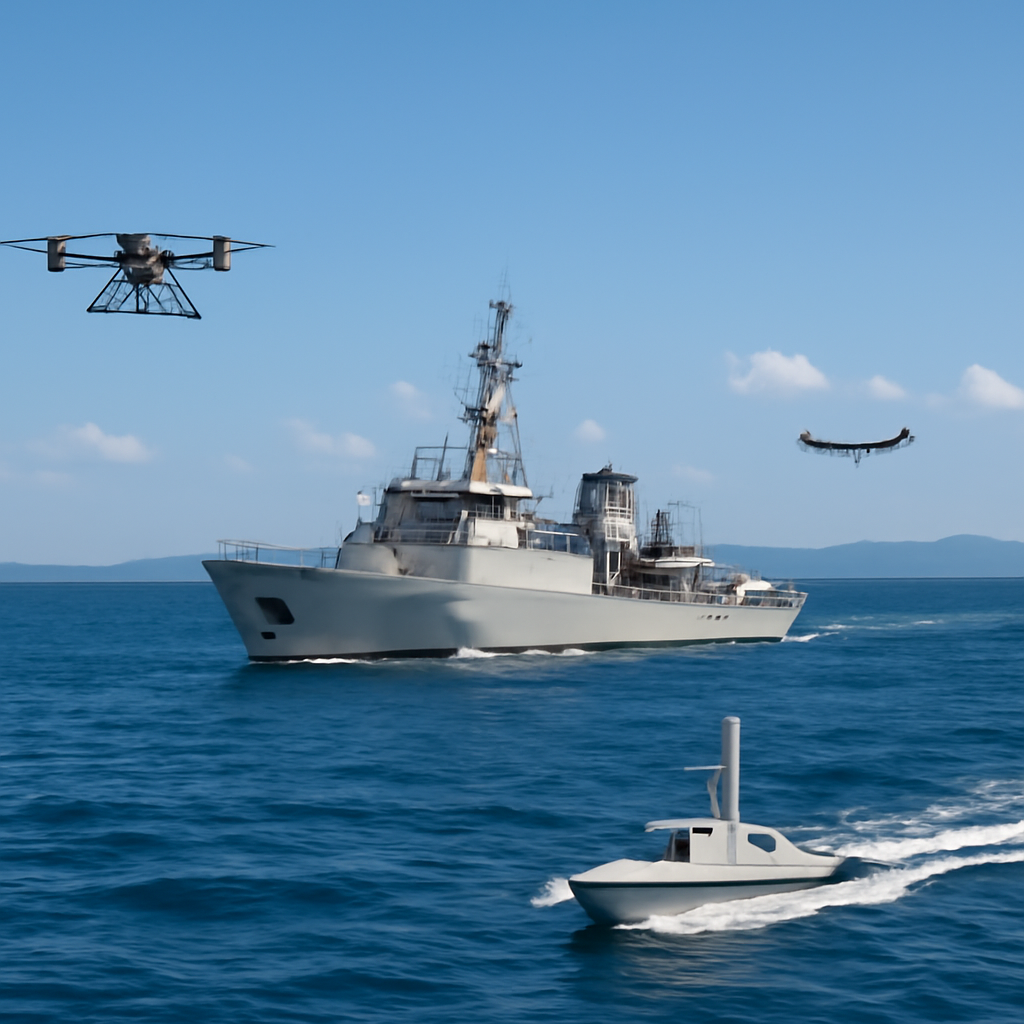
Indonesia’s maritime jurisdiction covers some 6.4 million square km — an area that crewed platforms alone cannot cover persistently.
February admission and Wetar Strait transits
In February, an Indonesian naval officer publicly acknowledged what the service had long understood: foreign submarines routinely transit Indonesian waters, including through passages such as the Wetar Strait, often with little warning to Indonesian forces. The admission underscored a growing surveillance challenge as undersea activity in the Indo‑Pacific intensifies.
Why persistence, endurance and coverage matter more than ship numbers
The navy’s expanding fleet — including two Scorpene Evolved submarines, new multipurpose offshore patrol vessels and additional locally built frigates — improves capabilities but does not change the basic geometry of the problem. With 337 trillion rupiah (A$26 billion) budgeted for defence in 2026, equal to 1.5 percent of GDP and 37 percent higher than a year earlier, acquisition funds have risen. But fleet maintenance and readiness remain enduring constraints, and closing the surveillance gap is fundamentally a question of persistent sensor coverage rather than platform counts alone.

Audit-ready is a season. It shouldn't be.
Evidence in spreadsheets, controls drifting between audits, frameworks multiplying on flat headcount. Nubivance runs continuous compliance on Rapid7 Cyber GRC - SOC 2, HIPAA, ISO 27001, PCI, CMMC.
End the scrambleUncrewed aircraft: what is already operational and immediately deliverable
The navy already operates several uncrewed aircraft, including Boeing Insitu ScanEagles donated by the United States and HC‑540s from China. During Latopslatgab, the navy’s Joint Naval Operation Exercise in April, it demonstrated shipborne uncrewed‑aircraft operations. In May 2026, a Turkish Aerospace Industries delegation inspected Tanjungpinang Naval Air Station for hangars intended for Anka‑S drones, indicating likely future deployment. Those aircraft and associated long‑range drones planned under the National Maritime Security System offer the clearest near‑term path to greater persistent surveillance.
Undersea and surface uncrewed programs: prototypes, ambitions and limits
Efforts beneath and on the sea surface remain less mature. PT PAL’s Kapal Selam Otonom — an autonomous submarine — is still at prototype stage, though it successfully fired a torpedo for the first time in waters off Surabaya in October 2025. The Defence Ministry’s target of producing up to 30 boats of the class for deployment along critical straits does not appear close to achievement. Surface‑uncrewed programs are similarly exploratory: the most visible efforts include converting jet skis into remotely controlled vessels. Meanwhile, recoveries of uncrewed devices — from a 2020 Sea Wing glider near Selayar to three devices recovered in April this year along Archipelagic Sea Lane II — demonstrate that foreign actors are already using autonomous platforms to gather hydrographic, acoustic and seabed data in Indonesian waters.
Integration challenges: networks, datalinks, doctrine and human resources
Uncrewed sensors will have limited effect unless they are woven into the navy’s existing architecture. Indonesia’s Integrated Maritime Surveillance System comprises coastal surveillance stations, ship‑based radars and regional command centres operated by the navy. A parallel National Maritime Security System, launched in 2025 for the Maritime Security Agency at a cost of 167 million euro (A$274 million), will add command centres, coastal surveillance towers, long‑range drones and patrol‑vessel integration. For uncrewed assets to contribute operationally they must feed into the navy’s Integrated Fleet Weapon System — requiring reliable datalinks, secure communications, a common operating picture, doctrine, training, maintenance systems and clear rules of engagement. That will be difficult given delayed availability of satellite communications, a diverse inventory of aircraft and ships, and shortages of trained operators.
What this means for the navy, the Defence Ministry, and regional partners
- The navy: will intensify use of aerial drones and other uncrewed systems for maritime patrols, and has publicly signalled interest in autonomous submarines for underwater surveillance, but faces limits in training, communications and maintenance.
- The Defence Ministry: has set ambitious production targets — up to 30 autonomous submarines — and requested funding for fixed undersea surveillance systems in 2025, while listing undersea sensing among the top 10 national defence industry priority technologies.
- Regional partners and suppliers: are already engaged operationally and technically — from donated ScanEagles and Chinese HC‑540s to Turkish inspections for Anka‑S hangars — while the navy continues to rely on cooperation with Singapore’s Information Fusion Centre as a partial stopgap.
The arithmetic is simple and unsparing: others have judged Indonesia’s waters worth persistent, autonomous surveillance; Indonesia has some building blocks in place and clear aspirations to match. The harder work lies not in the idea but in integration — creating the datalinks, doctrine, training pipelines and sustainment that will let uncrewed aircraft and vessels move from impressive demonstrations into a coherent, persistent maritime surveillance posture that can cover 6.4 million square km.
Source: Obvious but not easy: uncrewed systems should surveil Indonesia’s seas