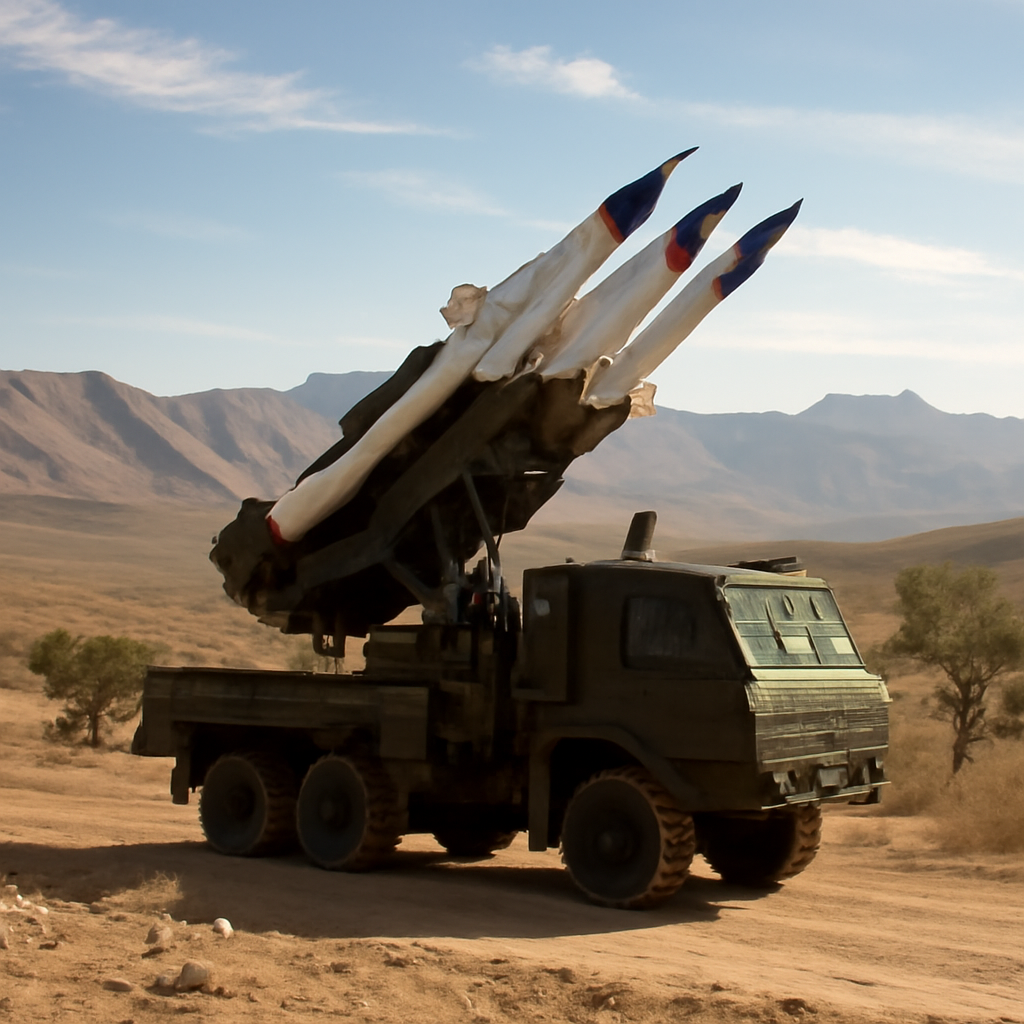
“The first customer was Armenia, which has taken multiple batteries,” Rajesh Kumar Singh said. “Thereafter, we’ve also exported it to Tajikistan and Turkmenistan. Production has stabilised. We have additional orders for our own services, and I’m sure there will be many more from various parts of the world…”
Rajesh Kumar Singh’s public confirmation
In early October, India’s defense secretary Rajesh Kumar Singh told Asian News International (ANI) that the indigenously designed and produced Akash medium-range mobile surface-to-air missile (SAM) system has become a ‘‘success story.’’ Singh identified Armenia, Tajikistan, and Turkmenistan as export customers and said production has stabilised while domestic orders continue. ANI also reported that the Defence Research and Development Organization (DRDO) and the Ministry of Defence had confirmed Tajikistan and Turkmenistan as additions to the buyer list.
What is confirmed — and what is not
Multiple Indian sources now point to exports of the Akash system beyond the initial Armenian deal, but the Central Asian recipients themselves have not spoken publicly. A July report in BW Businessworld, citing official data, listed Tajikistan and Turkmenistan as export destinations for Akash; ANI and DRDO/MoD confirmations align with that record. Absent statements from Dushanbe or Ashgabat, however, essential details remain undisclosed: the number of systems, delivery timelines, and prices are not publicly known.

Audit-ready is a season. It shouldn't be.
Evidence in spreadsheets, controls drifting between audits, frameworks multiplying on flat headcount. Nubivance runs continuous compliance on Rapid7 Cyber GRC - SOC 2, HIPAA, ISO 27001, PCI, CMMC.
End the scrambleArmenia’s deal as the only visible precedent
The transfer to Armenia is the clearest, documented export and therefore the best available comparator for readers tracking the new Central Asian claims. In 2022 Yerevan signed a $720 million contract with Bharat Dynamics Limited that covered an unspecified number of Akash SAMs and 15 Ashwin ballistic missile interceptors. Deliveries were delayed, but in November 2024 Armenia received its first Akash battery — described as comprising four launchers and a Rajendra radar — and a second delivery reportedly followed in July 2025. Those concrete milestones show how an Akash export program can be structured, even if neither price-per-unit nor full package details were published.
Central Asia’s widening procurement menu
Regional military parades and procurement choices illustrate an ongoing diversification away from exclusive reliance on Soviet- and Russian-origin equipment. RFE/RL reporter Zamira Eshanova catalogued recent displays: Turkmenistan’s Independence Day parade on September 27 showcased a Chinese FK-2000 air-defence system alongside a Brazilian-made A-29 Super Tucano attack aircraft and Italian Leonardo M-346 training jets. Tajikistan has publicly displayed China’s HQ-17AE air-defence system and Chinese-made armored vehicles. Uzbekistan’s 2026 Independence Day featured Chinese J-10CE fighter jets, and Kyrgyzstan has acquired multiple types of Turkish military drones. Those examples provide context for how an Indian system like Akash could enter a varied supplier ecosystem.
Interoperability and supplier-balance implications
Officials and analysts cited in reporting warn that a single type of air-defence system will not overturn long-standing supplier relationships in Central Asia. The export of Akash to new buyers underscores a regional intent to seek additional partners and reduce strict dependence on one supplier. At the same time, mixing Soviet- or Russian-designed equipment with Chinese, Turkish, Indian, Brazilian, and Western platforms creates practical challenges around interoperability — the technical and operational ability of disparate systems to work together effectively — and those challenges will shape how new systems are employed.
What this means for Tajikistan, Turkmenistan, and procurement planners
- Tajikistan: India’s military connection to Tajikistan has historical roots, including India’s refurbishment of the Ayni Airbase in the early 1990s and early 2000s. After refurbishment, Tajikistan moved closer to Russia — walking back plans that would have hosted a permanent Indian military presence and instead signing an agreement with Moscow to allow Russian forces to use Ayni. India has maintained access, but not a permanent presence, at Farkhor Airbase near the Afghan border. Any Akash deliveries would thus arrive into a security environment already shaped by those past decisions.
- Turkmenistan: Recent public displays in Ashgabat show a mix of Chinese, Brazilian, and Italian equipment. If Turkmenistan takes Akash systems as reported, planners in Ashgabat will need to integrate them alongside other imported platforms, a nontrivial task given different national standards and support chains.
- Procurement planners: For defense ministries and procurement agencies, the main open items are transactional and technical: confirming numbers, establishing delivery schedules and prices, and planning for sustainment and integration across heterogeneous arsenals. None of those specifics have been released for Tajikistan or Turkmenistan.
The broader fact is straightforward: India’s defense industry has begun landing customers beyond South Asia, and official Indian statements now include two Central Asian capitals on the Akash buyer list. Whether those exports will move from announcement to deployment, how many batteries will be fielded, and how recipient forces will integrate the system with existing hardware remain the practical questions that the current public record does not answer.