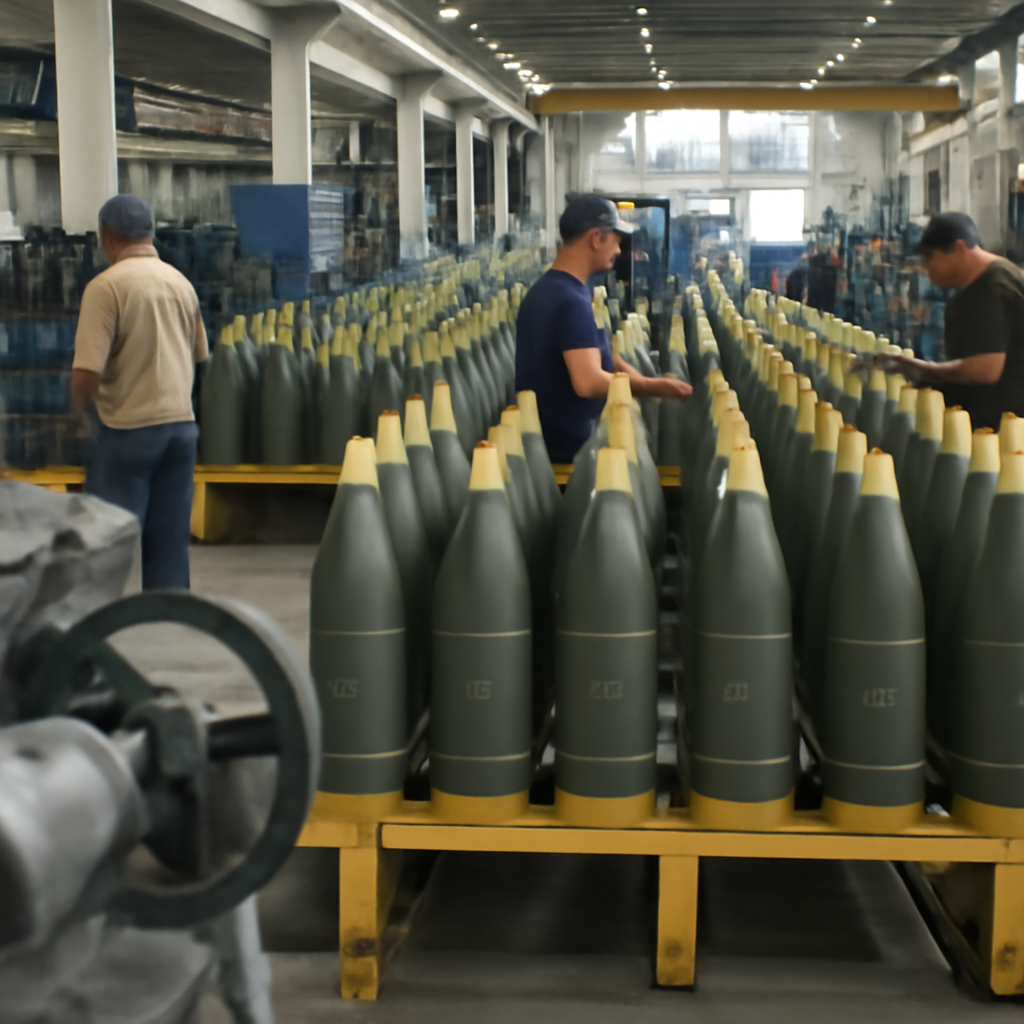
"Recent conflicts have highlighted the pressing need to acquire and produce the munitions, weapons, and technology our troops require to meet the moment in both modern and future warfare," California Rep. Ken Calvert, chairman of the House Appropriations defense subcommittee, said in a statement.
Munitions, multiyear authority, and the industrial push
The House Appropriations Committee's FY27 defense bill centers munitions production. Appropriators included $10.6 billion to buy critical legacy munitions — explicitly naming PAC-3, THAAD and Tomahawk — and $836 million to procure low-cost munitions for the first time. Lawmakers would authorize multiyear procurement authority for those weapons, enabling the Pentagon to finalize recently announced framework deals with defense contractors for systems like PAC-3 and THAAD.
The measure also directs more than $2.9 billion toward programs aimed at shoring up the defense industrial base and fostering new technology: the Defense Production Act, the Office of Strategic Capital, and Industrial Base Analysis and Sustainment (IBAS). Separately, the bill allocates $1 billion for the Defense Autonomous Warfare Group (DAWG) and $1.4 billion for the Joint Interagency Task Force 401 — two efforts described as focused on drone and counter-drone technology.
Air Force: Wedgetail restored and major platform buys
House appropriators reversed an Air Force decision to cancel the E-7 Wedgetail program in FY27 by including almost $1.6 billion for Wedgetail development. The source says Pentagon leaders signaled plans to request a "budget amendment" to add funding back for the program, and the appropriations text reflects that change.
The bill fully funds F-35 procurement at $6.9 billion and provides $379.9 million for Golden Dome. Appropriators also funded 15 KC-46 aircraft at $3.5 billion and 24 F-15EX aircraft at $2.6 billion; they included $2.2 billion for B-21 Raider procurement and $977 million for procurement of the Collaborative Combat Aircraft. The Compass Call program would receive $660 million for three aircraft, and lawmakers allotted $300 million for additional C-130Js for the Air National Guard.
Development lines are significant: $5 billion is provided for the sixth-generation F-47 fighter, and $2.8 billion for further B-21 development. The bill also includes $355 million to procure the Air Force’s Family of Affordable Mass Missile systems.

The cyber insurance questionnaire just landed. Now what?
SOC 2, HIPAA, insurance renewals - someone has to own security strategy. Nubivance provides fractional CISO leadership without the full-time salary.
Get a security leadNavy and Marine Corps: ships, shipyards, and carrier air
The committee included $56.7 billion for 21 ships, funding 11 battle force ships: one Columbia-class ballistic missile submarine, two Virginia-class fast attack submarines, one FF(X) frigate, one Arleigh Burke-class destroyer, one amphibious assault ship, one amphibious transport dock, two oilers, one AS(X) submarine tender, and one T-AGOS SURTASS antisubmarine warfare ship. The Navy had sought funds for one additional AS(X) tender; the bill funds one.
Appropriators added $828 million for the submarine industrial base, $1.3 billion for private nuclear shipyards in the form of "productivity enhancements" to improve capacity and efficiency, and $471 million for wage enhancements. On aviation, the Navy would receive $2.1 billion for six E-2D Advanced Hawkeye planes and $771 million for three MQ-25 Stingray carrier-based tanker drones. The Marine Corps would get $3 billion for 22 CH-53K heavy transport helicopters and $1.6 billion for 11 KC-130Js for the Marine Corps and Navy Reserve. For development, the Navy would receive $915 million for the Next Generation Fighter F/A-XX and $156 million to procure low-cost hypersonic strike systems.
Space Force and Army provisions
Appropriators earmarked $3.7 billion for 20 space launch services and $680.9 million for two Global Positioning System III Follow On spacecraft. Space Force research and development lines include $200 million for Next Generation Overhead Persistent Infrared Polar spacecraft and $100.7 million for commercial space services.
On the Army side, the bill provides $493 million "for additional UH/HH-60M Army Black Hawk helicopters" and $456 million "for additional CH-47F Block II Chinook helicopters," with the source not specifying aircraft counts. Ground and sustainment lines include $661.2 million for M109A7 Paladin self-propelled howitzers and M992A3 ammunition support vehicles, $655 million to upgrade 22 Abrams tanks to the M1A2 (SEP)v3 variant, and $1.1 billion for Armored Multi-Purpose Vehicle procurement. Development accounts include $2.1 billion for the Future Long Range Assault Aircraft (MV-75), $155 million for the Improved Turbine Engine Program, and $325 million for low-cost hypersonic strike systems.
What this means for defense policymakers, procurement buyers, and industrial base leaders
- Defense policymakers: The bill aligns with a discretionary spending level similar to the Pentagon’s $1.15 trillion request while separating military construction and a $350 billion mandatory request into other vehicles. The text signals congressional intent to prioritize munitions and industrial capacity within that envelope.
- Procurement buyers (Pentagon acquisition offices): Multiyear procurement authority for legacy munitions and the explicit funding lines for aircraft, ships, and ground systems would allow program offices to execute multiyear buys and finalize framework deals that the Defense Department and contractors have recently outlined.
- Industrial base and shipbuilders: Targeted boosts—$828 million for the submarine industrial base, $1.3 billion for shipyard productivity enhancements, and funds for wage enhancements—are intended to expand capacity and efficiency at private nuclear shipyards and other builders.
The House Appropriations defense subcommittee is slated to meet Thursday to mark up the bill in a closed session, with full committee debate scheduled for June 24. Democratic appropriators have already signaled reservations: Minnesota Rep. Betty McCollum, the top Democrat on the House Appropriations defense subcommittee, called the measure an "unprecedented sum" that she said comes at the expense of investments such as education. The timetable for markup and committee debate will be the next concrete test of whether those objections shape the bill’s path forward.
https://breakingdefense.com/2026/06/house-appropriators-release-1-trillion-defense-bill-for-fy27/