“We have done so far, some field trials. We did the mixed swarm, now we just started with eight units,” Havelsan Vice President for International Business Development and Marketing Sevket Unal told Breaking Defense after the company showed the new UGV at a defense expo in Istanbul.
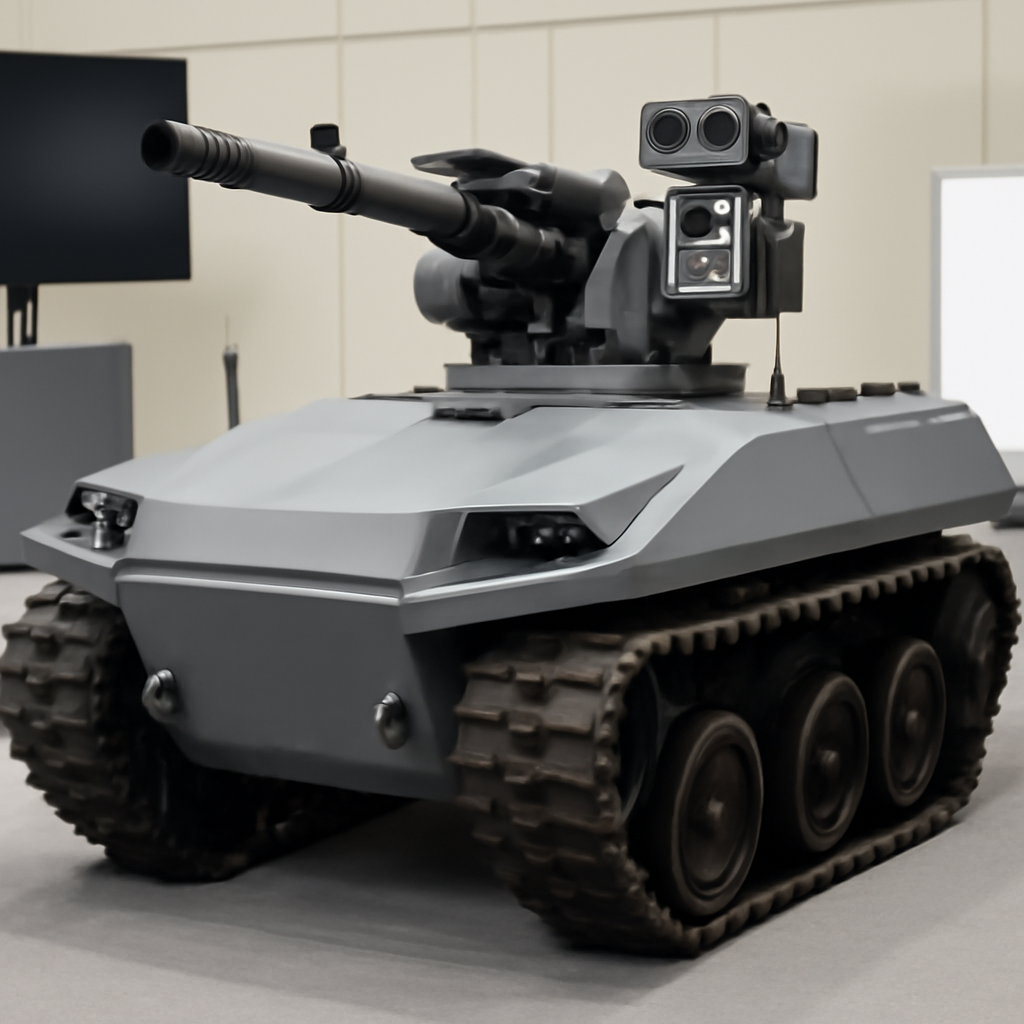
Barkan 3: physical specs and on-display features
Havelsan unveiled the Barkan 3 unmanned ground vehicle (UGV) at the SAHA defense expo in Istanbul. The vehicle displayed at the company's booth carried a 12.7 mm weapon system and was fitted with front-driving and ground-facing cameras. Havelsan lists the UGV's maximum speed as 25 kmph (15.5 mph) and its endurance as five hours at full load. Barkan 3 is described as the latest member of the Barkan family; the first Barkan platform was inducted into the Turkish military in 2023.
In Havelsan's official announcement, the company framed the evolution from earlier Barkans as a change not only in payload but in system behaviour: “what defines the system is no longer only what it carries, but how effectively it responds to changing conditions in the field,” the firm said.
ADVENT‑AI: an AI decision layer for naval operations
Alongside the Barkan 3, Havelsan displayed an AI-enabled combat management system called ADVENT‑AI. Havelsan described ADVENT‑AI as “designed as an AI-supported decision layer that supports operators in naval operations.” According to the company, the system analyzes high-volume operational data in real time, helps detect patterns, filters critical information, and supports faster decision-making.
Havelsan placed ADVENT‑AI and Barkan 3 under a broader “digital troops” concept and said the company is integrating AI both into combat management systems and into the digital troops construct more generally.

This site is the portfolio.
OSINTSights runs on Cloudflare Workers, D1, R2, and Vectorize, with an AI pipeline on Hetzner ARM. Nubivance designed, built, and operates it. We do the same for clients.
See what we buildJoint swarming: mixed-domain autonomy and field trials
Unal described the company's work as oriented toward “joint swarming” — coordinated operation across domains. He specified swarming pairings such as between unmanned aerial vehicles (UAVs) and unmanned ground vehicles (UGVs), or between UAVs and unmanned surface vessels (USVs). “We have been doing field trials, so we are improving our knowledge and increasing our competence in this area,” he said.
Havelsan reported it has completed mixed-swarm field trials and is now deploying small group tests; Unal said the company had “just started with eight units.” He added that joint swarming between Barkan 3 and Havelsan’s UAVs, including the Baha and Bozbey platforms, “is ready for deployment” and could be fielded in 2026.
Export push: Gulf states, North Africa, and a Saudi office within two months
Unal said Havelsan has ongoing projects in the Asia Pacific, the Middle East, and Europe, and described active activity across specific regional markets. He named Gulf countries where Havelsan is “very active” — Kuwait, Qatar, UAE, Saudi Arabia, Oman and Bahrain — and said the company is “having some discussions” with neighbours Iraq and Syria. In the Mediterranean/North Africa, he listed Egypt, Libya, Algeria, Tunisia and Morocco.
On offices and local presence, Unal said Havelsan planned to open an office in the Kingdom of Saudi Arabia “within two months.” He said opening an office would mean settling there not only for business development but “for enforcing and supporting the local employment, technology transfer, competence, settling inside the country.” Unal added that Havelsan could expand its offices to Kuwait after the Saudi opening.
What this means for the Turkish Armed Forces, Gulf buyers, and technologists
- Turkish Armed Forces: Havelsan emphasized close cooperation with the Turkish Armed Forces during development, saying systems are developed together with them because “in the end, they are the end users.” The company’s timelines — including a possible 2026 fielding for mixed-domain swarms — are tied directly to that collaborative development posture.
- Gulf and regional buyers: Unal’s list of active markets and the planned Saudi office signal an export push focused on Gulf states and North Africa. The company framed office openings as mechanisms for local employment and technology transfer rather than purely sales outposts.
- Technologists and integrators: Havelsan’s messaging centers on integrating AI into combat management and “digital troops,” and on scaling from small mixed-swarm trials to “tens of units.” That roadmap implies continued development work on autonomy, interoperability between UGVs and UAVs, and real‑time data processing such as ADVENT‑AI’s pattern detection and filtering functions.
Havelsan presented a compact, weapons‑equipped UGV and an AI decision layer as elements of a single strategy: move from single platforms toward coordinated, mixed-domain unmanned forces. The near-term markers the company has given — joint-swarm readiness with Baha and Bozbey, a possible 2026 fielding date, and a Saudi office within two months — are concrete milestones to watch as the firm seeks both domestic deployment and regional expansion.