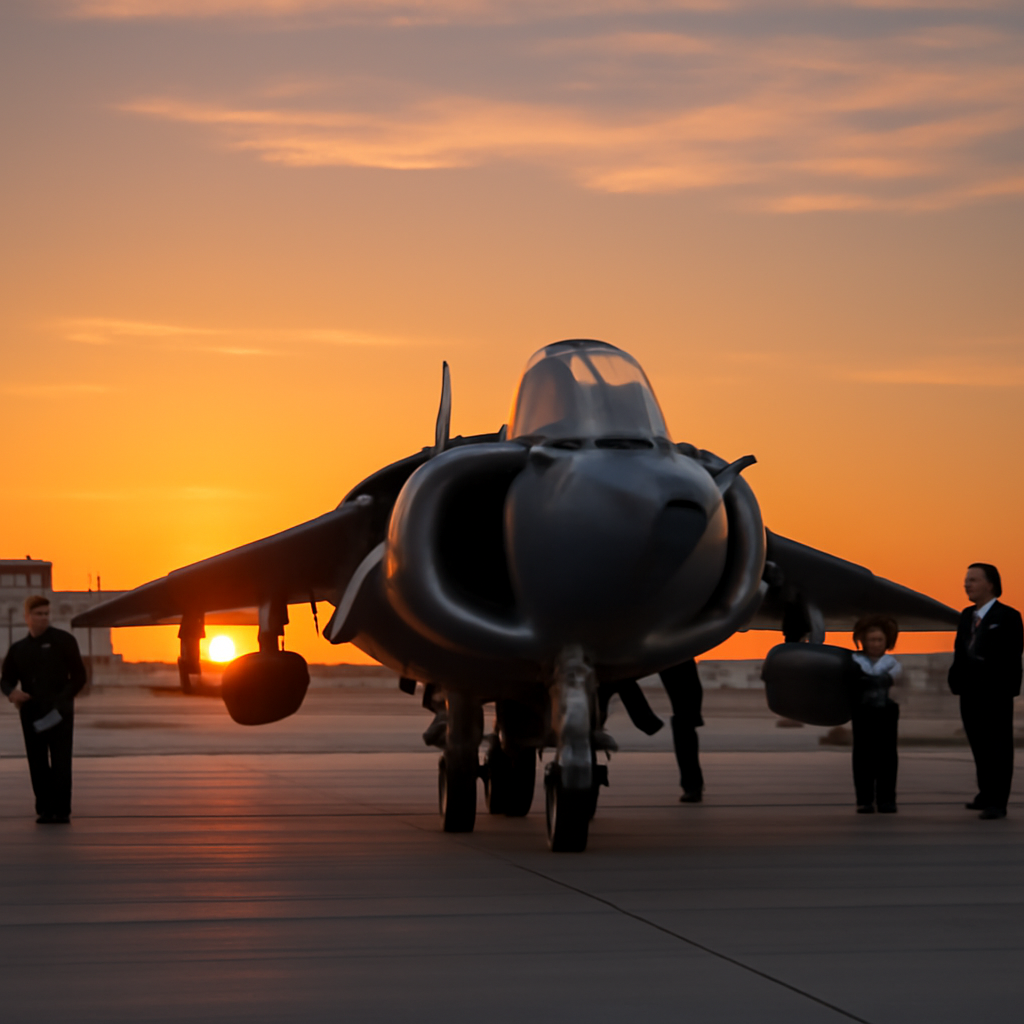
“Today, the U.S. Marine Corps celebrated the end of more than half a century of Harrier ‘jump jet’ operations with a sundown ceremony at Marine Corps Air Station Cherry Point in North Carolina.” The line opens a chapter in a transatlantic story that began in British design rooms and ended on a U.S. flight line — a story of engines, nozzles, and a string of officers and engineers who pushed a radical concept into sustained service.
From Kestrel trials to AV-8: how a British idea found U.S. wings
The Harrier’s journey into U.S. service traces back to Cold War-era experiments with vertical takeoff and landing aircraft. Early American projects, exemplified by the Ryan X-13 Vertijet and other 1950s efforts, failed to produce a workable jump jet. By contrast, the Hawker Siddeley P.1127 — later evolving into the Kestrel and then the Harrier — used a comparatively simple, single-engine approach and four rotatable exhaust nozzles beneath the wing that provided vertical, hovering and conventional flight.
That mechanical simplicity impressed U.S. observers. The P.1127 and its Kestrel derivative were trialed jointly by British, American and West German personnel; six Kestrels were taken to the United States and redesignated XV-6As. The XV-6A demonstrated operations from grass, semi-prepared surfaces and ship decks — operational flexibility that appealed to the Marine Corps.
Key people who bridged design and adoption
The source highlights three individuals who materially shaped the Harrier’s U.S. trajectory. Col. Willis “Bill” F. Chapman of the U.S. Air Force, described as an early American proponent, funded the Pegasus engine and cultivated a close working relationship with Hawker’s design team led by Ralph Hooper. Over “10 years before” the Marines’ 1968 interest, Chapman had already been in Hawker’s tent at Farnborough examining the P.1127.
In 1968 two Marine officers walked into Hawker Siddeley’s Farnborough hospitality chalet and arranged flights; within two weeks they had flown the jet. One of those men, Col. Tom Miller, then used his influence inside the Marine Corps to secure the Harrier for the service and later led the 2nd Marine Aircraft Wing at Cherry Point — the same unit that retired the Harrier 55 years after the Corps’ decision to acquire it.
Ralph Hooper appears throughout the narrative as the British designer who not only built the Harrier family but later brought advanced jump-jet concepts into U.S. design conversations.

This site is the portfolio.
OSINTSights runs on Cloudflare Workers, D1, R2, and Vectorize, with an AI pipeline on Hetzner ARM. Nubivance designed, built, and operates it. We do the same for clients.
See what we buildDesign evolution: AV-8A to AV-8B to ideas that fed the Joint Strike Fighter
The Harrier’s U.S. life moved from British-built AV-8A models to the AV-8B Harrier II, a second-generation aircraft “jointly-developed, with mostly American technology.” The American industrial role in the Harrier program created jobs in the United States and deepened operational ties between American and British pilots, engineers and ground crews.
In the 1980s and beyond, designers sought a supersonic jump jet. In 1981, Hooper and engineers from the Harrier factory worked at McDonnell Douglas in St. Louis on a larger P.1218 twin-engine concept. That joint work fed into the Model 279-4 and into long-term research — including projects with NASA — that the source connects to the genesis of what became the Joint Strike Fighter program. Hooper’s single-engine P.1216 design, investigated in the United Kingdom and discussed with Marine officers, shared weight and role ambitions with emerging U.S. requirements for a Hornet-sized supersonic vertical-capable aircraft.
Operational lessons and the handoff to the F-35B
The Harrier’s operational record was uneven: its mechanical innovations allowed flexibility but demanded rigorous training, and the aircraft “had its problems” with accident rates mirroring early jump-jet eras when training standards slipped. The source notes the F-35B also faced hurdles and that Hooper was called on in the early 2000s to assist with fixes.
The technical and interpersonal bridges built across the Atlantic — the article calls them the work of a “Harrier Mafia” — helped knit together solutions and eased procurement pathways. Those same connections and lessons, the source argues, contributed to Marine Corps support for the Lockheed Martin F-35B Lightning II, which now replaces the Harrier at Cherry Point.
What this means for the Marine Corps, British designers, and NASA/McDonnell Douglas
- The Marine Corps: The Corps moved from a rapid adoption of a foreign design in 1968 to decades of operating a uniquely capable but demanding platform; Cherry Point’s sundown ceremony marks a formal transition to the F-35B after 55 years of Harrier operations.
- British designers and Ralph Hooper: Hooper’s ideas not only produced the Harrier but continued to inform U.S. programs through collaborative work at McDonnell Douglas and technical exchanges, including a 1992 handover of plans to Col. Tom Miller that helped galvanize Marine interest in follow-on vertical-capable designs.
- NASA and McDonnell Douglas: Research collaboration and joint design efforts in the 1980s and 1990s — including redirected work toward NASA research — played a role in the technical lineage that fed into the Joint Strike Fighter effort and ultimately into a practical F-35B design for Marine use.
The Harrier’s American chapter closes at Cherry Point, but the source frames the aircraft’s legacy as more than metal and engines: it is a testament to cross-border engineering, officers who championed unconventional ideas, and institutional learning that carried a novel capability from British drawing boards into sustained U.S. Marine service and on to the next generation of vertical-capable fighters.