"As we talk with the Navy, they’re very interested in modular solutions," HDUSA CEO Michael Coulter told reporters — a succinct line that frames a near-term push to field a new medium unmanned surface vessel designed from the ground up for swap-in payloads and rapid testing.
Hanwha Defense USA and Magnet Defense: partnership and schedule
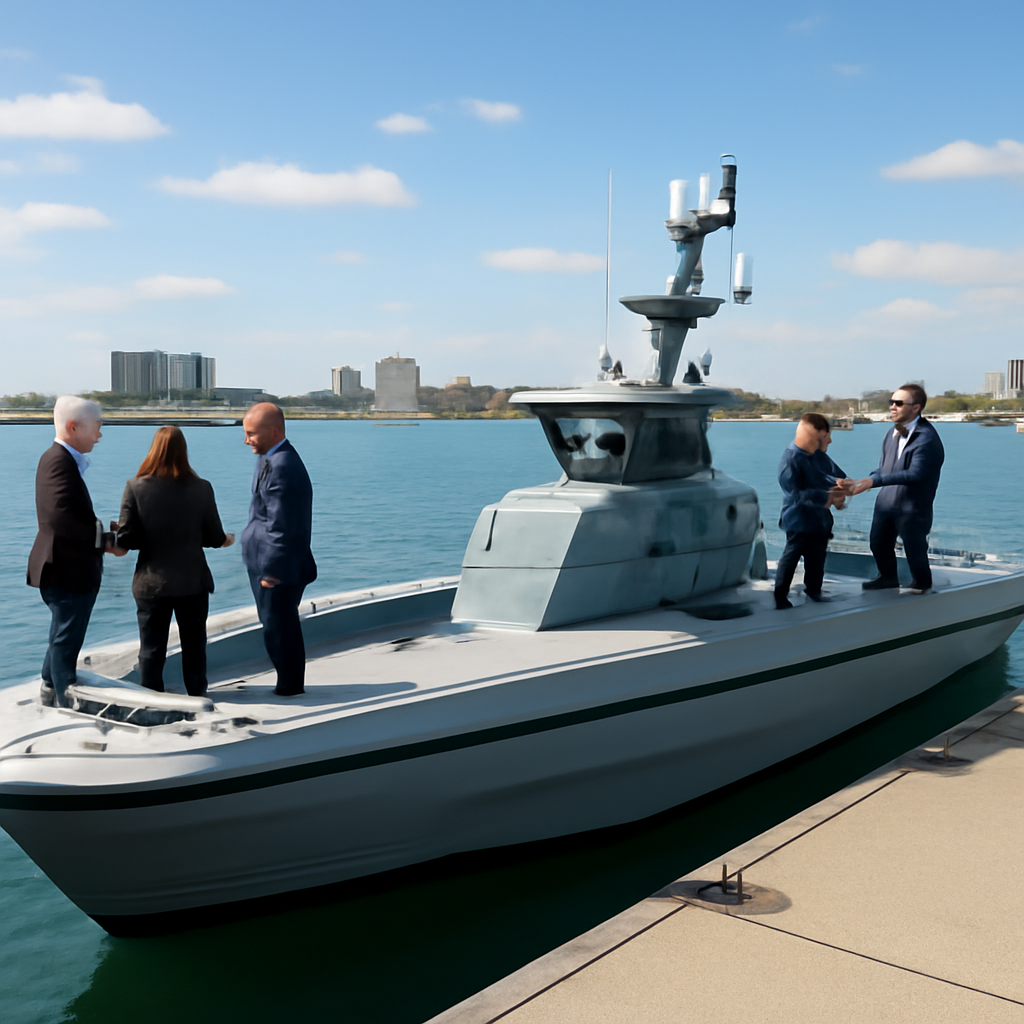
Hanwha Defense USA (HDUSA) and Magnet Defense formalized cooperation in an April memorandum of understanding to develop a 38‑meter MUSV, the H38, derived from Magnet Defense’s flagship M48. On the Wharf Marina in Washington, company officials — including Coulter and Kevin Schoonover, HDUSA’s senior vice president for missiles — toured reporters aboard an M48 docked pier side and described the near-term program timeline.
Coulter told reporters, "we will be beginning construction of those next month, and we’ll be testing on other platforms our payloads this fall, and testing on the H38 in January to bring capability." Kevin Schoonover said Hanwha is monitoring the Navy’s MUSV marketplace and that the company is prepared to compete when opportunities arise: "Our main focus is that we’re leaning forward. We’re going to bring the capability not just as a vessel, but as a complete system that has all the hooks to be able to switch and swap, whether it’s directed energy or a missile system."
The H38 and M48: dimensions, missions, and tested endurance
The H38 is being pitched as a slightly smaller variant of the M48; Magnet’s vessel measures 48 meters long while the H38 is planned at 38 meters. Magnet Defense’s March press release — cited in company remarks — describes the M48 as equipped to support integrated air and missile defense, anti-surface and anti-submarine warfare, and search and rescue missions.
The M48’s operational pedigree was highlighted by the companies: in 2024 the vessel completed a 32,000‑nautical mile transit from Miami to American Samoa, transiting the Panama Canal and enduring Sea State 9 conditions. That endurance record underpins the partners’ claims that payloads and mission systems can be validated at sea before the H38’s own trials.

Audit-ready is a season. It shouldn't be.
Evidence in spreadsheets, controls drifting between audits, frameworks multiplying on flat headcount. Nubivance runs continuous compliance on Rapid7 Cyber GRC - SOC 2, HIPAA, ISO 27001, PCI, CMMC.
End the scrambleNavy’s March MUSV marketplace: procurement context
Hanwha’s H38 development comes against the backdrop of a March launch by the Navy of a new MUSV marketplace intended to accelerate procurement of production‑ready unmanned surface vessels. Schoonover described the marketplace as "evolving" and said the company is awaiting further information, while signaling an intent to participate: "we want to throw its hat in the ring if it gets the opportunity to do so," he told reporters.
Both Hanwha and Magnet framed the H38 as conforming to what they say the Navy wants: modular, mission‑capable platforms that can host electronic warfare payloads, communications relays, lethal effects, directed energy, or missile systems as mission needs change.
What this means for Hanwha Defense USA, Magnet Defense, and the Navy
- Hanwha Defense USA: The company is positioning the H38 as a systems offering — a vessel plus "all the hooks" for swap‑in payloads — and has laid out an aggressive near‑term program of construction and testing aimed at creating production momentum and a competitive entry into the Navy’s MUSV marketplace.
- Magnet Defense: Having demonstrated long-endurance transits and operations in heavy seas with the M48, Magnet supplies a proven hull form and operational data that the partners will rely on to validate modular payloads across other platforms this fall and then on the H38 in January.
- The Navy and the MUSV marketplace: The Navy’s March marketplace launch framed the procurement environment the companies cited; the Navy’s stated preference for production‑ready, mission‑capable platforms creates an opportunity for vessels like the H38 to compete, but the marketplace’s evolution means the companies are watching for formal acquisition opportunities and requirements updates.
The picture painted by Hanwha and Magnet in Washington was straightforward: move from demonstration to construction quickly, test payloads on existing platforms this fall, and press the H38 into sea trials in January. The timeline — and the companies’ explicit framing of the H38 as a "complete system" with modular "hooks" for directed energy, missiles, electronic warfare, and communications — makes clear their intent to align closely with the Navy’s marketplace priorities.
The next concrete markers to watch will be the start of construction the companies announced they would begin "next month," the results of payload tests on other platforms this fall, and the H38 trials slated for January. Together, those milestones will tell whether this partnership translates from an April memorandum of understanding and a pier‑side tour into an operational entry into the Navy’s MUSV ecosystem.