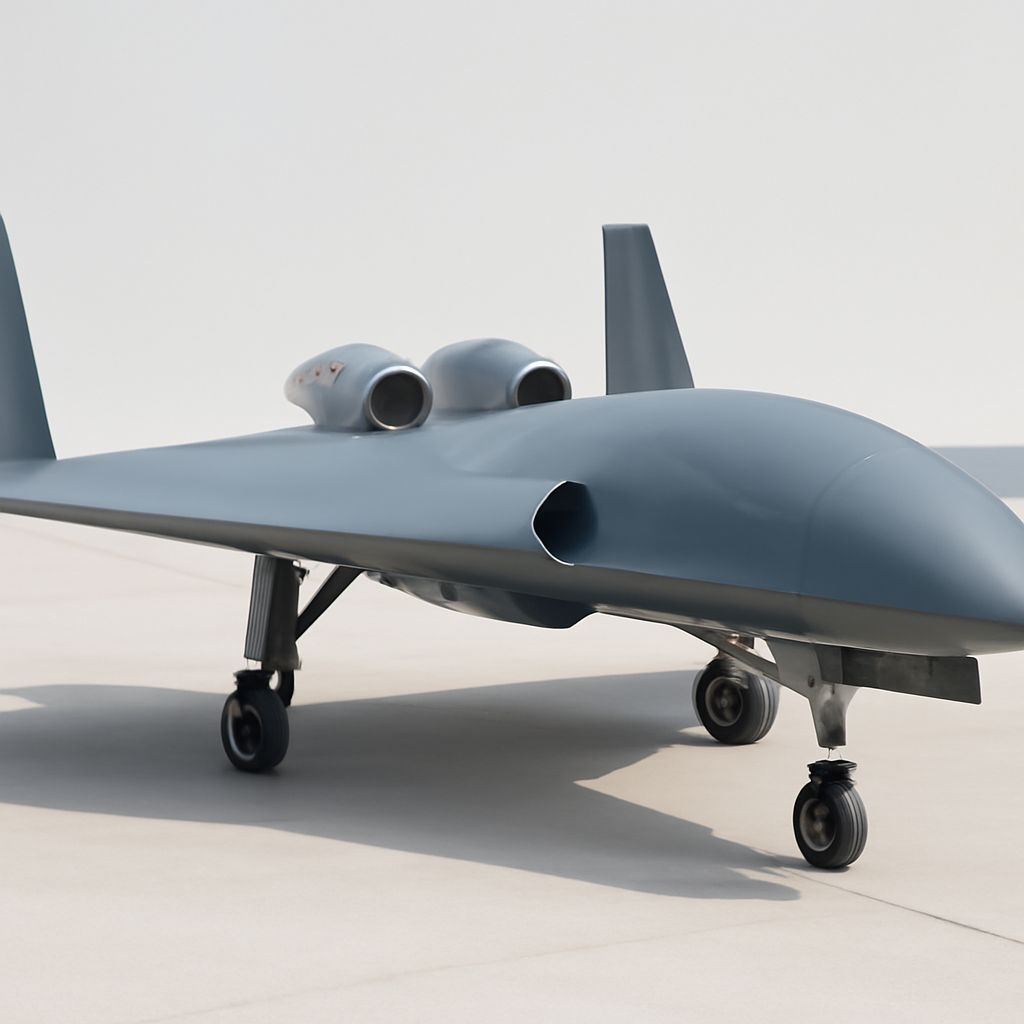
With the missile fitted, the Cobra 600 has a range of around 250 miles.
Polaris Raumflugzeuge’s Cobra 600 drone platform
The Cobra 600, also presented as the Airborne Launching and Attack System (AirLAS), is a jet-powered drone platform built by the German start-up Polaris Raumflugzeuge. The design echoes a modified flying-wing with a delta planform and endplate vertical stabilizers on the wingtips. As displayed, the prototype uses two JetCat‑P1000‑PRO micro turbojet engines — each rated at a maximum thrust of 20 pounds — and the airframe includes intake ports for two additional engines. Concept art released by Polaris also shows a four‑engine configuration with turbojets buried in longer intakes to lower detectability.
Polaris has fitted the Cobra 600 with retractable wheeled tricycle landing gear, enabling runway takeoff and recovery and, in some cases, operations from shorter airstrips such as stretches of highway. The company states the platform is intended to be inexpensive enough that commanders might accept a risk of loss in combat rather than treat every aircraft as single‑use only.
Diehl Defence’s IRIS‑T integration and the “missile taxi” concept
Diehl Defence has combined its IRIS‑T missile with the Cobra 600, creating what the companies describe as a “missile taxi” — a drone that carries an off‑the‑shelf air defense missile to a forward area and then launches it. The physical interface is a standard Eurofighter-style pylon. The missile used is the same IRIS‑T variant employed by ground systems such as the IRIS‑T SLM and IRIS‑T SLS; the latter uses the identical missile in its air‑to‑air derivative.
With the missile aboard the Cobra 600, the system’s range is given at roughly 250 miles, compared with ground‑launched IRIS‑T SLM range of about 25 miles and IRIS‑T SLS range of approximately eight miles. That differential makes the drone a launcher that substantially extends the geographical reach of existing IRIS‑T batteries, albeit with tradeoffs in speed, maneuverability and target set relative to long‑range surface‑to‑air missiles.

This site is the portfolio.
OSINTSights runs on Cloudflare Workers, D1, R2, and Vectorize, with an AI pipeline on Hetzner ARM. Nubivance designed, built, and operates it. We do the same for clients.
See what we buildCommand and sensor chain: tethering, LOAL and seeker options
In its current form the Cobra 600 carries no independent target sensors beyond the imaging infrared seeker built into the IRIS‑T missile itself. Operationally, a ground‑based air defense system (typically an IRIS‑T SLM or SLS) would detect and identify a target, then vector the drone via datalink. The missile employs a lock‑on‑after‑launch (LOAL) mode: after launch it uses inertial guidance to reach a predicted engagement area, then activates its infrared seeker to search for the target.
The developers note several possible variations for command and control: adding an infrared camera to the drone so a human operator can confirm missile lock, relying on SATCOM links such as Starlink to overcome line‑of‑sight datalink limits, or “uncaging” the seeker and allowing the missile to autonomously engage targets within a predefined kill box. The source explicitly flags ethical and operational questions about these autonomous or semi‑autonomous modes.
How the Cobra 600 compares to Russian Shahed/Geran missile adaptations
The Cobra 600 is presented in the context of similar battlefield adaptations. Russian forces have mounted short‑range air‑defense weapons — including the R‑60 air‑to‑air missile and handheld MANPADS such as the Igla — on Shahed‑136 (Geran) one‑way attack drones. Those Russian efforts typically add a camera and radio modem to provide remote launch capability, and have been used as a deterrent against fixed‑wing aircraft and helicopters.
The Cobra 600, by contrast, is considerably larger than the Shahed‑136 derivatives and is jet‑powered; Polaris’ approach with up to four engines is positioned to give faster response and greater maneuverability than the modified Shaheds. The source notes, however, that the Cobra 600 remains dependent on its tethered ground systems for situational awareness.
What this means for commanders, procurement leaders, and frontline defenders
- Commanders and procurement leaders: Cobra 600 offers a way to extend IRIS‑T interceptors to contested forward areas without buying entirely new long‑range missiles, and its reusability and runway recovery change deployment tradeoffs versus one‑way kamikaze drones.
- Policymakers and defense planners: integration choices — adding onboard sensors, securing datalinks, and rules for autonomous engagement — will drive doctrine and raise ethical and legal questions that the source flags but does not resolve.
- Frontline defenders and adversaries: the system’s 250‑mile reach shifts where an IRIS‑T launcher can be placed tactically; defenders will need to consider datalink resilience and the economics of using an expensive interceptor against lower‑cost threats.
The Cobra 600 has already completed flight tests with a dummy IRIS‑T fitted, and development is mainly company‑funded with investment from at least one interested nation. It is being shown publicly for the first time at the ILA Berlin airshow. Whether battlefield operators will favor forward‑positioned reusable “missile taxis” over existing solutions will depend on answers to the datalink, seeker, and command questions Polaris and Diehl have laid on the table. Those answers will determine whether the Cobra 600 becomes a force multiplier or an expensive adjunct to traditional air defenses.