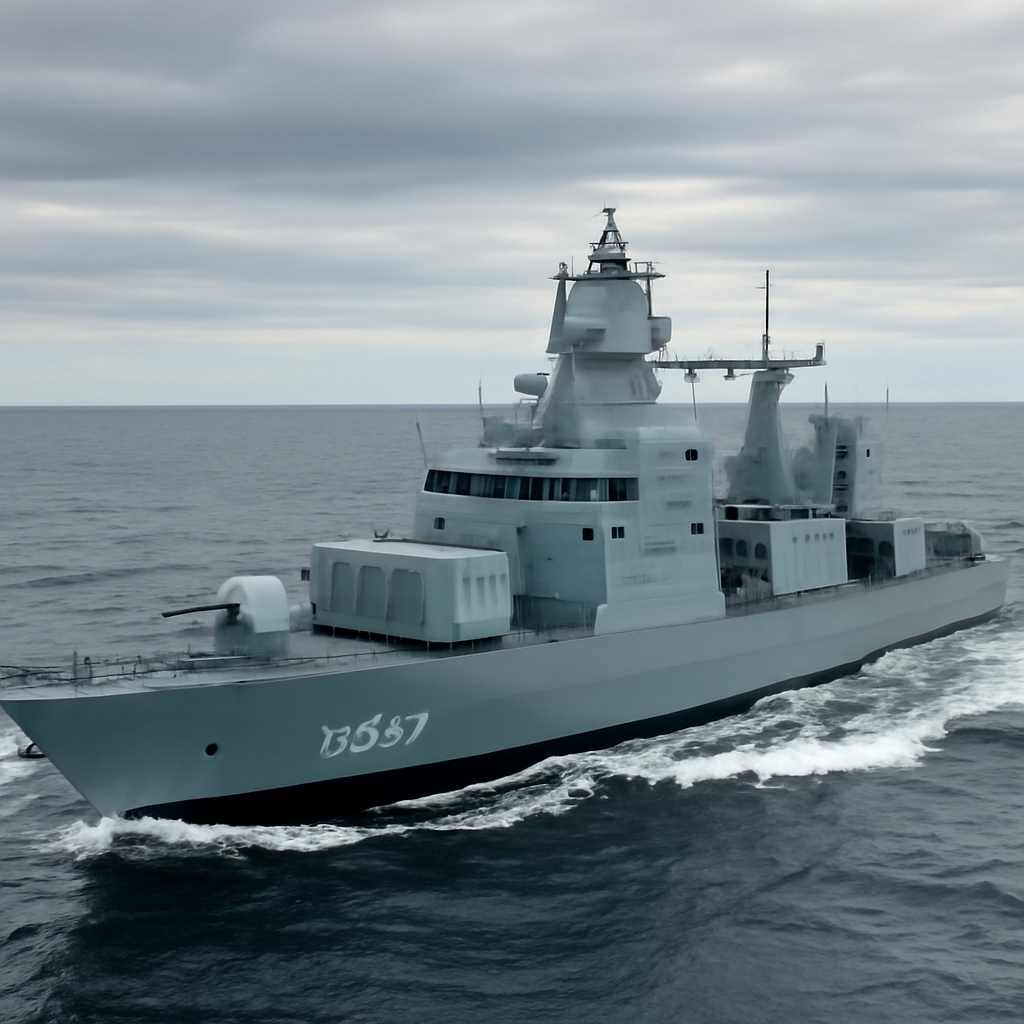
“With the successful launch of a ballistic missile last night in the North Atlantic, we have made naval history. I am extremely pleased with this achievement. The system can be successfully deployed by our units, and its potential range exceeds anything we have seen before.” — German Navy Inspector General Vice Adm. Jan Christian Kaack, via the Bundeswehr’s official WhatsApp channel.
Sachsen-Anhalt and the North Atlantic test
At least two Israel Aerospace Industries (IAI) LORA ballistic missiles were fired from the German frigate Sachsen-Anhalt (F 224) during a test conducted in the waters between Ireland and Iceland as part of the Bundeswehr’s operational experimentation (OPEX) series. Video released by the German Ministry of Defense shows two containerized LORA launchers on the frigate’s flight deck and a missile departing each container. Two German frigates were reportedly deployed for the trial, and maritime and air traffic received a warning 45 days in advance.
LORA: technical profile and operational claims
IAI describes LORA as a containerized, quasi‑ballistic missile available for ship- and ground-launch. The source states the missile is about 17 feet long, 25 inches in diameter, and weighs roughly 3,500 pounds. Its officially stated range is approximately 60 to 270 miles; LORA combines GNSS satellite navigation with an inertial navigation system and can reportedly achieve a circular error probable (CEP) of about 33 feet. IAI also says LORA can be launched within minutes from unprepared positions and can hit a target in less than 10 minutes after a launch decision. IAI confirmed the recent test’s results, saying both missiles followed planned trajectories and struck their targets with high precision.

This site is the portfolio.
OSINTSights runs on Cloudflare Workers, D1, R2, and Vectorize, with an AI pipeline on Hetzner ARM. Nubivance designed, built, and operates it. We do the same for clients.
See what we buildOperational constraints: flight deck, seekers, and undisclosed details
The test highlighted practical and conceptual limits. The Sachsen-Anhalt cannot keep LORA canisters on its flight deck permanently because they block the flight deck and thus deprive the F125 of a critical capability; the source notes any permanent installation would require relocation elsewhere on the vessel. The basic LORA configuration lacks a terminal seeker, which the source says constrains the weapon to fixed-location targets rather than autonomously acquiring and tracking a maneuvering warship during terminal flight. The source also makes clear that the exact targets, engagement ranges, flight profiles, and missile configurations used in the North Atlantic test have not been disclosed.
Bundeswehr OPEX, future platforms F127 and LRMV, and prior demonstrations
The launches were carried out under the Bundeswehr’s OPEX framework in cooperation with the Bundeswehr Innovation Center in Erding, a program intended to evaluate emerging technologies and operational concepts before considering wider adoption. There is precedent for German naval experimentation moving systems toward procurement: the source notes Israeli systems such as IAI’s Blue Whale autonomous underwater vehicle were evaluated through German experiments and subsequently progressed toward adoption. The article points to potential integration pathways beyond the four F125 hulls — specifically the planned F127 multi-purpose frigates and the proposed Large Remote Missile Vessels (LRMV), uncrewed “arsenal ship” wingmen. The source also recalls earlier LORA shipboard demonstrations: in 2017 a containerized LORA was fired from a truck on the deck of a cargo ship and hit a land target, and in 2020 IAI fired two LORAs from a ship at floating targets at roughly 60 and 250 miles.
What this means for the German Navy, NATO, and adversaries
- German Navy — A naval LORA option would give surface combatants a long-range, rapid-strike tool that exceeds the reach of naval guns and many shorter-range precision weapons; integrating such capability on future hulls or remote missile vessels could expand the fleet’s role in high-end combat operations.
- NATO planners — The test aligns with a broader European push toward longer-range precision fires; Germany’s work to expand deep-strike capability (including planned acquisition of land-based Tomahawk cruise missiles, noted in the source) would add options for distributing long-range fires across allied forces.
- Potential adversaries — LORA’s quasi‑ballistic trajectory poses a different air‑defence challenge than low‑flying cruise missiles and, by impacting with greater kinetic energy, is suited to harder targets. That said, without a terminal seeker in its basic form it is more tailored to fixed targets than to maneuvering warships.
The Sachsen-Anhalt demonstration is a clear operational experiment: it proved that containerized LORA can be launched from an F125 flight deck and that launches can be integrated into Bundeswehr experimentation cycles. The more consequential questions the test leaves are concrete and tangible — will Germany move from experimentation to procurement for shipborne LORA, where on a warship launchers would be permanently sited if that path is chosen, and whether variants with terminal seekers or alternate employment concepts will be pursued to address anti‑surface targeting. Those decisions will determine whether this demonstration becomes a historic one-off or the opening chapter of a new long-range naval strike capability for Germany and its allies.
Source: TWZ — Israeli LORA Ballistic Missiles Fired From German Frigate