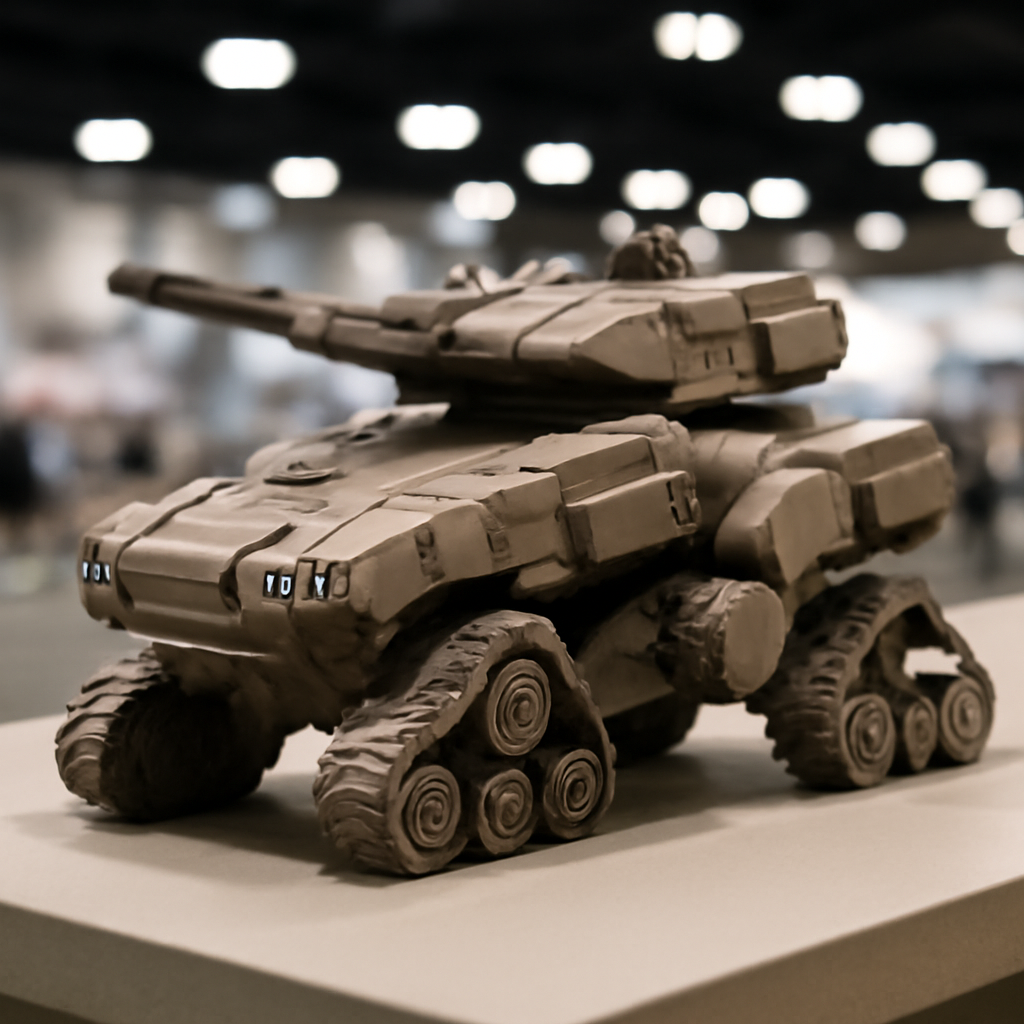
"Because we have a reduced crew from the Bradley [which has a commander and gunner in turret] there has to be greater efficiency in how those soldiers execute their tasks," Geoffrey Norman, General Dynamics Land Systems' director for U.S. Strategy & Growth, told TWZ. That practical constraint is visible in the first official images and model of GDLS's Wolf, the company's bid to replace the U.S. Army's Bradley Fighting Vehicle as the XM30 Mechanized Infantry Combat Vehicle (MICV).
GDLS shows a one-eighth-scale Wolf model at AUSA
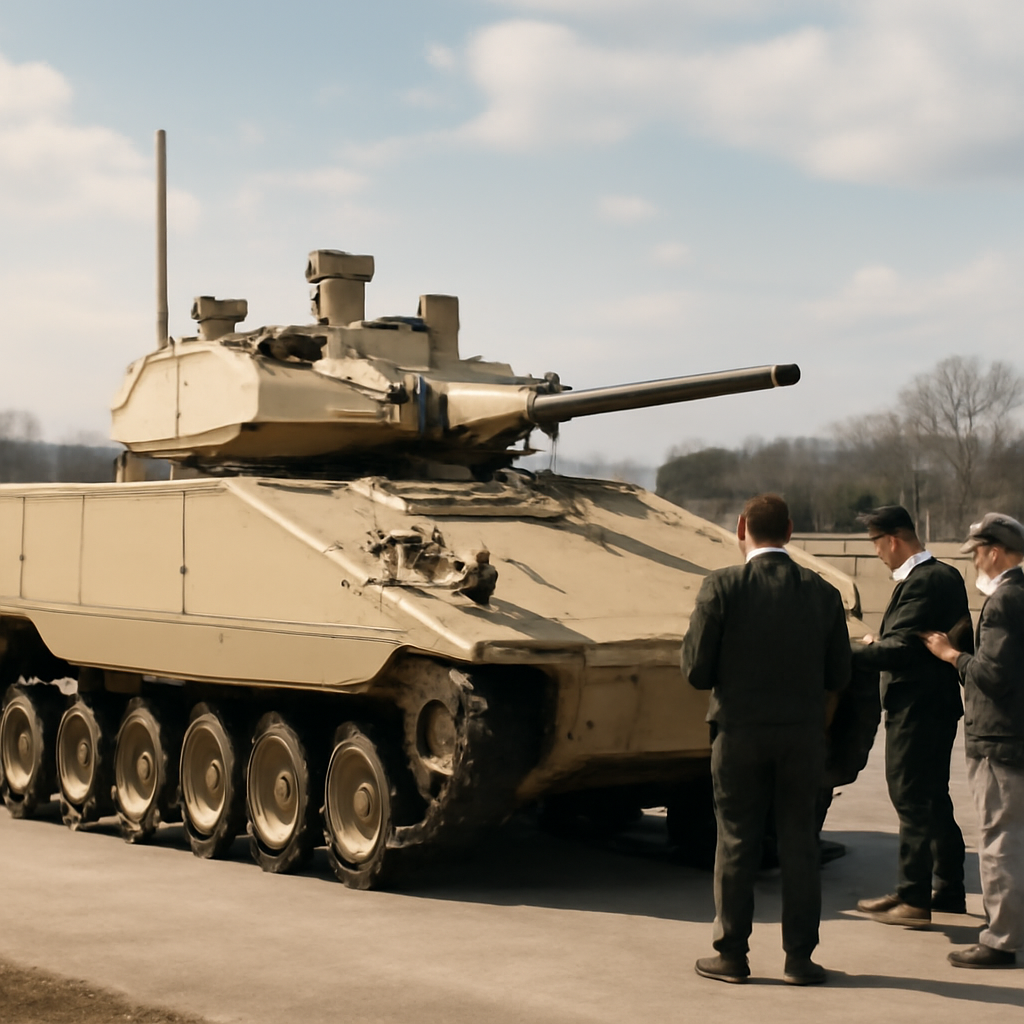
GDLS presented a one-eighth-scale model of Wolf at the Association of the U.S. Army's main annual convention. The scale model, produced by KiwiMill and displayed at AUSA, offers the first public, detailed look at GDLS's proposal. GDLS has already delivered an actual Wolf prototype to the Army; TWZ photographed it under wraps after delivery to Aberdeen Proving Ground around the end of August 2026.
Turret, sensors, and a departures from Griffin III
Wolf is described as a further evolution of GDLS's Griffin III demonstrator, itself derived from the ASCOD 2 family. The model shows substantive changes to the turret and sensor layout compared with Griffin III: a broader, flatter, more streamlined turret sized for a remotely-operated weapon station; a single sensor turret on top; and a forward-looking sensor suite positioned to the left of the main 50mm cannon. The model also appears to include extra apertures along the turret and additional smoke-grenade launchers around the turret's front edges compared with Griffin III.

Audit-ready is a season. It shouldn't be.
Evidence in spreadsheets, controls drifting between audits, frameworks multiplying on flat headcount. Nubivance runs continuous compliance on Rapid7 Cyber GRC - SOC 2, HIPAA, ISO 27001, PCI, CMMC.
End the scrambleCrew arrangement, internal layout, and hull changes
The Wolf model depicts a reworked hull that eliminates a traditional driver's hatch ahead of the turret ring. Instead, the vehicle places the commander (who also acts as the gunner) and the driver side-by-side deeper within the hull, and shows a rear compartment configured to carry up to six passengers. For comparison, the Bradley has a crew of three and the ability to carry six passengers, a direct point of reference the source highlights. The hull on the model also features side skirts and a different style of tracks than Griffin III, and outward-facing sensors toward the front sides of the hull, consistent with a distributed camera system intended to provide riders a 360-degree external view.
Loitering munitions, hybrid-electric propulsion, and on-board power
Next-generation fire control, sensors and networking, plus improved active and passive defenses, are explicit requirements for the XM30 program. Both GDLS's Wolf and American Rheinmetall's Lynx-based design include built-in launchers for loitering munitions; GDLS has chosen to integrate AeroVironment's Switchblade 300 more specifically, though the one-eighth-scale model does not explicitly show the Switchblade integration. Both designs also feature hybrid-electric propulsion, which the reporting ties to benefits in fuel economy and electrical power generation relative to the diesel-engined Bradley. Norman emphasized that "the emphasis from the Army has really been about having margin on the vehicle for future [system] requirements – directed energy, counter-UAS systems, or fill-in-the-blank," underlining that electrical capacity is being treated as a growth factor for new capabilities.
Testing at Aberdeen and soldier touchpoints at Fort Hood
GDLS and American Rheinmetall have each delivered prototypes to the Army and conducted initial testing at Aberdeen Proving Ground in Maryland. Soldier touchpoints and field evaluations are set to occur at Fort Hood in Texas between February and March of next year. The competition for the XM30 will therefore move from prototype demonstrations to hands-on soldier evaluations in the months ahead, with both Wolf and a Lynx-derived U.S. design competing head-to-head.
What this means for soldiers, procurement leaders, and test teams
- Soldiers: The Wolf's reduced crew size, relocated driver position, and distributed camera suite imply changes to how vehicle crews will work and perceive the battlefield; the company says interface design and menu logic are intended to be "very intuitive."
- Procurement leaders: Hybrid-electric propulsion, built-in loitering-munition launchers (AeroVironment's Switchblade 300 is named), and increased electrical margin are tangible trade-offs procurement officials will weigh as they compare the two prototypes' ability to host future capabilities.
- Test teams: Aberdeen's initial testing and the scheduled Fort Hood soldier touchpoints between February and March will be the immediate checkpoints to assess how the design changes—no driver's hatch, remote turret, sensor distribution—affect mobility, survivability, and human-machine interaction under realistic conditions.
The Wolf's public debut on a one-eighth-scale model and the delivery of a wrapped prototype to Aberdeen mark a clear step in the XM30 competition. The coming months of soldier touchpoints and Fort Hood evaluations will be decisive in translating the model's design choices—remote turret, 50mm main gun placement, loitering-munition integration, hybrid-electric architecture—into operational judgments about whether Wolf or the Lynx-based entry better meets the Army's requirements.