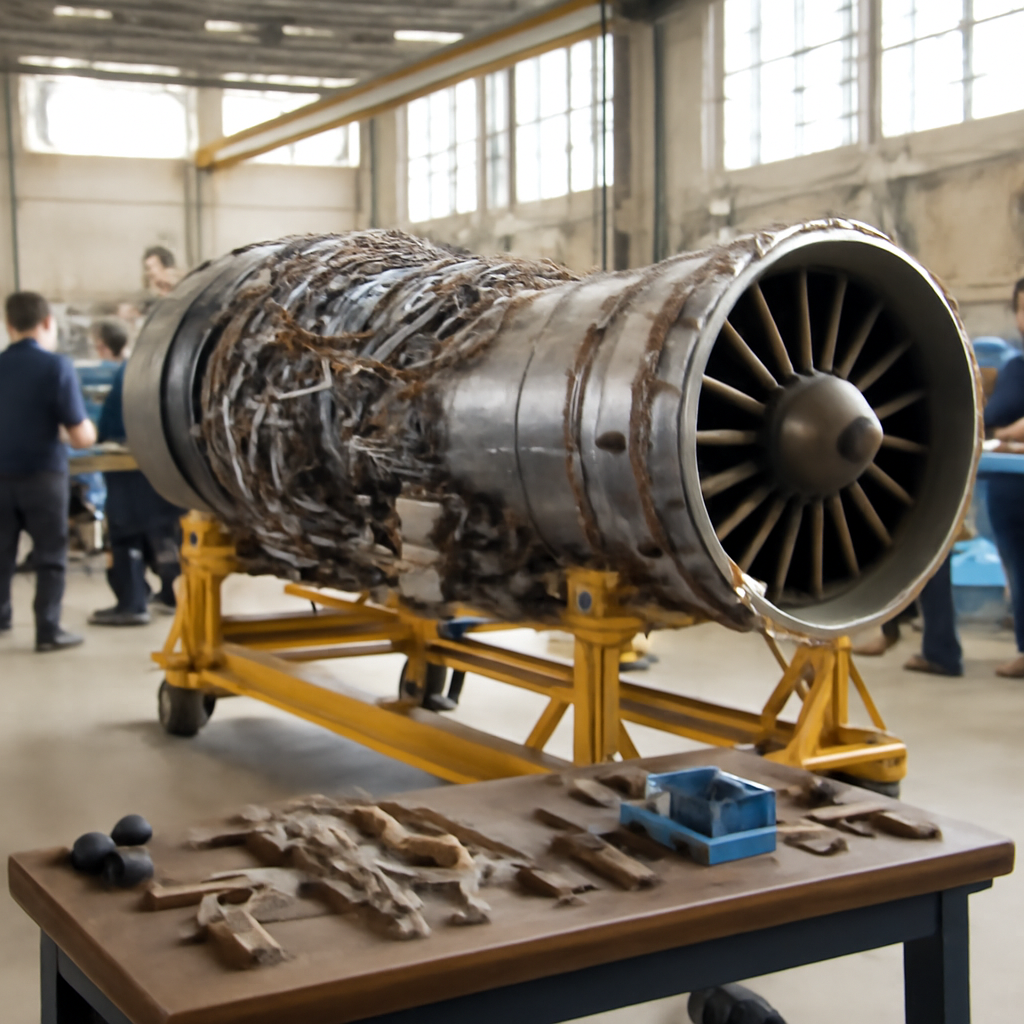
“Right now we’re in the middle of a transformation, where we used to be 414 heavy. Now, we’re going to be 404 heavy.”
Pentagon awards GE Aerospace up to nearly $2.9 billion for F414 engine parts
The Department of Defense awarded GE Aerospace a performance-based logistics contract worth up to nearly $2.9 billion to provide parts for the F414 engine, the powerplant for the Navy’s F/A-18 Super Hornet and EA-18G Growler, according to a Defense Department announcement posted Tuesday. The contract runs through August 2031 and contains no option periods. GE did not respond by press time when asked to comment on the award.
Performance-based logistics: outcome-focused, bounded timeline
The award was issued as a performance-based logistics contract, a structure that pays vendors based on outcomes rather than unit deliveries, and it has a defined end date of August 2031 without option extensions. The Defense Department notice framed the arrangement around lifecycle support and part supply for the F414 fleet through that fixed term.

The cyber insurance questionnaire just landed. Now what?
SOC 2, HIPAA, insurance renewals - someone has to own security strategy. Nubivance provides fractional CISO leadership without the full-time salary.
Get a security leadGE’s production shift from F414 toward F404 and modernization efforts
At GE’s Lynn, Massachusetts manufacturing facilities, executives described an active, company-wide rebalancing of production capacity. During a media tour, Ryan Wood, GE’s executive plant manager for assembly and test operations, said the company is moving from being “414 heavy” to “404 heavy,” expecting to “essentially double” F404 production over roughly the next five years. Company officials declined to share exact production rates, describing the figures as forecasts tied to anticipated demand.
Amy Gowder, president and CEO of GE’s defense and systems business unit, said the firm is “trying to move to a different supply base that maybe has different commercial-off-the-shelf type standards that have operated this volume.” Paul Ferraro, GE’s vice president and general manager of defense engines and services, said the firm is pursuing additive manufacturing to produce crucial components “relatively rapidly and more cheaply,” and that GE is “going back through legacy engines” such as the F404 to identify candidate parts for 3D printing. Ferraro also acknowledged persistent supply-chain challenges: “How do we ramp to rate? How do we respond to this increase in demand? It’s been challenging, to be honest with you.”
DIU selects GE for HyCAT hypersonic test vehicle and a 24‑month flight-testing phase
Earlier the same week, the Pentagon’s Defense Innovation Unit chose GE to provide a liquid-fueled hypersonic test vehicle under the HyCAT (Hypersonic and High-Cadence Airborne Testing Capabilities) program. A GE spokesperson told Breaking Defense the next phase under the DIU contract is approximately 24 months and includes flight testing. DIU did not respond to a request for comment.
Steve “Doogie” Russell, vice president and general manager of GE’s Edison Works unit, called the DIU award a “significant milestone.” Russell said GE will act as prime contractor to integrate an all-up-round hypersonic vehicle and supply technologies including a dual-mode ramjet, a propulsion system that operates in both subsonic and supersonic regimes. GE’s Dean Modroukas, general manager of hypersonics, said the HyCAT vehicle will be boosted by a solid rocket motor and that GE has “a group of teammates” supplying elements of the vehicle, though the company is not yet naming them.
Russell emphasized GE’s stated role as a propulsion and integration provider rather than a weapons house for hypersonics: supplying a hypersonic weapon “is not currently our vision,” he said.
What this means for the Navy, GE Aerospace, and the Defense Innovation Unit
- The Navy: The contract secures a supplier commitment for F414 parts through August 2031, supporting sustainment of Super Hornet and Growler fleets while GE adjusts its production posture.
- GE Aerospace: The company faces the parallel tasks of scaling F404 output—“essentially doubl[ing]” production over about five years—and integrating new manufacturing approaches such as additive manufacturing to lower cost and speed up parts production.
- The Defense Innovation Unit (DIU): DIU’s HyCAT selection advances its goal to expand flight-test options for high-speed vehicles; the next phase is expected to last about 24 months and include flight testing with GE as prime integrator.
Taken together, these moves place GE at the intersection of sustainment for a current tactical fleet and experimental work on tomorrow’s high-speed systems. The company has signaled a clear operational pivot—more F404 production, selective use of additive manufacturing, and an integrator role for hypersonic flight testing—while the Pentagon has locked in a multi-year parts-support contract and a separate test-vehicle effort.
Key near-term milestones to watch, all named in GE’s briefings and government notices, include GE’s implementation of new supply-base arrangements for higher-volume F404 production, the company’s identification of candidate parts for additive manufacturing on legacy engines, and the roughly 24-month DIU flight-test phase for the HyCAT vehicle. Whether GE’s internal transformations and partner choices can sustain both large-scale production and rapid test-vehicle integration will determine how effectively those milestones are met before the F414 parts contract reaches August 2031.