“I want to be clear: there’s no shenanigans going on here,” Mike Lawler said at a news conference Tuesday as election officials in Westchester County worked to sort ballots after early scanner malfunctions.
What happened in Westchester County
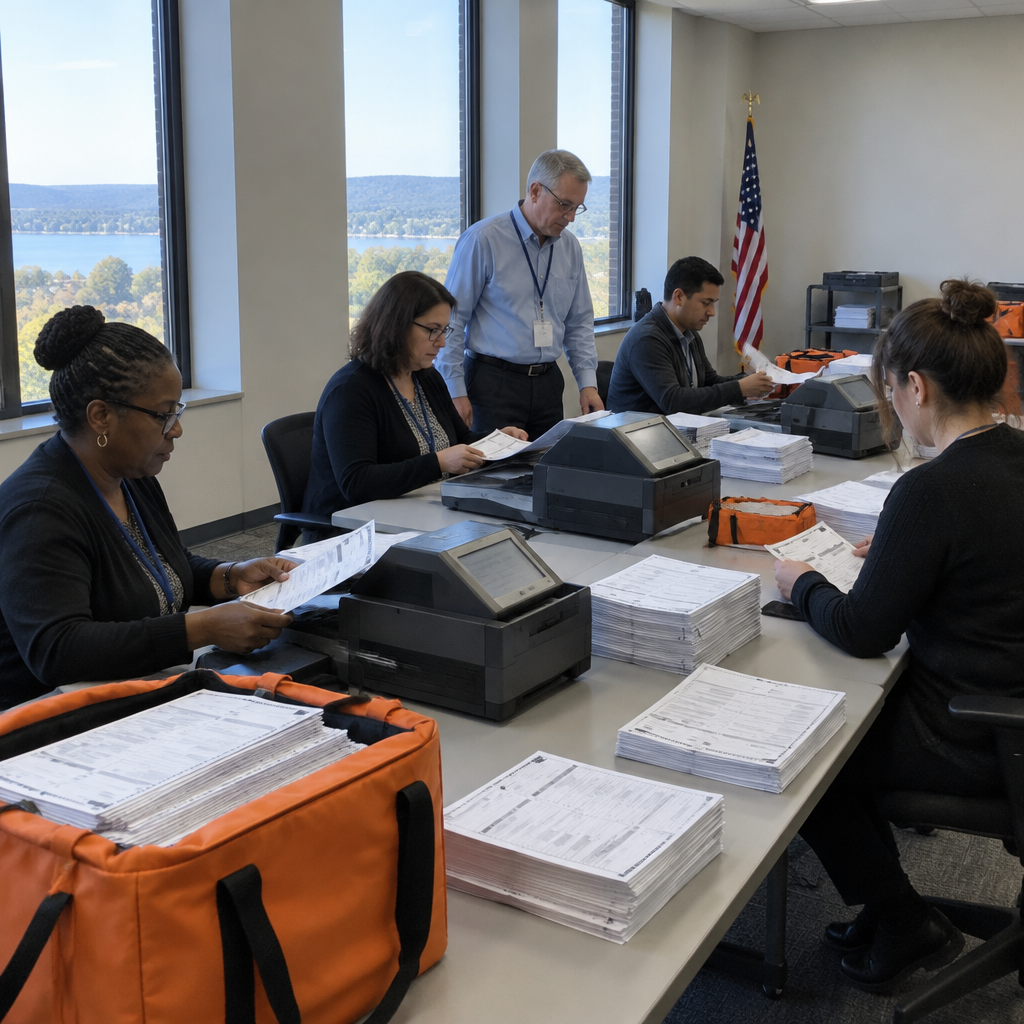
Election officials in Westchester County, New York reported that ballot scanners were rejecting some paper ballots because the affected ballots were too thick for the machines to accept. The Westchester County Board of Elections said voters with those ballots were instructed to place them in designated orange emergency ballot bags. The board said the bags will be secured, monitored and counted by officials in compliance with election laws, and that the office was “in constant communication with New York State officials, Westchester County Government and poll workers to address this issue and ensure that voting continues with as little disruption as possible.”
The county’s problems emerged on the final day of voting and touched races in which many Westchester ballots will be cast, including the NY-17 congressional contest between Republican incumbent Mike Lawler and Democratic nominee Cait Conley. Conley is identified in public reporting as having previously served as the election security lead for the Cybersecurity and Infrastructure Security Agency under the Biden administration.
How election officials described handling and chain-of-custody
County officials and at least one candidate emphasized steps intended to preserve ballot integrity: affected ballots were to be bagged, not opened at the polling place, and — according to Lawler — transported by police escorts to a central board of elections location for processing. The board told voters to continue completing paper ballots as instructed by poll workers while county and state officials worked on a solution.
New York Attorney General Letitia James posted on X that her office was monitoring the situation and “is in touch with the state and local Boards of Elections as they work on a solution.” She added, “Westchester voters can still safely fill out and turn in their ballots at their polling locations. Your votes will count.”

The cyber insurance questionnaire just landed. Now what?
SOC 2, HIPAA, insurance renewals - someone has to own security strategy. Nubivance provides fractional CISO leadership without the full-time salary.
Get a security leadOnline amplification and disinformation dynamics
Scholars and observers of online election rumors flagged immediate amplification of the scanner reports. Kate Starbird, a University of Washington professor who researches online rumors and disinformation tied to elections, said posts on X about the scanner malfunctions surged to as many as 100 a minute in the hours after the initial reporting. Established election-denying outlets, including The Gateway Pundit, were cited as amplifying conspiracist framings, according to Starbird and the reporting.
The coverage noted that equipment failures and breakdowns are not uncommon and typically affect a small number of precincts each election cycle, and that there was no evidence of foul play in these Westchester incidents — even as rapid online spread of alarmist claims raced ahead of official explanations.
Federal legal and enforcement moves on noncitizen voting
On the same day, the Department of Justice issued a news release announcing charges against 63 individuals for allegedly voting as noncitizens in a past election. The reporting said many of those charged are lawful permanent residents who have lived in the U.S. for decades and some later became naturalized citizens with legal voting rights. The DOJ also announced plans to deploy 1,000 election monitors to precincts across all 50 states.
These developments came amid a flurry of last-minute actions by the Trump administration seeking to highlight alleged widespread noncitizen voting. The administration filed lawsuits in recent days against states including California and Alaska that sought to influence how ballots are treated and counted in upcoming Senate races; federal courts, including the U.S. Supreme Court, threw those suits out and reiterated that the executive branch has no constitutional or legal role in the administration of state-run elections. A separate federal court ordered the DOJ and the Department of Homeland Security to stop sending lists of “potential noncitizen” voters to states after administration lawyers acknowledged in court that the data used had a “high” error rate.
How Westchester voters, local election officials, and the Department of Justice are affected
- Westchester voters: Those whose ballots were rejected by scanners were given clear, documented instructions — complete the paper ballot and place it in an orange emergency ballot bag for secure handling and later counting, with officials and the attorney general’s office publicly assuring that votes will count.
- Local election officials: County and state boards are managing technical problems on site while trying to maintain visible chain-of-custody procedures and calm voters amid fast-moving online narratives that amplify suspicion.
- Department of Justice and courts: DOJ’s criminal charges and decision to deploy 1,000 monitors reflect an aggressive enforcement posture even as federal courts have pushed back on administrative efforts to influence state election processes and ordered stops to problematic data-sharing practices.
The Westchester episode illustrates a narrow, routine equipment failure colliding with an accelerated legal and communications environment: local procedures for preserving ballots are in place, while last-minute federal actions and rapid online amplification are reshaping perceptions on the final day of voting. Officials will need to show not only that ballots are secured and counted, but that the procedures are followed and clearly communicated to a public watching both court filings and social feeds in real time.