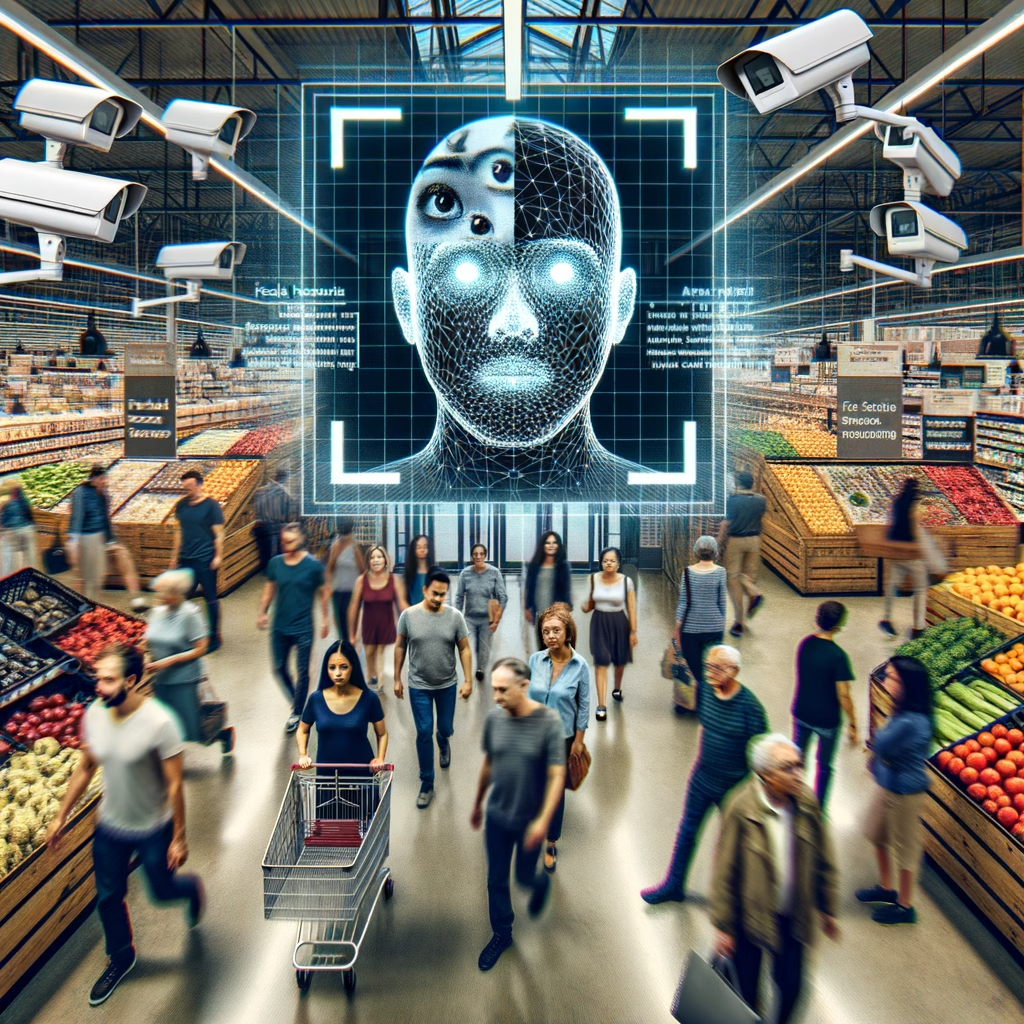
What would you do if a routine trip to buy milk became a moment in a digital ledger — your face converted into data, stored, compared and perhaps shared without your clear consent? That is the dilemma now facing customers of the New York City Wegmans: evidence suggests the store is collecting biometric information about patrons, raising urgent questions about privacy, accuracy and oversight.
Facial-recognition technology, long the province of law enforcement and tech firms, has moved steadily into commercial spaces. Independent experts warn that live facial-recognition systems are technically fallible, vary dramatically by lighting and angle, and have higher error rates for certain demographic groups — producing false positives and false negatives that can have real-world consequences for people misidentified or overlooked .
Security researcher and privacy advocates have emphasized that technical fixes alone are insufficient. Dr. Michael Veale and others argue that accuracy improvements must be paired with legal oversight and participatory governance; without those, even well-performing systems can perpetuate harms through flawed policies, vendor choices and opaque data handling .
The current situation, as reported, centers on Wegmans’ New York City operation collecting biometric data from customers. Whether the system is being used for theft-prevention, loyalty-personalization, or other operational reasons, the shift is notable because it moves biometric scanning from a background possibility to an everyday retail reality. The details of retention, access, and third-party sharing are the critical unknowns — and those are precisely the vectors that concern technologists and civil-liberties groups alike.
Why this matters: there are three intertwined stakes at play — technical reliability, governance and social trust. On the technical side, errors in facial-recognition systems can lead to wrongful suspicion and unequal treatment; studies consistently show variability in performance across different lighting, camera angles and demographic groups, meaning some customers are more likely to be misidentified than others .
On governance, the lack of binding rules around biometric data creates risk. Without clear retention limits, auditing, and restrictions on secondary uses, images and derived biometric templates can persist and be repurposed — turning a short-term security measure into a long-lasting registry of people’s movements. Experts recommend statutory authorisation, mandatory public notice, independent audits, strict data controls and accessible redress mechanisms to prevent mission creep and protect civil liberties .
From the perspective of different stakeholders:
- Technologists point out that even state‑of‑the‑art systems are not infallible. False matches are not merely inconvenient; they can have legal and social consequences for individuals, and systems can be vulnerable to spoofing or dataset manipulation .
- Policymakers face a choice: permit opportunistic adoption of biometric tools with limited oversight, or set clear legal standards that define permissible use-cases, retention schedules and independent oversight mechanisms .
- Consumers must weigh convenience against privacy. Some shoppers may accept biometric checks if they believe it reduces crime or speeds service; others will resist being identified and tracked without explicit, informed consent.
- Potential adversaries — from data brokers to bad actors — view biometric datasets as high-value targets. Weak vendor vetting, insecure storage, or permissive sharing agreements increase the risk that sensitive biometric data could be exfiltrated or repurposed .
Practical safeguards could include transparent signage and clear notice to customers, independent audits of accuracy and bias before and during deployment, tightly limited retention windows, strict contractual controls on vendors, and simple redress mechanisms for those who believe they were misidentified. These measures are not purely technical: they require policy, oversight and public deliberation to be effective .
Balanced reporting requires acknowledging potential benefits: retailers argue biometric tools can deter shoplifting, speed checkout, and personalize service. But benefits must be measured against harms. When biometric identification becomes routine — especially without robust rules — society risks normalizing pervasive surveillance whose long-term social costs are poorly understood.
Wegmans’ move — whether limited, experimental or scaled — is a marker of a broader trend: biometric systems are migrating into everyday commercial life before many jurisdictions have settled the legal and ethical frameworks needed to regulate them. The central question remains: will we accept a future where routine errands generate permanent biometric traces, or will we insist that convenience does not trump fundamental expectations of privacy and fairness?
Source: https://www.schneier.com/blog/archives/2026/01/the-wegmans-supermarket-chain-is-probably-using-facial-recognition.html