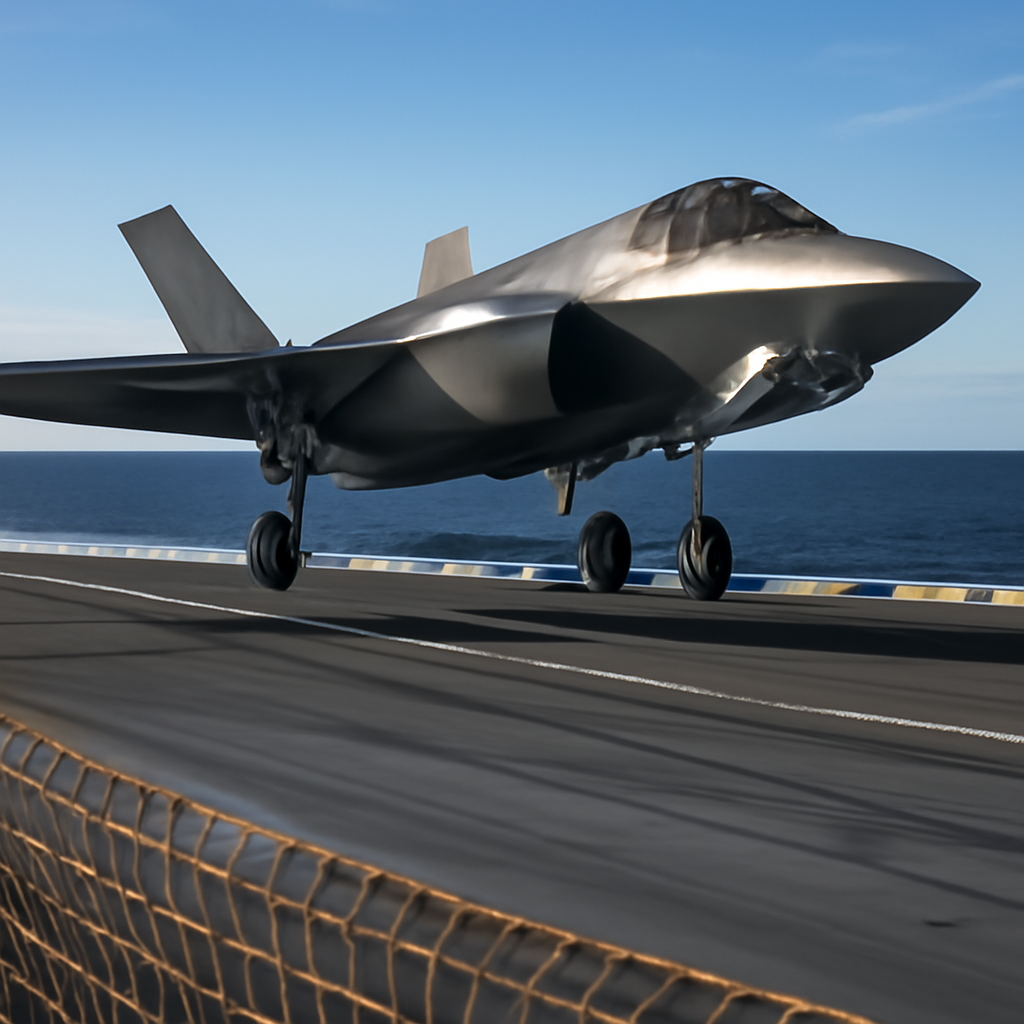
On Oct. 13, 2026, a U.S. Navy F-35C executed the first arrested landing of its type aboard a Ford‑class carrier — the future USS John F. Kennedy (CVN 79) — a milestone reached during at‑sea Aircraft Compatibility Testing in the Western Atlantic.
Arrested landing aboard PCU John F. Kennedy (CVN 79)
Two F-35C test pilots assigned to Air Test and Evaluation Squadron 23 (VX-23), part of the Naval Air Warfare Center Aircraft Division (NAWCAD), flew to the carrier as part of an ongoing Aircraft Compatibility Testing (ACT) campaign. Imagery released by the Navy shows two F-35Cs overhead the ship on Oct. 13, 2026; one aircraft is depicted carrying three inert 500‑pound JDAM-series weapons externally, while the other — a specially instrumented example operated by the Patuxent River‑based F-35 Integrated Test Force (ITF) detached to the ship — made the arrested landing and caught the wire on the Kennedy’s flight deck.
Aircraft Compatibility Testing: instrumentation and immediate limits
ACT is the formal process the Navy uses to evaluate how a ship’s launch and recovery equipment interacts with individual aircraft and to collect data needed to validate system performance. The use of a specially instrumented F-35C allows test teams to record flight‑deck and systems data with precision; telemetry markings on the airframe act as visual references during capture of spatial data. The Navy cautioned that the first arrested landing is an important compatibility milestone but does not mean all testing, certification, or operational qualification requirements are complete.

The cyber insurance questionnaire just landed. Now what?
SOC 2, HIPAA, insurance renewals - someone has to own security strategy. Nubivance provides fractional CISO leadership without the full-time salary.
Get a security leadEMALS and AAG: the Ford class integration challenge
The Ford‑class carriers employ electromagnetic catapults (EMALS) and Advanced Arresting Gear (AAG), replacing steam‑powered launch systems and conventional arresting machinery used on the Nimitz class. Development and reliability challenges with both EMALS and AAG have been a recurring issue for the class, contributing to delays in program progress. The Kennedy’s milestone advances validation of F-35C operations on Ford‑class equipment, but the Navy still needs to demonstrate an EMALS takeoff for the F-35C before this testing begins to translate into an operational carrier air‑wing capability.
Maintenance spaces, networks, and jet blast deflectors on John F. Kennedy
Integrating the F-35C aboard Kennedy extends beyond launch and recovery. The Navy identified a set of shipboard modifications that are required: specialized maintenance spaces for the aircraft’s sensitive mission systems and classified data; computer networks and interfaces to link the F-35C’s maintenance and logistics systems with the Navy’s infrastructure; facilities and equipment to support upkeep of low‑observable coatings and materials; and more robust jet blast deflectors (JBDs) to withstand the F-35C’s engine exhaust. Earlier integration work on Nimitz‑class carriers included JBD upgrades for heat resistance and cooling; John F. Kennedy was built with explicit plans for JBD upgrades and changes to maintenance and information systems incorporated during construction under a single‑phase delivery approach.
What this means for the U.S. Navy, VX-23, and China’s Fujian program
- For the U.S. Navy: the arrested landing confirms the Kennedy has reached an important F-35C compatibility milestone and allows the ship and crew to continue at‑sea testing while the shipbuilder completes final systems work. The Navy took preliminary acceptance of the carrier from Newport News Shipbuilding on Sept. 29, 2026, following acceptance trials in August, and formal delivery remains scheduled for spring 2027.
- For VX-23 and the F-35 ITF: successful arrested recoveries and instrumented data collection will inform what further shipboard modifications or software, hardware, and procedures adjustments are required to certify carrier operations and supportability for the F-35C.
- For observers of carrier aviation development: the Kennedy milestone arrives alongside public demonstrations by other navies. The source notes China’s Fujian carrier has demonstrated electromagnetic catapult launches and arrested recoveries involving several aircraft types, including the J-35, underscoring the technical demands inherent in integrating modern aircraft with advanced carrier launch and recovery systems.
The arrested landing aboard John F. Kennedy is a tangible, photographed step forward — but it is explicitly a step, not a finish line. The Navy must still complete the ACT campaign, demonstrate EMALS launches for the F-35C, and validate maintenance, information‑system, and flight‑deck protections before the fighter will be fully integrated into Ford‑class carrier air wings. How quickly those remaining items are closed out will determine when the milestone moves from a test achievement to routine operational capability.