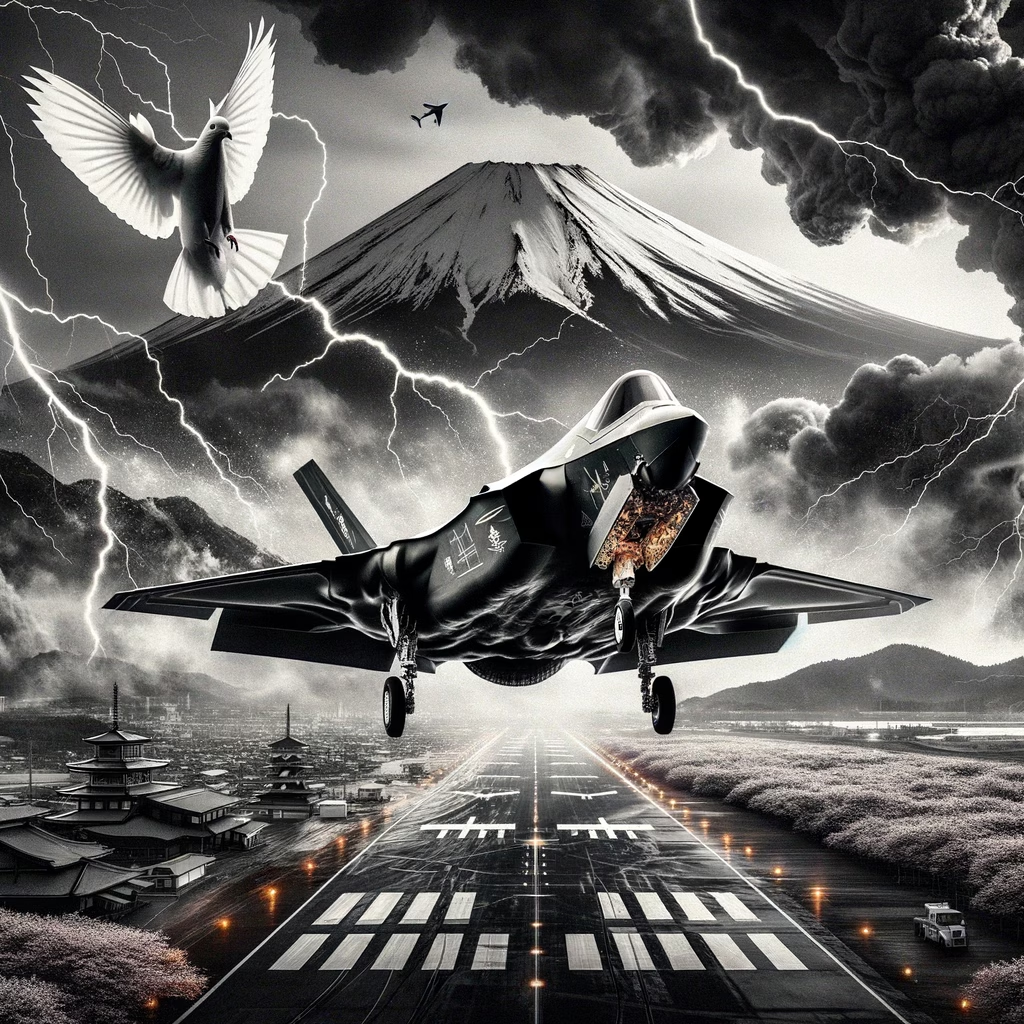
F-35B Lightning II: Emergency landing in Kagoshima raises technical and strategic questions
“Was it a technical hiccup or a warning light about broader reliability?” That question framed immediate reactions after a British Royal Air Force F-35B Lightning II made an unscheduled descent to Kagoshima Airport in southern Japan. The pilot reported a potential technical issue and executed an emergency landing shortly after 11:30 a.m. Local officials confirmed there were no injuries and that normal airport operations resumed, but the incident has prompted a raft of operational, diplomatic, and technical questions that extend well beyond the runway.
The F-35B Lightning II is the short-takeoff/vertical-landing (STOVL) variant of the fifth-generation Joint Strike Fighter family, prized for its ability to operate from carriers, amphibious ships, and austere airstrips. That operational flexibility is central to British expeditionary strike concepts and carrier aviation, but it brings complex engineering and logistics demands. When one of these advanced jets makes an emergency landing, observers from allies and competitors pay close attention.
Immediate facts and safety outcome
Airport officials reported the pilot declared a potential technical problem and carried out an emergency landing without injuries to the crew or anyone on the ground. Initial reporting surfaced through Defence Blog and local authorities. At this stage, details beyond the safe recovery are sparse: no official technical findings have been released, and both UK and Japanese authorities are likely coordinating inquiries.
Technical follow-up and forensic steps
A standard response to such incidents will include a comprehensive inspection of the airframe, engine, hydraulics, avionics, and software logs. For the F-35B Lightning II, that analysis often requires specialized maintenance crews with secure access to proprietary systems and telemetry data. Investigators will look for mechanical reasons (engine or hydraulic failures), electronic or software faults, human factors, and external influences such as bird strikes or foreign object ingestion.
Because the F-35’s systems are highly integrated—blending sensors, avionics, and mission software—failure modes can be complex and multifactorial. Determining whether the issue was isolated to a single aircraft or indicative of a recurring fault across the fleet is critical. If software anomalies are involved, fixes could range from patching code to updating avionics modules. Mechanical fixes may require parts swaps or even shipment of specialized components from the UK or the aircraft manufacturer.
Operational impact and logistics
An extended maintenance period for a forward-deployed F-35B could reduce sortie generation or force asset rotation. For units operating in remote or host-nation environments, availability of parts, technical documentation, and qualified personnel becomes a logistical challenge. Backlogs in maintenance can ripple through deployment schedules, training cycles, and mission readiness—especially for highly networked aircraft where a grounded jet may also limit squadron-level capabilities that depend on integrated sensor data and mission planning.
Strategic signaling and alliance dynamics
Incidents involving Western high-end platforms in the Indo-Pacific carry diplomatic weight. Partners and potential adversaries monitor such events for indications of capability and reliability. For allied publics, British defense officials will want to reassure that risks are managed and that safety and operational standards are upheld. Japanese authorities will emphasize civilian safety and airspace procedures. The episode sits against a backdrop of increased Western military presence in the region, where interoperability, logistics, and host-nation coordination are continuously tested.
Maintainers, pilots, and the human element
Beyond telemetry and hardware, the human side matters. Pilot decision-making, crew resource management, and maintenance practices all feed into the investigative timeline. The safe landing without injury highlights the training and professionalism of the pilot and support personnel. But it also raises questions for maintainers about spare parts availability, the adequacy of technical documentation, and the pressures of operational tempo that can stress sustainment systems.
Public transparency and adversary interpretation
Accidents and precautionary landings occur across air forces; the key issue is how transparently and quickly an investigation proceeds. Observers in foreign capitals will note the incident but should avoid premature conclusions. The real test will be whether any identified problem is isolated and remedied rapidly or whether it points to broader systemic vulnerabilities.
What comes next
Expect a coordinated inquiry involving the RAF, the UK Ministry of Defence, and relevant Japanese authorities to collect flight data, maintenance records, and pilot reports. Until those analyses are complete, analysts should resist speculation while pressing for clarity about safety implications and operational impacts. For the public and allied partners, timely, factual updates will help maintain confidence.
Conclusion: F-35B Lightning II incidents as risk probes and lessons
The emergency landing of the F-35B Lightning II in Kagoshima—resolved without injury—serves as both a reminder of aviation risk and a test of the processes that keep advanced fleets safe and ready. In a region of rising strategic competition, each technical incident feeds into broader narratives about readiness, transparency, and alliance confidence. How thoroughly investigators probe this event, and how quickly any fixes are implemented and communicated, will determine whether this remains a contained event or becomes a catalyst for wider scrutiny and corrective action.