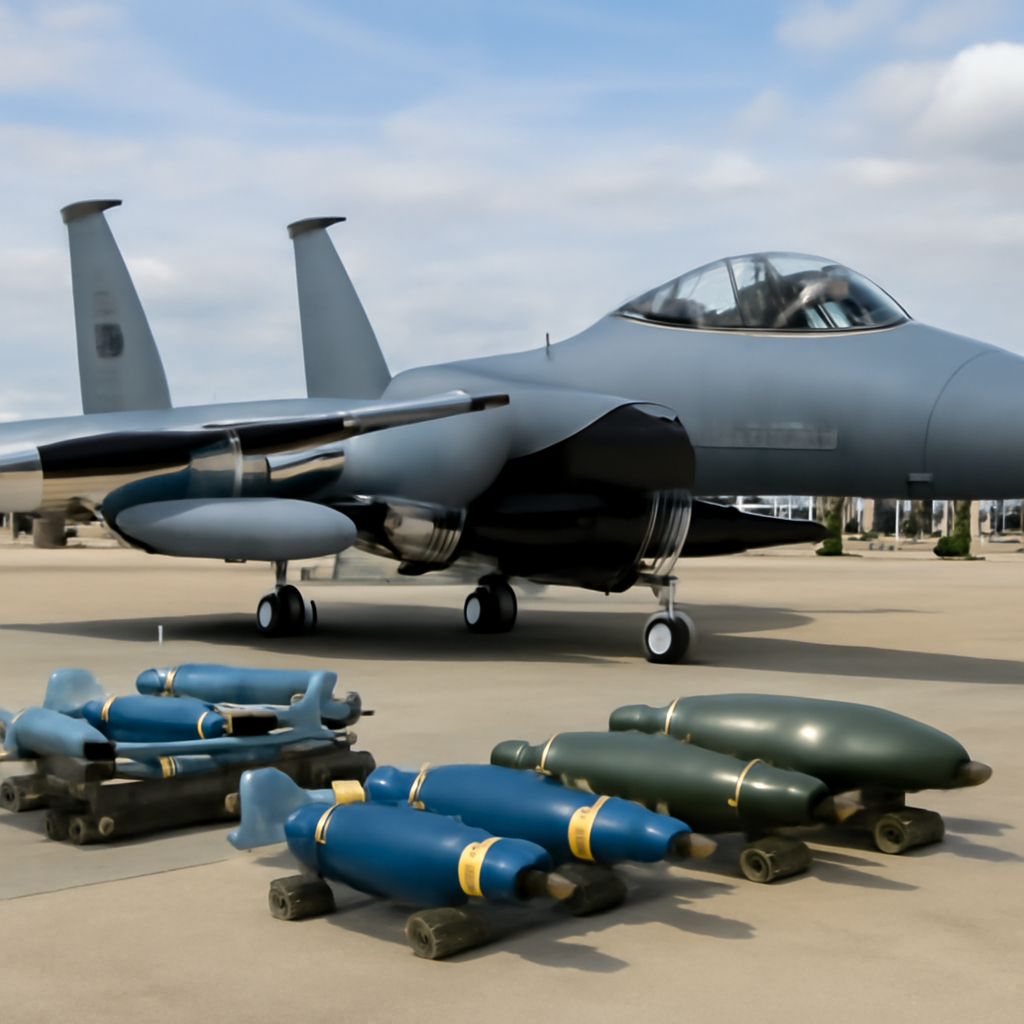
"The crew dropped a total of 24 BDU-50s and 12 BDU-56s over 10 missions with zero safety incidences and satisfactory scores," according to an official release.
142nd Wing’s Mountain Home training: a concrete first step
The Oregon Air National Guard’s 142nd Wing, based in Portland, announced that one of its F-15EX Eagle IIs conducted its first-ever drops of inert training bombs during a May deployment to Mountain Home Air Force Base in Idaho. The release specifies the use of BDU-50/B and BDU-56/B inert bombs — training shapes that match the weight and form of 500‑ and 2,000‑pound Mk 82‑ and Mk 84‑class weapons — and notes the sorties occurred over 10 missions with no safety incidents.
Those basic bombing skills included both airborne release and ground handling: weapons loaders from the wing traveled to Nellis Air Force Base earlier in the year to work with F-15E models from the 59th Test and Evaluation Squadron to become certified on loading bombs. Three 142nd pilots completed a nine‑month course to develop a training curriculum for the rest of the wing, the release said, reflecting that the 142nd previously flew F-15C Eagles with no operational air‑to‑ground mission set.
85th Test and Evaluation Squadron at Kadena: live SDB II practice
The Air Force’s test community has taken F-15EX air‑to‑ground work overseas. Photographs released on July 8, 2026 show the 85th Test and Evaluation Squadron from Eglin Air Force Base operating at Kadena Air Base, Japan, where ground crews practiced loading live GBU‑53/B Small Diameter Bomb II (SDB II, “StormBreaker”) munitions onto an F-15EX. An F-15E Strike Eagle also participated in the munitions load training event.
Two active‑duty F-15EX squadrons are slated to stand up at Kadena, replacing units there that had flown F-15Cs; in the meantime, the Air Force has rotated F-15Es and other fighters to fill that gap, the reporting notes.

This site is the portfolio.
OSINTSights runs on Cloudflare Workers, D1, R2, and Vectorize, with an AI pipeline on Hetzner ARM. Nubivance designed, built, and operates it. We do the same for clients.
See what we buildDesign lineage, payload capacity, and stated mission intent
The Eagle II is part of the extended F-15E Strike Eagle family, derived from the F-15QA. The F-15EX can carry large and outsized payloads over distance and accommodate a mix of air‑to‑air and air‑to‑ground munitions — attributes stressed in the reporting as underpinning its growth potential beyond a homeland air‑defense focus. The Air Force’s 2027 Fiscal Year budget request reiterated that "the F-15EX aircraft will be used predominantly in defensive and offensive counter‑air missions at both Air National Guard (ANG) and Air Combat Command (ACC) operational squadrons," and also noted that the "F-15EX will perform the Homeland Defense mission and provide Combatant Commanders (CCDR) with strike packages capable of operating in Highly Contested Environments (HCE)."
The article links that potential multi‑role use to operational pressure on the aging F-15E fleet, including the reported total loss of four F-15Es this year during operations against Iran, and to congressional decisions: in 2024 Congress blocked an Air Force attempt to divest roughly half of its Strike Eagles.
Conformal fuel tanks, two‑seat potential, and growth limits
The F-15EX is a two‑seater, unlike the single‑seat F-15C it is replacing in some roles, but the Air Force initially planned for single‑pilot operations in the Eagle II. The platform can accept the same conformal fuel tanks (CFTs) used on the F-15E; CFTs add fuel and top‑side hardpoints for ordnance. Now‑retired Col. Michael Kosderka, then commander of the 142nd, told TWZ in 2024 the X "has tremendous growth capability" and that CFTs would enable broader air‑to‑ground capabilities and the potential to "put WSOs or other experts in the backseat." Lt. Col. Robert Waller, then commander of the 40th Flight Test Squadron, said in 2024 the F-15EX would have "an inherent capability that we need to put to work from day one, to include limited air‑to‑ground capability."
The public record here notes uncertainty: the initial jets delivered to the 142nd arrived without CFTs and photographs of the Mountain Home jet show it without CFTs; test aircraft, by contrast, have been seen in the default configuration with CFTs fitted.
What this means for the 142nd Wing, the Test & Evaluation community, and Congress/procurement leaders
- 142nd Wing (Air National Guard): The wing is building air‑to‑ground basics — pilot curricula and weapons‑loading certifications — to expand its mission set after transitioning from F-15C operations to the two‑seat F-15EX.
- Air Force Test & Evaluation community (85th, 59th, 40th squadrons): Test units are operationalizing munitions loading and live‑weapons handling overseas and at home, validating multi‑role employment and training ground crews on SDB II and inert bomb handling.
- Congress and procurement leaders: Budget requests envision sizeable fleet growth — potentially a dozen squadrons or more — while past congressional action has constrained divestment of older Strike Eagles; procurement and force‑structure choices will shape whether F-15EX buys relieve strain on the F-15E fleet or expand multi‑role missions.
The record is clear that air‑to‑ground skills are already being introduced into the Eagle II fleet through training and test events — from inert Mk‑class bomb drops at Mountain Home to SDB II handling at Kadena — even as official guidance continues to emphasize a predominantly counter‑air role. Key open items remain in public statements: whether conformal fuel tanks will be fielded broadly on operational jets, how often two‑seat crews will be used in practice, and how procurement decisions tied to the FY2027 request will translate into squadron composition and mission mix across the force.