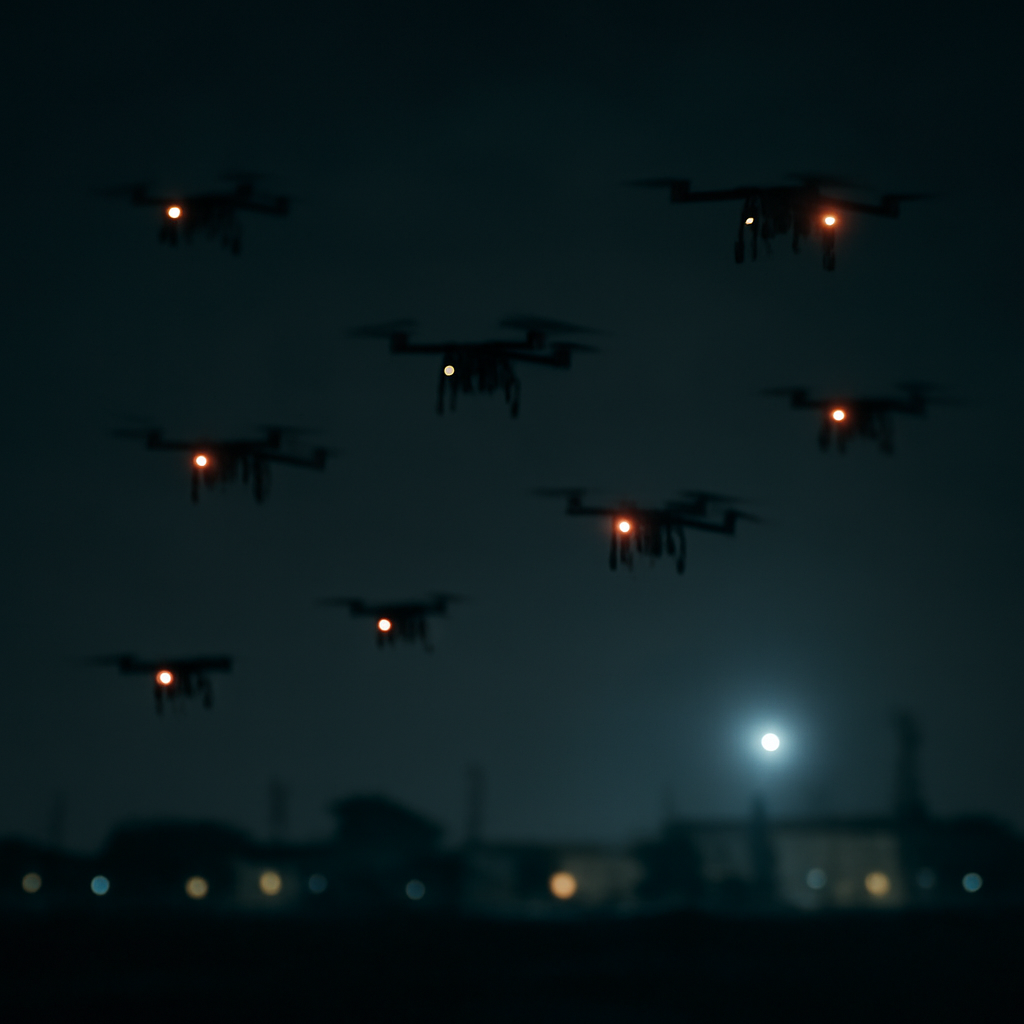
“It’s the dead of night when the buzz of the engines of a series of Shahed-136 one-way attack drones breaks the silence.” That opening — lifted from the reporting — frames the problem: small, cheap, and sometimes swarming unmanned aircraft challenging conventional sensors and response timelines.
Layered, networked sensing: a time-buying strategy
Ray Bischoff, a former U.S. Army officer now senior director of business development at Leonardo DRS, argues the central operational answer is not a single miracle sensor but a layered, networked architecture of many complementary sensors. “The primary reason for this is that the biggest enemy in many situations like these is time,” Bischoff told TWZ’s Jamie Hunter. His prescription: distribute sensors physically and across different sensing modalities so commanders gain time to evaluate, reposition, and decide.
Layering, as Bischoff describes it, is both technological and geographic: mix radar bands, electro-optical/infrared (long-, mid- and short-wave), acoustic sensors, and electronic-warfare receivers, and place them at different elevations and locations to remove blind spots. That approach is intended to offer redundancy if one sensor is degraded or destroyed and to improve accuracy through intersecting lines of bearing.
Leonardo DRS’ 202 Expeditionary Skid (U-KIT-0091): S‑band AESA on a skid
Bischoff walked through the capabilities of Leonardo DRS’ 202 Expeditionary Skid, also called U-KIT-0091, which is based on the company’s Extended Multi-Mission Hemispheric Radar (exMHR). The exMHR is described as a software-defined Active Electronically Scanned Array (AESA) pulse‑Doppler radar operating in S‑band — a band Bischoff said “is a very reliable band for all weather conditions including strong performance in dust storms and rain.”
Key, claimed characteristics of the skidded set: a single panel with a 90‑degree-by‑90‑degree search area; a very fast scan rate compared with spinning radars; and the option to field systems in groups of four to provide full 360‑degree coverage. The skid’s footprint is compact — occupying roughly four‑by‑four feet — and Bischoff said it can slide into pickup trucks, tactical vehicles, trailers, be mounted on ships or aircraft, or be fixed to structures. It carries its own power and positional systems “that works in denied environments” and is designed to operate while the host vehicle is moving: “You can turn it on and set-off. It’s working. If you come to a stop, it’s still working.”
Bischoff emphasized modularity and integration: the radar can run standalone for local protection or be networked and fused into larger command-and-control systems and effectors. He said customers typically pick their own C2 and that the system was designed for “plug-and-play” incorporation.

This site is the portfolio.
OSINTSights runs on Cloudflare Workers, D1, R2, and Vectorize, with an AI pipeline on Hetzner ARM. Nubivance designed, built, and operates it. We do the same for clients.
See what we buildWhy some drones are still hard to stop: altitude, numbers, and decisioning
Bischoff listed multiple detection challenges: higher speed, smaller low-observable designs, and, importantly, very low‑altitude flight. “The lower they bring them in altitude, they are harder to track as an independent target,” he said. The bigger operational headache with swarms, he added, is not initial detection but track management and response prioritization.
“The challenge with drone swarms isn't detection — if you can see the drones, you can track them,” Bischoff said. The harder problem is managing hundreds of tracks, deciding which threats matter most, and assigning the right effector given practical limits: “If 100 drones are inbound, it’s not just about having 100 weapons available. It’s about coordinating a fast, cost‑effective response across a large number of simultaneous threats.”
What this means for the U.S. Army, naval operators in the Strait of Hormuz, and procurement teams
- U.S. Army: Tactical formations should prioritize sensor diversity and elevation coverage. Bischoff specifically urged addressing “dead space” — valleys and low approaches — by elevating sensors or adding low‑level detectors to avoid blind spots.
- Naval operators in the Strait of Hormuz: Bischoff used the Strait as an example where “a layered and networked system” is required across a vast area; modular, mobile radars that can be ship‑mounted and networked to land sensors could be used to increase time for decision‑making.
- Procurement and acquisition teams: The 202 Expeditionary Skid positions mobility, rapid redeployability, and open architecture as procurement priorities — small footprint, self‑powered skids intended to plug into existing C2 and effectors.
Bischoff’s recurring theme is practical: disperse and diversify sensing to survive both kinetic attack and electronic countermeasures. “If you put all your eggs in one basket, and if you lose that basket, you lose everything,” he said. The combination of S‑band, fast electronic scanning, small form factor, and networked integration attempts to answer evolving UAS threats by buying the principal commodity commanders need — time.
The 202 Expeditionary Skid is described as already in service, although Bischoff declined to specify locations. That unresolved detail underscores the operational question his answers seek to address: in a world of smaller, faster, and swarming threats, where and how many of these distributed sensors are deployed will determine whether defenders gain the time they need to act.