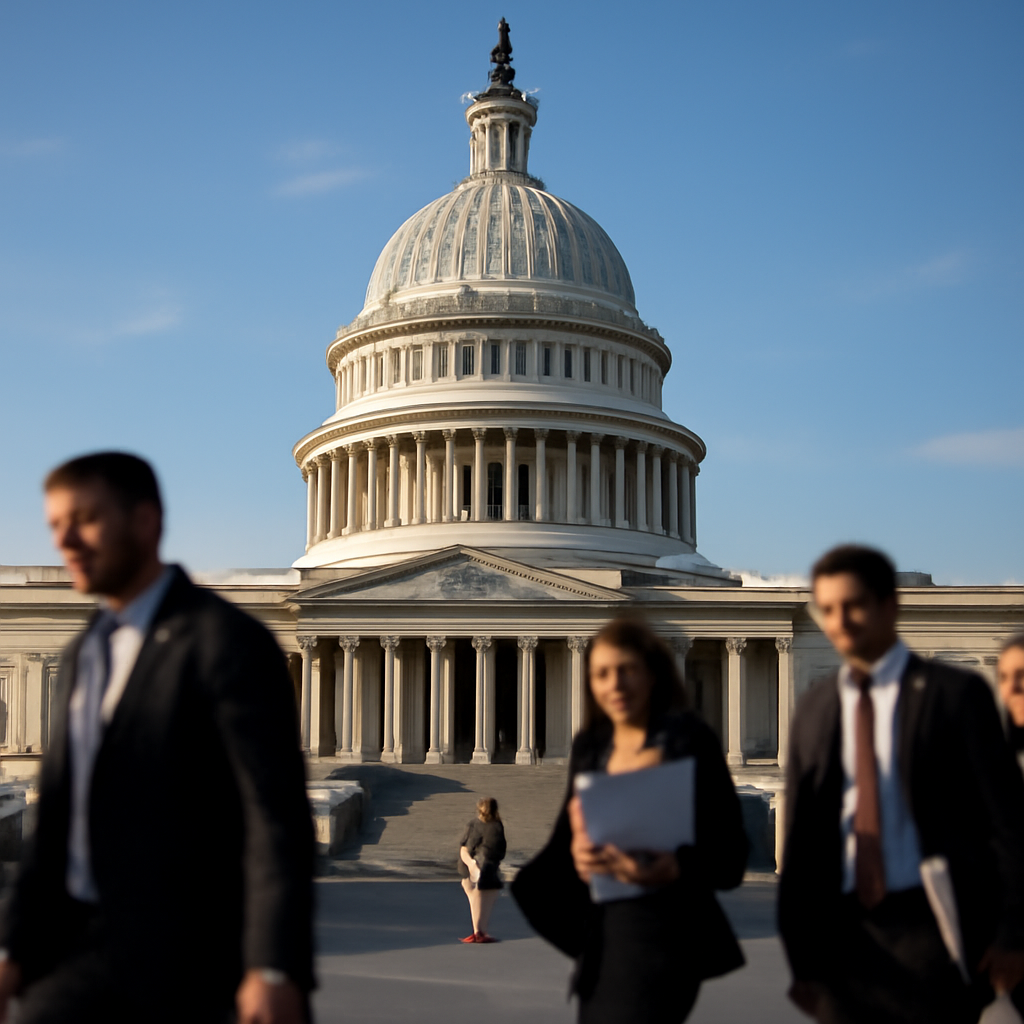
"Can both chambers reach an agreement to fund the government before the start of the new fiscal year?" — Breaking Defense.
Congress and the compressed post-recess window
The question posed by Breaking Defense places Congress at the center of a single, urgent task: securing a funding agreement in a compressed time frame described simply as "after August recess." The piece frames urgency as a function of timing — an unresolved funding decision that must be made once lawmakers return from that recess — without offering further operational detail.
What "both chambers" names and what the article does not specify
Breaking Defense uses the phrase "both chambers," an explicit reference to the bicameral legislature. Beyond that label the article does not enumerate the actors, votes, or procedures that would produce an agreement. The question leaves open whether the required work is expected to be routine negotiation, a conference between differing measures, passage of a unified bill, or another path to funding.

Your town's IT department is one person. Maybe.
Ransomware crews target small municipalities because nobody's watching. Nubivance gives Maine and New Hampshire towns a security program sized to a town budget.
Protect the town office"An agreement to fund the government": the narrow, stated issue
The source limits the problem statement to a single objective: an agreement to fund the government. It does not define the content of that funding, the level of funding, whether the funding would be enacted as a single continuing resolution or multiple appropriations measures, or what contingency plans — if any — exist if agreement is not reached. The phrasing concentrates attention on the binary outcome the article highlights: agreement achieved, or not, before the fiscal deadline cited.
"Before the start of the new fiscal year" as the explicit deadline
The article names "the start of the new fiscal year" as the temporal boundary that gives the question its force. It does not supply a calendar date, an interim timeline, or reference to any procedural clock beyond that phrase. The deadline is presented only as the organizing fact that generates the urgency posed in the headline and the single-line question.
How the phrasing shapes the problem for observers and participants
By stating the issue in terse terms — an August recess and a need to reach agreement before a fiscal-year milestone — the article reduces a complex set of legislative choices to a single test of timing. Observers reading that framing are invited to see the situation as one driven by schedule: the return from recess, a compressing interval, and a named fiscal threshold. Participants, likewise, are cast as actors whose principal challenge is whether they can convert post-recess days into an accord that satisfies the described objective.
Conclusion: a question that insists on an answer
Breaking Defense leaves readers with a clear, narrow prompt rather than a developed narrative: Can both chambers reach an agreement to fund the government before the start of the new fiscal year? That single sentence — the only factual proposition in the piece — commits the publication to a measurable outcome. The record here is short and specific: the article sets a deadline, names the institutional actors collectively as "both chambers," and asks whether agreement will arrive in time. The answer, the piece implies, will be evident once the post-recess period and the start of the new fiscal year arrive.
https://breakingdefense.com/2026/08/why-congress-will-be-in-a-hurry-after-august-recess/