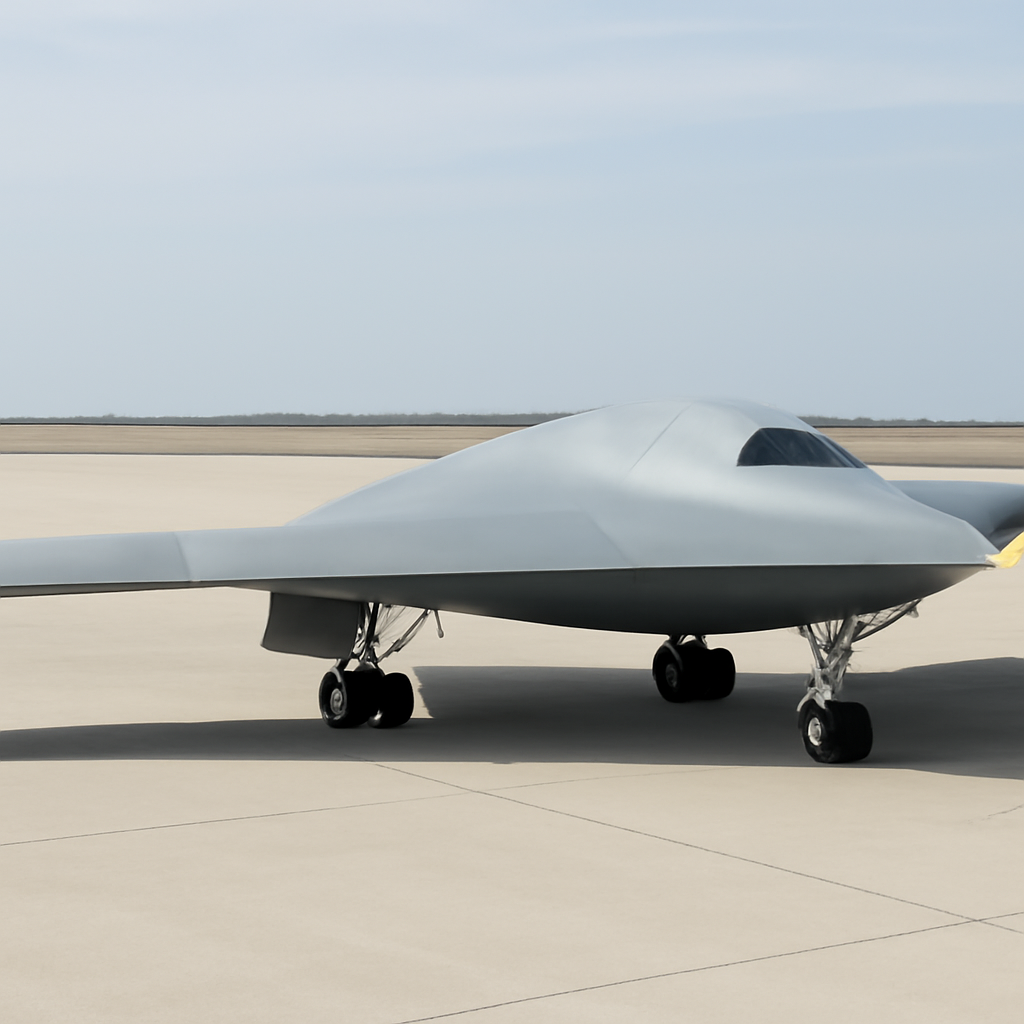
"The aircraft has a broader-chord inner wing section that transitions into a substantially narrower outer section," The War Zone reports, a description now confirmed by new photographs and fresh satellite imagery from China's Malan test facility.
Wing geometry: a conspicuous 'step down' and long, narrow outer panels
New photos and a recent Planet Labs satellite image published by The War Zone show the WZ‑X’s wing planform in greater detail than previously available. Rather than a continuous taper from center to tip, the aircraft’s wing features a broader‑chord inner section that abruptly transitions to a much narrower outer section—creating a “step down” in chord and yielding exceptionally long, slender outer wings. The arrangement produces a notably long outer span while keeping substantial structural mass and internal volume nearer the aircraft’s center.
Visible control and propulsion clues: split rudders, landing gear, and exhaust hints
The imagery shows split rudders toward the outer wing areas, a layout broadly reminiscent of those used on the B‑2. Landing gear are extended in at least one image, revealing large main undercarriage doors and substantial gear consistent with an aircraft of the WZ‑X’s estimated size. The rear of the center section may show slot‑like exhaust openings, a feature that supports assessments the airframe is twin‑engined.

The cyber insurance questionnaire just landed. Now what?
SOC 2, HIPAA, insurance renewals - someone has to own security strategy. Nubivance provides fractional CISO leadership without the full-time salary.
Get a security leadPerformance, endurance and the low‑observable tradeoffs
The War Zone’s analysis lays out both aerodynamic advantages and stealth tradeoffs tied to the unusual planform. A longer span with a relatively narrow outer wing would raise the effective aspect ratio and reduce induced drag at high altitude, which could improve endurance and cruise efficiency—attributes desirable for a very long‑endurance, high‑altitude platform. At the same time, the chord discontinuity introduces additional planform geometry and potential edge‑alignment discontinuities that will affect radar reflections depending on viewing aspect, orientation, and exact surface relationships. Modern low‑observable philosophy typically favors large, continuous structures to minimize such features; the WZ‑X’s semi‑sawtooth trailing edge therefore represents a compromise whose stealth implications will vary with perspective.
Scale, configuration estimates, and mission possibilities
Initial satellite analysis placed the WZ‑X’s wingspan at approximately 170 feet, roughly comparable to the B‑2’s 172‑foot span and considerably larger than other Chinese flying‑wing drones identified to date. Andreas Rupprecht, an analyst and TWZ contributor, assesses the design as twin‑engined and similar in configuration to the supposed U.S. RQ‑180 but considerably larger, estimating a length of about 46 feet. Rupprecht also describes a relatively spacious central fuselage and a dorsal satellite communications antenna; his range estimate exceeds 12,000 miles and he suggests a normal cruising altitude between 59,000 and 66,000 feet—estimates that remain unconfirmed. The aircraft’s proportions, with a broad, flattened center body and vast span, appear particularly compatible with high‑altitude endurance missions. While a strike capability cannot be ruled out—given China’s broader development of combat‑capable flying‑wing UCAVs—the WZ‑X’s configuration is described as especially well suited to persistence and reconnaissance.
Malan test hub, the GJ‑X, and a broader Chinese flying‑wing effort
The images emerged from activity at or near Malan, a sprawling test facility in Xinjiang where The War Zone first identified the WZ‑X in satellite imagery collected in May 2025 (including a Planet Labs image dated May 14, 2025). Malan has been associated with multiple large flying‑wing projects, including the distinct GJ‑X cranked‑kite planform—which is estimated to have a wingspan of about 137 feet and is also undergoing flight testing. The WZ‑X therefore appears to be part of a broader program of tailless and flying‑wing designs of differing sizes and missions; The War Zone lists other programs in China’s pipeline, including crewed developments such as the J‑36, J‑XDS and an eventual H‑20 stealth bomber.
What this means for technologists, policymakers, and military planners
- Technologists and aerospace analysts: will watch the WZ‑X’s trailing‑edge geometry, chord transition, and reported exhaust/engine layout to assess how designers reconcile aerodynamic efficiency with low‑observable requirements.
- Policymakers and procurement planners: will note the platform’s claimed scale and endurance estimates—if validated, those characteristics change assumptions about persistent, high‑altitude surveillance reach and the logistics of countering or competing with such systems.
- Military planners and intelligence analysts: will track Malan’s activity and the WZ‑X alongside other large flying‑wing projects such as the GJ‑X to understand role differentiation—reconnaissance, networking, or strike—based on internal volume, antennaing, and configuration details observed.
The new imagery removes some earlier ambiguity about the WZ‑X’s silhouette, confirming an unusual stepped wing that privileges span and endurance even as it complicates low‑observable design. Key technical claims—range, altitude, propulsion, and the aircraft’s ultimate mission—remain estimates rather than confirmed fact, leaving a narrow but important set of follow‑ups: how the chord transition is faired for signature control, whether the suspected twin engines and dorsal antennaing are flight‑characteristic, and how Malan’s other large flying‑wing projects relate to this platform. For now, the WZ‑X stands as a visible, if still enigmatic, example of large‑scale experimentation with high‑altitude, low‑observable uncrewed aircraft.
https://www.twz.com/air/chinas-huge-wz-x-stealth-drones-strange-wing-configuration-confirmed