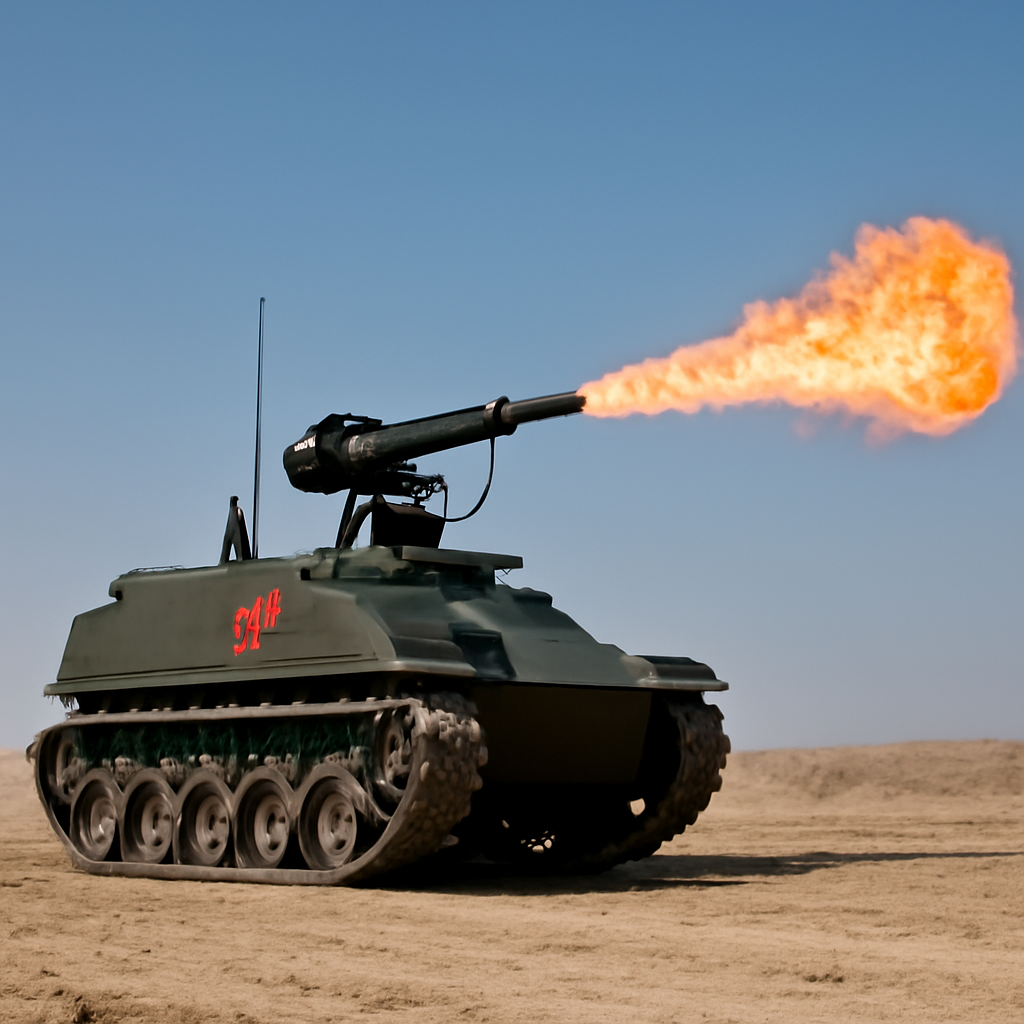
China's PLA Deploys Flamethrowers on Unmanned Ground Vehicles
Analyst 207||Source: ChinaDefenseBlog
China's Military Embraces Flamethrower Technology on Unmanned Ground Equipment
The People's Liberation Army (PLA) has long been known for its affinity for flamethrowers, utilizing them for close-in combat situations to clear trenches and bunkers. This approach, while effective, poses significant risks to the operator. In a move to modernize and enhance safety, the PLA has combined the Type 74 flamethrower with the ZRY222 Unmanned Ground Equipment (UGE) platform.
"a flamethrower is just as dangerous to the operator as to the poor soul hiding in the next trench over."
This integration represents a significant advancement in the PLA's pyrotechnic capabilities, allowing for remote-controlled operations that minimize risk to personnel. The ZRY222 UGE, equipped with the Type 74 flamethrower, can advance into dangerous areas, dispensing flames and smoke with precision, while the operator remains safely behind a console.
Historical Context and Current Capabilities
The PLA's fondness for flamethrowers is not new; they have been a part of the military's arsenal for decades. According to sources, flamethrowers are organic to a Combined-Arms Brigade's Combat Support Battalion, Combat Engineering Company in the new China Army's Table of Organization (TOE). The Shanghai PAP Corps, a unit of the People's Armed Police (PAP), has also been known to utilize flamethrowers for policing duties.
Technological Advancements and Strategic Implications
The pairing of the Type 74 flamethrower with the ZRY222 UGE exemplifies the PLA's commitment to leveraging unmanned systems for enhanced combat effectiveness. This approach enables the military to deploy flamethrowers in a safer and more controlled manner, potentially altering the dynamics of urban warfare and combat operations.
What this means for the PLA, PAP, and Military Analysts
For the PLA and PAP, this technological advancement presents an opportunity to enhance their combat capabilities while reducing the risk to personnel. Military analysts will likely closely monitor the deployment and effectiveness of this technology, assessing its potential impact on future conflicts and military strategies.
Conclusion
The integration of flamethrowers with unmanned ground equipment marks a significant development in the PLA's military capabilities. As this technology continues to evolve, it is likely to have far-reaching implications for modern warfare.
Read the original article
North Korea has just unveiled its most powerful warship yet, the Choe Hyon-class destroyer, marking a major milestone in its naval modernisation efforts. This massive 145-metre-long vessel is a game-changer for the Korean People's Army Navy.
The Air Force's T-7 Red Hawk trainer jet program, meant to train the next gen of pilots, is facing major hurdles with the first 82 aircraft projected to fly with a serious airworthiness risk. This alarming issue is just one of many technical, contractual, and budgetary challenges plaguing the program's path to the fleet.
NATO Secretary-General Mark Rutte promises a huge boost in defence spending, with "tens of billions" of dollars in new contracts set to be unveiled at the Ankara summit, marking a major step from commitment to action. The move aims to show the alliance is delivering on its pledges, not just making promises.
Japan is taking a giant leap in its defense strategy, renaming its air force to the Japan Aerospace Self-Defense Force to reflect its expanded role in the space domain. This move, approved by parliament on June 26, 2026, will take effect on April 1, 2027, and marks a significant shift in Tokyo's military capabilities.