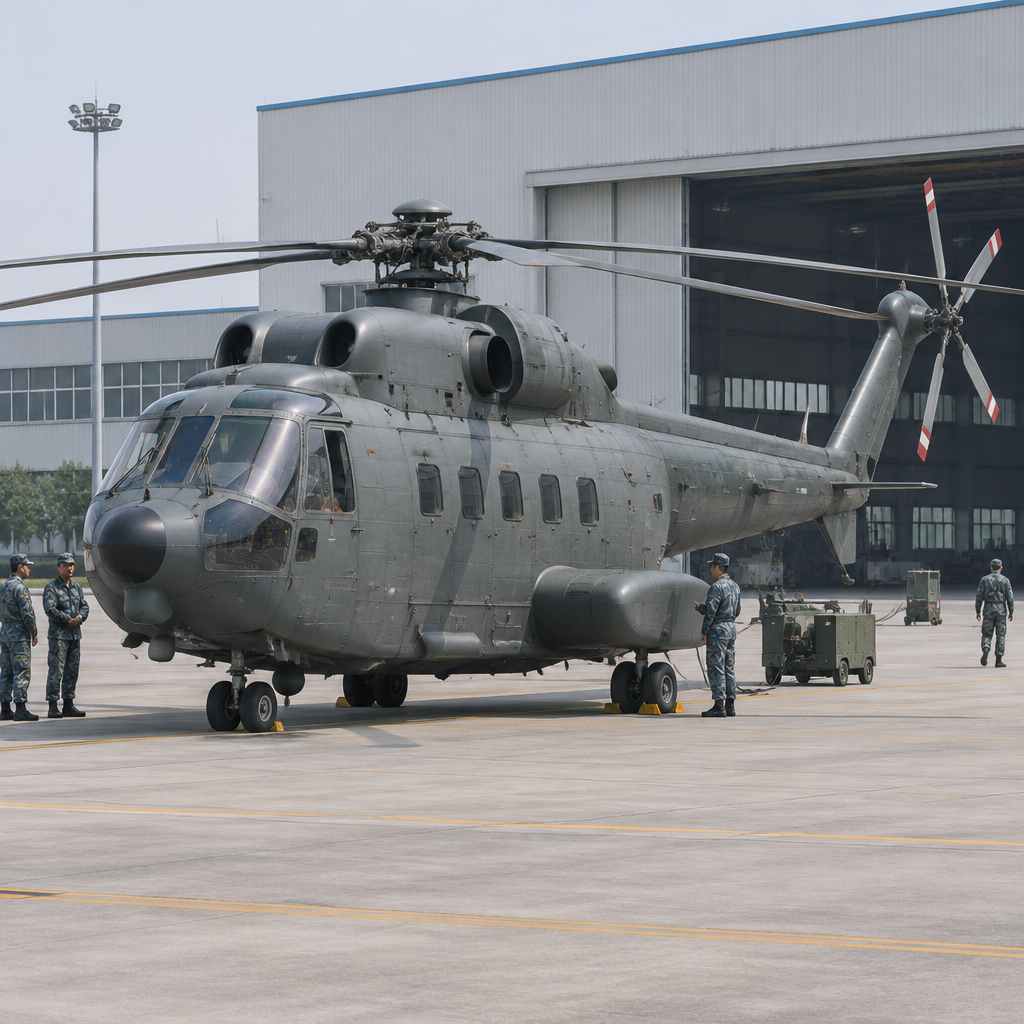
China bought 13 examples of the French SA321Ja Super Frelon in the late 1970s — a purchase that seeded a helicopter family now serving across the People’s Liberation Army in roles from carrier logistics to airborne early warning.
The Z-8 line: a Cold War import grown into many specializations
What began as an indigenous derivative of the French Super Frelon became the broad Z-8 family, a workhorse for Navy, Army Aviation, and the PLAAF. The Z-8J remains a shipborne transport with a boat-like hull and can be fitted for anti-submarine warfare (surface-search radar, a French HS-12 dipping sonar, and Whitehead A244S or ET52 torpedoes). From that base China produced the Z-8S SAR variant, the Z-8JH medevac/SAR, and the Z-8K/Z-8KA search-and-rescue and combat-search-and-rescue models with FLIR, RWR, chaff/flare dispensers and rescue hoists.
The family continued to evolve: the Z-8C — with a redesigned nose, chin-mounted weather radar, FLIR, pilot night-vision system, and longer engine compartment for WZ-6C power — has become a principal transport for the Type 075 amphibious assault ship. Wide-body and mission-specialized members such as the Z-8L, Z-8D, and Z-8G introduce larger internal volume, sponsons for extra fuel or equipment, improved avionics and engines (including PT6B-67A and later WZ-series turboshafts), and extensive self-protection suites for shipborne operations.
Naval sensor and anti-submarine capability: Z-18, Z-9, and Russian types
The PLA’s carrier and frigate fleets operate a mix of purpose-built Chinese designs and Russian imports. The Z-18 family — derived from the AC313 — supplies carrier onboard delivery (Z-18Y), airborne early warning (Z-18J with a vertically lowered retractable AESA radar), and anti-submarine/anti-ship roles (Z-18F). The Z-18F carries a surface-search radar, dipping sonar, sonobuoys, and can arm pylons with torpedoes or YJ-9 anti-ship missiles; improved Z-18 variants move toward domestic WZ-series engines.
Light naval helicopters derived from the French AS365/AS565 line include the Z-9C, Z-9D and Z-9F: the Z-9C carries dipping sonar and can mount Yu-7K torpedoes; the Z-9D emphasizes anti-surface warfare with stub wings for AShMs; the Z-9F modernizes ASW capability with a new dipping sonar, glass cockpit and updated radar. Complementing domestic types, Russian Mi-17/171 transports and Ka-28/Ka-31 naval helicopters remain in service — the Mi-171Sh serving as a combat search-and-rescue platform and the Ka models providing shipborne ASW and radar surveillance where their capabilities continue to meet operational needs.

Audit-ready is a season. It shouldn't be.
Evidence in spreadsheets, controls drifting between audits, frameworks multiplying on flat headcount. Nubivance runs continuous compliance on Rapid7 Cyber GRC - SOC 2, HIPAA, ISO 27001, PCI, CMMC.
End the scrambleZ-20: a new medium-lift backbone with broad variants
The Z-20 entered service with PLA Army Aviation by 2019 after a 2013 first flight. Powered by two WZ-10 turboshaft engines, it carries up to 13 fully equipped soldiers, features a five-blade rotor, glass cockpit, PNVS and an array of defensive and communications systems (SATCOM, RWR, LWR, ECM antennas). Its modular design spawned role-specific models: Z-20K for airborne assault, Z-20KS for SAR, Z-20KT with a folding tail for aerial transport, the shipborne Z-20F ASW helicopter first flown in 2018, the assault-oriented Z-20J for naval operations, and the heavily armed Z-20T assault variant equipped for KD-series ATGMs and other stores. The Z-20F specifically adds sonobuoy launchers, dipping sonar, flotation and weapons pylons for anti-ship missiles and lightweight torpedoes, and has been observed aboard the carrier Fujian and Type 075 amphibious ships.
Attack and scout rotorcraft: Z-10, Z-19, and the new Z-21
China’s dedicated attack helicopter programs produced the Z-10, Z-19 and the recently identified Z-21. The Z-10 — in production since 2010 — is a tandem-seat gunship carrying up to eight KD-9/KD-10 laser-guided ATGMs, PL-90 AAMs and a chin 23mm chain gun; later improvements added ceramic armor, MAWS sensors and SATCOM, and longer-range IIR/CCD and millimeter-wave-guided munitions in some configurations.
The Z-19 fills a scout-attack role with a narrow tandem fuselage, EO turret and optional mast-mounted millimeter-wave radar; armament mirrors Z-9WA family loadouts and supports newer long-range ATGMs (KF-series) when fitted with datalink antennas. The Z-21, first identified in 2024, appears as a larger, more heavily protected gunship with WZ-10-derived engines, a nose PNVS/TADS, mast MMW search radar, 30mm chain gun, stub wings carrying KF-series ATGMs and PL-90 AAMs, and significant electronic-survivability and DIRCM defenses on the airframe.
What this means for the PLA Navy, PLA Army Aviation, and the PLAAF
- PLA Navy: The Z-18, Z-20F, Z-9 family and upgraded Z-8 derivatives increase carrier and amphibious force logistics, ASW and AEW reach — with Z-18J serving as an interim airborne early-warning solution and Z-18F/Z-20F fielding modern ASW suites aboard carriers and assault ships.
- PLA Army Aviation: The Z-20 and expanded Z-8 variants provide more capable medium-lift and high-altitude transport, specialized assault (Z-20T) and CSAR assets (Z-20KS, Z-8KA), broadening air mobility for heliborne operations.
- PLAAF: Attack and scout types (Z-10, Z-19, Z-21) and PLAAF-tailored Z-20K variants extend strike, reconnaissance and airborne assault capabilities while SAR-configured models support personnel recovery.
China’s rotary-wing force today is a layered mix: legacy Russian and French-origin systems continue where they meet needs, while an expanding set of indigenous designs — evolving through engine, sensor and defensive upgrades — aim to cover transport, ASW, AEW, assault, attack and rescue missions. The trend in the record is clear: a steady push to diversify roles, increase survivability and reduce reliance on foreign suppliers through homegrown variants and domestic engines.