"Beijing has effectively pulled off an end run around Hanoi’s air and maritime flanks." — Hunter Marston
That sentence, published in the Interpreter and widely repeated by commentators, crystallizes the alarm that followed the September 29 opening of the Laos‑China Joint Support and Training Center and the Friendship Aviation Academy at Ban Keun. The claim — that the facility is a Chinese forward air base enabling power projection across mainland Southeast Asia — has been amplified by images and commentary. A review of the publicly available evidence in the record, however, shows a much narrower reality: Ban Keun is small, built for training, and lacks the infrastructure associated with expeditionary combat operations.
The aircraft on the apron: JL‑8/K‑8 trainers, not strike fleets
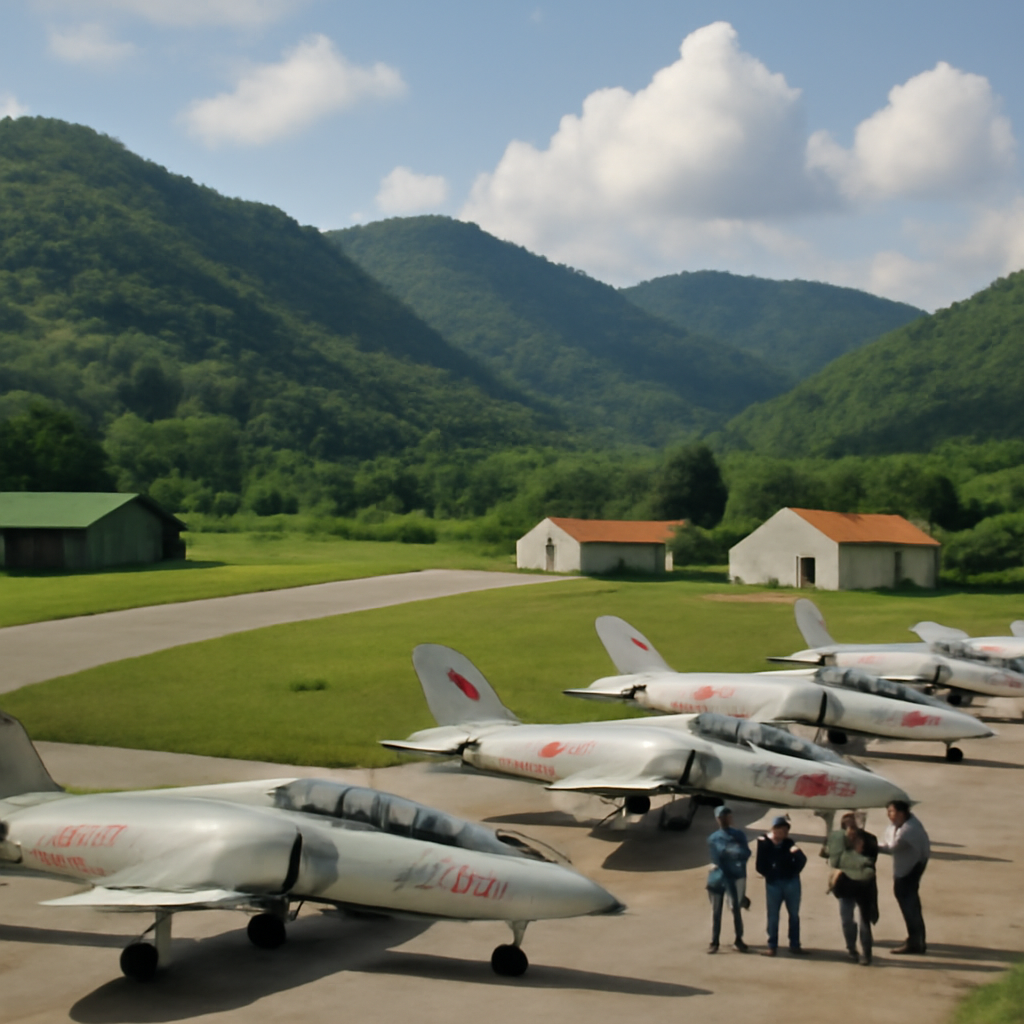
Commercial satellite imagery from Vantor, first shared by Reuters, captured eight Chinese‑made JL‑8/K‑8 aircraft at Ban Keun. Media outlets and some analysts labeled those jets "light attack aircraft" or "attack aircraft," terminology the available evidence does not support for the Laotian context.
The K‑8 is a China‑Pakistan joint basic/intermediate jet trainer used in the region by China, Laos, Myanmar, and Pakistan. In Laos, the training sequence reported in open sources places the Chinese SAIC LE‑500 in phase one (elementary training), the K‑8 in phases two and three (basic jet introduction and advanced jet training), and the Russian YAK‑130 in phase four (tactical training). Unlike reports about Myanmar’s employment of K‑8s in a light‑attack role, there is no visual evidence across almost a decade of K‑8 service in Laos that the Lao People’s Liberation Army Air Force (LPLAAF) has used the type to carry air‑to‑ground munitions or participate in strike exercises. By contrast, the Russian YAK‑130 is noted as being capable of being armed for ground support, underscoring the difference between basic trainers and combat‑oriented platforms.

The cyber insurance questionnaire just landed. Now what?
SOC 2, HIPAA, insurance renewals - someone has to own security strategy. Nubivance provides fractional CISO leadership without the full-time salary.
Get a security leadRunway length and apron size: purpose-built for training
The Ban Keun runway measures approximately 2,000 meters. That is short by regional military standards: Wattay International Airport in Vientiane measures roughly 3,000 meters and Xieng Khouang (Phonsavan) approximately 2,500 meters, as measured in Google Earth. Neighboring Thailand’s military airfields are generally built to 3,000 meters. Within China’s Southern Theater Command, PLAAF fighter bases commonly have 2,500‑meter runways, while bomber bases at Shaodong and Leiyang extend to 3,000 meters.
The 2,000‑meter strip at Ban Keun matches the needs of trainer aircraft rather than long‑range combat aircraft or heavy bombers. Satellite imagery also shows a relatively small apron — sufficient for roughly a dozen trainers with sun shelters, hangars, and maintenance infrastructure — not the expansive hardstands, aircraft shelters, and large fuel and munitions "farms" typically required to sustain power‑projection operations. Those large logistics footprints are visible at Chinese bases across the border but absent at Ban Keun.
China’s existing regional reach reduces the need for forward basing in Laos
Analyses that treat Ban Keun as a missing strategic link often overlook the reach China’s air forces already possess from home bases and outposts. The Southern Theater Command fields an extensive network of well‑equipped air bases from Hunan and Guangdong down through Guangxi and Yunnan, abutting Vietnam, Laos, and Myanmar. Hainan Island and facilities on Woody Island plus features in the Spratly chain — Fiery Cross Reef, Subi Reef, and Mischief Reef — likewise extend operating locations into the South China Sea.
Regional combat aircraft cited in the record — JH‑7A, Su‑30MKK, J‑16, and J‑20 — are described as having combat radii generally from 600 nautical miles up to 1,000 nm; the J‑10C can exceed 600 nm with external drop tanks. The H‑6K bomber is estimated in the record to possess a combat radius of about 1,350 nm and, combined with long‑range precision weapons and an expanding aerial‑refueling capability, can cover mainland Southeast Asia from home bases at Shaodong and Leiyang. The point is explicit in the available evidence: China does not need Ban Keun to place strike aircraft within reach of Vietnam or other regional targets.
Surveillance claims versus practical utility
Commentators such as Abdul Rahman Yaacob have suggested the Laos facility could be used to "keep an eye on Vietnam" or "monitor air activities deep into Myanmar, Thailand, and Vietnam." The record notes that those countries — Myanmar, Thailand, Laos, and Cambodia — maintain very close relations with Beijing, and that monitoring Vietnam’s bases can already be done from Southern Theater Command assets with little additional benefit from a Lao outpost. Proposals that Ban Keun would substantially change China’s intelligence posture rely on speculative deployments of spy aircraft, radars, or signals‑collection systems that are not evident in the available imagery or official descriptions of the center.
What this means for Laos, China, and Vietnam
- Laos: The facility, described officially as a joint training center and Friendship Aviation Academy, expands LPLAAF training capacity and broader civil‑aviation support — part of China’s ecosystem approach that includes aircraft sales (LE‑500, JL‑8) and airliner models referenced in the record (C‑909).
- China: The infrastructure recorded at Ban Keun supports aviation cooperation and capacity building rather than forward basing for expeditionary combat or bomber operations; existing Southern Theater and maritime outposts already give strategic reach.
- Vietnam (and regional militaries): The evidence in the record suggests Ban Keun does not materially alter China’s ability to surveil or strike across the region, since those capabilities are already projected from nearer Chinese bases and island outposts.
Bottom line: the most publicly visible facts — an opening on September 29, a ~2,000‑meter runway, a small apron holding JL‑8/K‑8 trainers, and the absence of large logistics and munitions infrastructure — point to a training facility, not a new expeditionary air base. If the site’s character changes, the decisive indicators will be visible: runway extension beyond current dimensions, large fuel and munitions storage, sustained presence of combat or surveillance platforms configured for strike or signals collection, or imagery showing K‑8s employed in an attack role. Absent such evidence, many of the alarmist narratives rest on inference rather than the record in hand.
Source: Debunking Alarmist Narratives on the ‘China Air Base’ in Laos — The Diplomat, Oct. 2026