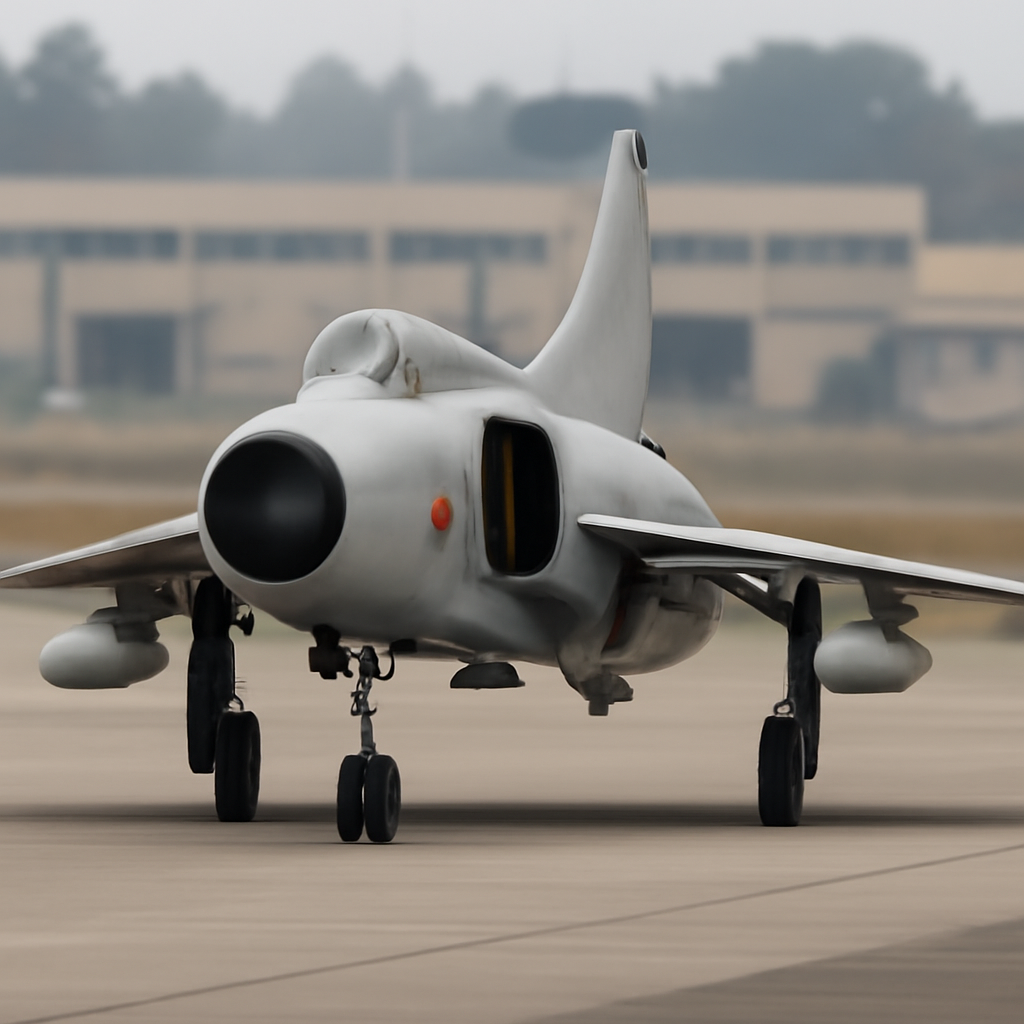
"J‑8I turns another year older every July 4th, PLAAF's Cold War interceptor sharing a birthday with fireworks," the China Defense blog wrote.
PLAAF's Cold War interceptor
The J‑8I is described in the source as "PLAAF's Cold War interceptor." That concise characterization places the aircraft in a specific operational niche: a platform aligned with the air-defence demands of the Cold War era rather than a multirole, modern fighter. The line in the source frames the J‑8I not as an experimental prototype or a post‑Cold War upgrade, but as a machine of a particular moment and purpose for the People’s Liberation Army Air Force (PLAAF).
Born from China’s push for a true high‑altitude, high‑speed fighter
The source says the J‑8I was "born from China’s push for a true high‑altitude, high‑speed fighter." That simple clause captures the program’s rationale: it was an answer to a national requirement for an aircraft capable of operating at altitude and at speed. The language underscores the aircraft as a response to a strategic gap, not merely a routine update to an existing type.

Audit-ready is a season. It shouldn't be.
Evidence in spreadsheets, controls drifting between audits, frameworks multiplying on flat headcount. Nubivance runs continuous compliance on Rapid7 Cyber GRC - SOC 2, HIPAA, ISO 27001, PCI, CMMC.
End the scrambleCharacteristics: "ole‑school, fast, and unapologetically 1970s"
The blog calls the J‑8I "ole‑school, fast, and unapologetically 1970s." Those adjectives sketch a machine of its era — straightforward in design philosophy, performance-focused in its day, and stylistically of the 1970s. The phrasing implies a contrast with later generations of fighters that emphasize avionics, multirole flexibility, and stealth; instead, the J‑8I is presented as a product of a time when speed and altitude were primary design drivers.
"It never became a superstar" — the J‑8I's legacy
The source notes that the aircraft "never became a superstar, but it marked China’s first real step toward actual airpower." That judgment acknowledges limits to the J‑8I’s long‑term prominence while underscoring its historical importance. Even if the platform did not achieve iconic status, the blog positions it as a milestone — the first meaningful movement toward a credible air‑force capability in the modern sense for China.
How the PLAAF, Chinese defense planners, and aviation historians see the J‑8I
- The PLAAF: The formulation in the source — calling the J‑8I the PLAAF's Cold War interceptor — implies the service views the type as a response to specific air‑defence needs of that era and as part of a broader capability progression.
- Chinese defense planners: Labeling the program "born from China’s push for a true high‑altitude, high‑speed fighter" highlights how planners prioritized a capability gap and pursued a focused solution rather than a multipurpose design.
- Aviation historians and enthusiasts: Descriptors such as "ole‑school" and "unapologetically 1970s," along with the observation that it "never became a superstar," provide the kind of narrative historians and hobbyists reference when tracing technological and doctrinal shifts in a country’s airpower development.
The J‑8I’s story, as told by the blog, is compact but telling: an aircraft with a July 4th birthday that links a national push for altitude and speed to a tangible, if modest, advance in aerial capability. The tone is neither celebratory nor dismissive; it acknowledges the J‑8I’s shortcomings while granting it a foundational place in the PLAAF’s evolution.
For observers of military aviation, the J‑8I is less an icon than a marker — the kind of step that marks the transition from aspiration to capability. That transition, the source suggests, is the real significance worth noting on a birthday that the blog cheekily pairs with fireworks.