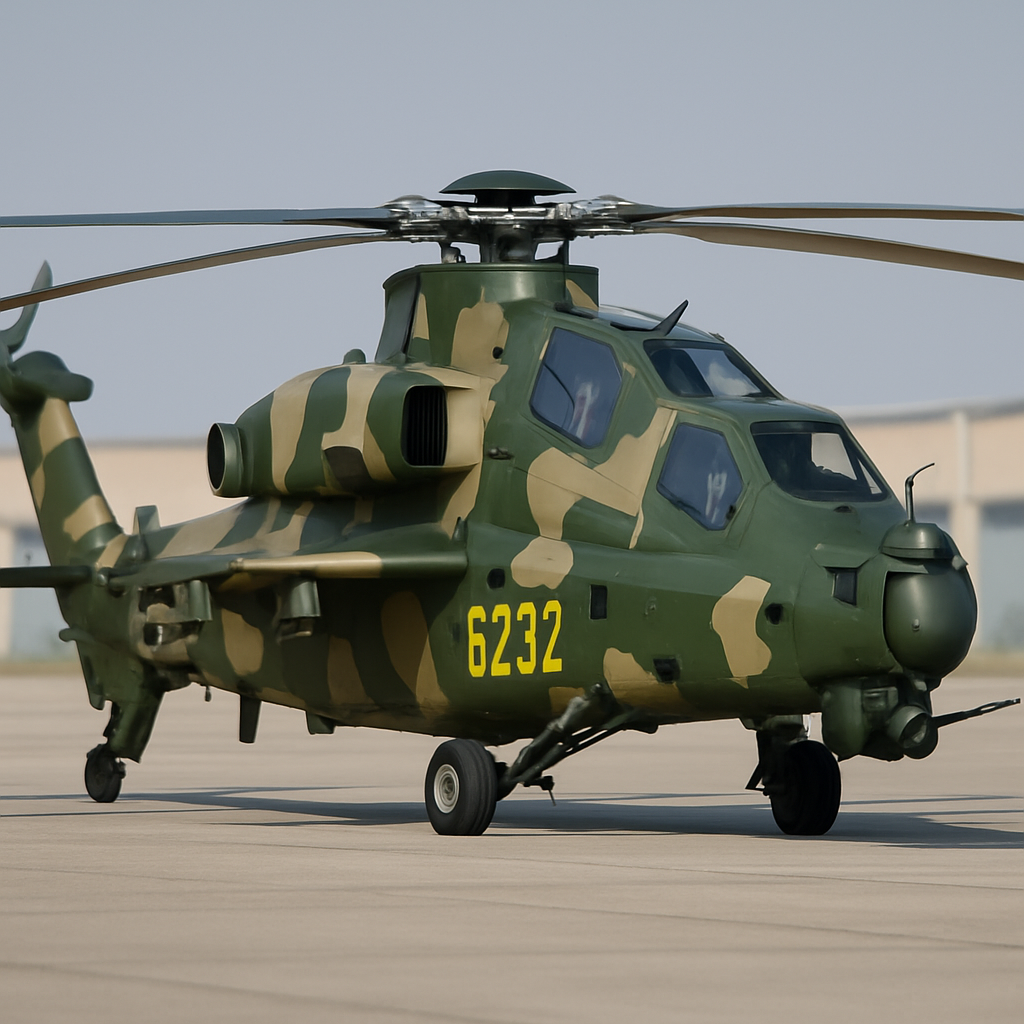
The new PLA Z‑21 heavy attack helicopter has been photographed bearing PLAAF serial numbers (6232), a detail that suggests the airframe belongs to the PLAAF rather than the PLA Ground Force’s Army Aviation — a surprising turn given earlier expectations that the Z‑21 would first enter Army Aviation (LH) units.
The Z‑21 photograph and the PLAAF serial prefix
The image carrying the “6***” serial prefix and the specific number 6232 was presented on December 1, 2025. That marking “strongly suggests this airframe belongs to the PLAAF,” the reporting states, and the camouflage and serial together point toward assignment to the Helicopter Regiment of the 130th Air‑Assault Brigade, 15th Airborne Corps, under the PLAAF. The detail is notable because the Z‑21 had long been expected to enter service with the PLA Ground Force’s Army Aviation units.
Why Ka‑52 sale rumors are still being watched
Rumors have circulated for months about a possible sale of Russian Ka‑52 “Alligator” attack helicopters to China, but “nothing solid has emerged.” The chatter remains relevant because the Ka‑52’s design — especially its coaxial rotor system that eliminates the tail rotor — produces specific operational advantages for shipboard use: fewer tail‑rotor strike hazards, more engine power devoted to lift and maneuvering, and a compact, highly controllable airframe suited to tight decks.

This site is the portfolio.
OSINTSights runs on Cloudflare Workers, D1, R2, and Vectorize, with an AI pipeline on Hetzner ARM. Nubivance designed, built, and operates it. We do the same for clients.
See what we buildPast Kamov imports and China’s helicopter trajectory
China’s navy is not a stranger to Kamov platforms. The PLAN imported the Ka‑28 in the late 1990s and added the Ka‑31 in the early 2010s. The reporting notes that many PLAN frigates and destroyers were relatively small at the time, and the Ka‑31’s handling “made it the more practical choice over the Z‑9 for certain missions.” The PLAN has been “generally satisfied with these Kamov platforms” and has only recently begun phasing in the domestically produced Z‑20F for anti‑submarine roles. Outside China, the Egyptian Navy plans to operate Ka‑52s from its two Mistral‑class carriers, and the Russian Navy originally intended to deploy the Ka‑52K on the same French Mistral‑class ships before that deal fell apart — precedents that keep Ka‑52‑related discussion alive.
Two plausible paths to coaxial‑rotor attack capability
- Buy a small batch of Ka‑52s and absorb the operational lessons from the coaxial rotor system.
- Acquire the technology directly — a feasible path, the reporting notes, because China has already produced civilian and unmanned coaxial‑rotor helicopters.
Either approach, the source argues, “would make it far less surprising to see a coaxial‑rotor attack helicopter operating from Chinese amphibious ships in the future.”
What this means for the 130th Air‑Assault Brigade, the PLAAF, and the PLAN
- 130th Air‑Assault Brigade (Helicopter Regiment): If the Z‑21 bearing PLAAF serials is joining the Helicopter Regiment of the 130th, that unit may be integrating a heavy attack helicopter into an airborne, air‑assault structure — a shift consistent with photos and public reporting that the PLAAF “maintain[s] one organic air‑assault brigade equipped with helicopter units.”
- PLAAF: The assignment of a Z‑21 with PLAAF numbers would indicate the PLAAF is operating heavy attack types alongside its airborne brigade, expanding the service’s helicopter ecosystem beyond previously visible Army Aviation expectations; prior PR photography has shown WZ‑10 attack helicopters attached to a helicopter regiment with a PLA airborne brigade (March 6, 2019), establishing that model of integration.
- PLAN: Given the PLAN’s prior preference for compact, shipboard‑friendly Kamov types (Ka‑28/Ka‑31) and its recent transition toward the Z‑20F for ASW, naval planners will continue to track coaxial‑rotor developments and the Z‑21’s design and deployment patterns for indications of future shipboard options.
The photograph and the enduring Ka‑52 rumors together sketch two parallel threads: a domestic heavy‑attack program represented by the Z‑21 that appears to be diversifying across services, and an open question about whether China will supplement that program by importing or otherwise acquiring coaxial rotor expertise. Both threads are visible in the sourcing: a PLAAF‑marked Z‑21 in December 2025 and months of speculation about Ka‑52 sales, anchored by long‑standing operational reasons why coaxial designs appeal to ship operators. The central unresolved fact remains whether Beijing will choose a purchase, a transfer of technical know‑how, or rely solely on its domestic Z‑21 development — and the next definitive answers will likely come not from rumors but from serial numbers on the ramp and the manifests of amphibious decks.



