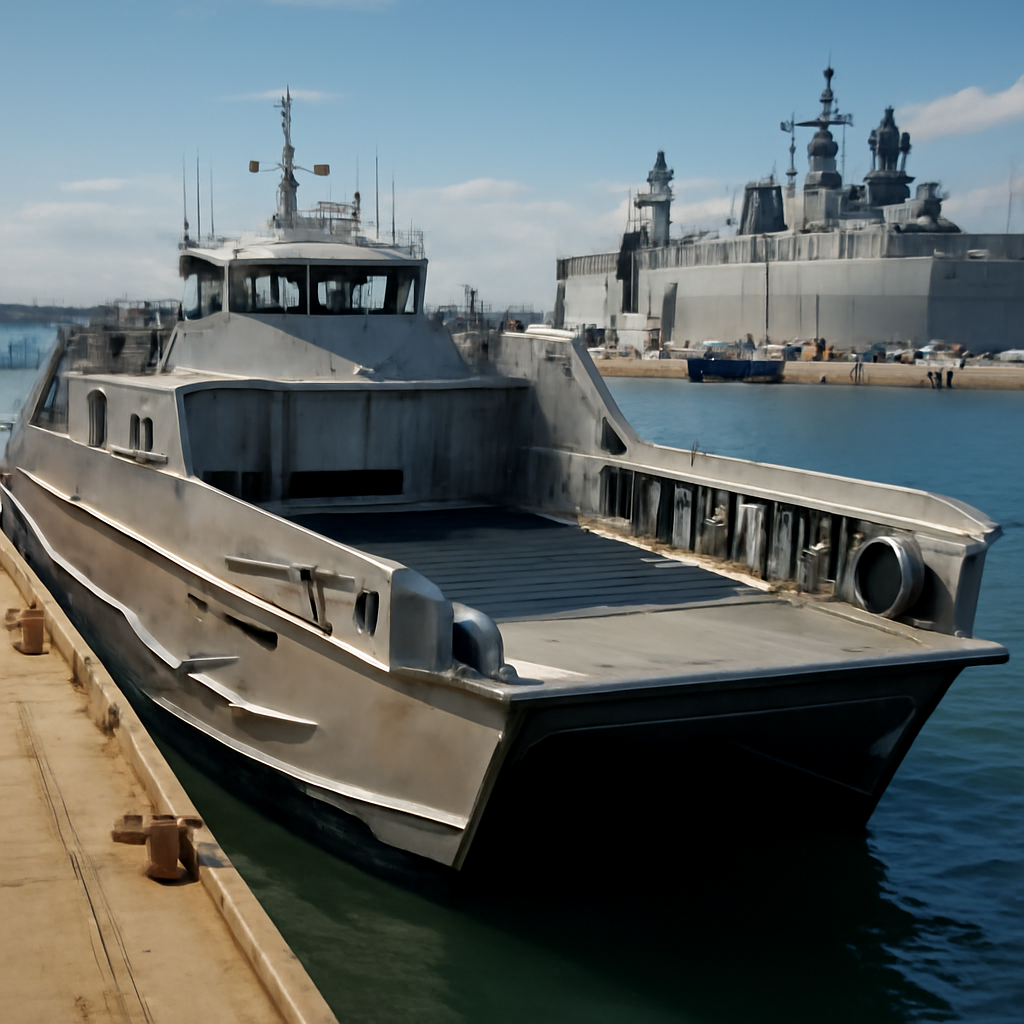
At 33 meters in length, the LCM matches the dimensions of the Type 726 Landing Craft Air Cushion (LCAC), ensuring compatibility with the well decks of both LPDs and LHDs.
New twin waterjet LCM added to the PLAN fleet (9 November 2025)
On Sunday, November 9, 2025, the People’s Liberation Army Navy (PLAN) introduced a new class of twin waterjet-powered Landing Craft Mechanized (LCM). The vessel is described as designed to operate alongside the service’s larger amphibious platforms — the Type 071 Landing Platform Dock (LPD) and the Type 075/76 Landing Helicopter Dock (LHD). The addition is portrayed as a pragmatic expansion of the PLAN’s amphibious fleet, intended to broaden options for ship-to-shore logistics and amphibious operations.
Type 071 Landing Platform Dock (LPD) and Type 075/76 Landing Helicopter Dock (LHD)
The new LCM was built to the same basic length as the Type 726 LCAC — 33 meters — a deliberate choice that preserves compatibility with the well decks of the PLAN’s existing LPDs and LHDs. That dimensional parity allows commanders to load and deploy either the hovercraft or the mechanized craft from the same mother ships, increasing tactical and logistical flexibility without requiring modifications to the service’s amphibious platforms.

Audit-ready is a season. It shouldn't be.
Evidence in spreadsheets, controls drifting between audits, frameworks multiplying on flat headcount. Nubivance runs continuous compliance on Rapid7 Cyber GRC - SOC 2, HIPAA, ISO 27001, PCI, CMMC.
End the scrambleTwin waterjet propulsion: quieter, simpler, and easier to maintain
The LCM uses twin waterjet propulsion rather than the gas-turbine drives typical of LCACs. According to the report, that choice reduces maintenance demands compared to turbine-powered hovercraft, and the craft is quieter and easier to handle. Those qualities are emphasized as practical advantages for routine sealift and logistics tasks where the extreme speed of a hovercraft is not required.
LCAC (Type 726) versus the new LCM: complementary roles
The report draws a clear operational distinction: the LCAC retains a decisive speed advantage, capable of reaching up to 80 knots, which makes the hovercraft "indispensable for rapid amphibious assaults." By contrast, the LCM is presented as a more economical and versatile option for sustained logistics operations. The new craft is characterized as offering more usable space for vehicles and supplies, trading peak speed for cargo capacity and lower operating and construction costs.
Cost, cargo, and maintenance implications for procurement and logistics
Three practical benefits are highlighted. First, construction of the LCM is described as simpler and cheaper than turbine-powered LCACs. Second, waterjet propulsion lowers upkeep compared to gas turbines, reducing maintenance burdens. Third, the LCM’s internal arrangement delivers "more usable space for vehicles and supplies," improving the efficiency of sealift when high speed is unnecessary. Together, these attributes make the LCM a candidate for routine sustainment missions where cost, cargo volume, and reliability take priority over speed.
What this means for amphibious commanders, procurement officers, and logistics planners
- Amphibious commanders: Will have a clearer choice between high-speed assault craft and lower-cost mechanized landing craft depending on mission tempo — the LCM for sustained logistics and the LCAC for rapid forcible entry.
- Procurement officers: Can weigh lower construction and maintenance costs for the LCM against the operational niche filled by LCACs; the shared 33‑meter footprint supports mixed inventories without major ship modifications.
- Logistics planners: Gain a larger, quieter platform with more usable cargo space for routine sealift, easing the sustainment of expeditionary forces where transit time is less critical than payload.
The introduction of the twin waterjet LCM is described in the source as illustrating an evolving amphibious doctrine: balancing the PLAN’s high-speed assault capability with reliable, cost-effective sealift to support growing expeditionary capabilities. The two platforms are presented not as substitutes but as complementary tools — one optimized for speed, the other for economy and cargo — that together broaden the operational options available from the PLAN’s existing LPDs and LHDs.
For readers tracking changes in amphibious logistics and force posture, the concrete details — a 33‑meter hull form matched to existing well decks, twin waterjet propulsion, lower construction and maintenance costs, and expanded cargo space — offer a straightforward explanation for the PLAN’s choice. How commanders will balance sorties between LCACs and the new LCMs in practice remains to be seen, but the reported shift emphasizes an institutional preference for a blend of rapid assault and sustainable sealift.
Original story: https://china-defense.blogspot.com/2026/05/video-of-day-chinas-new-twin-waterjet.html