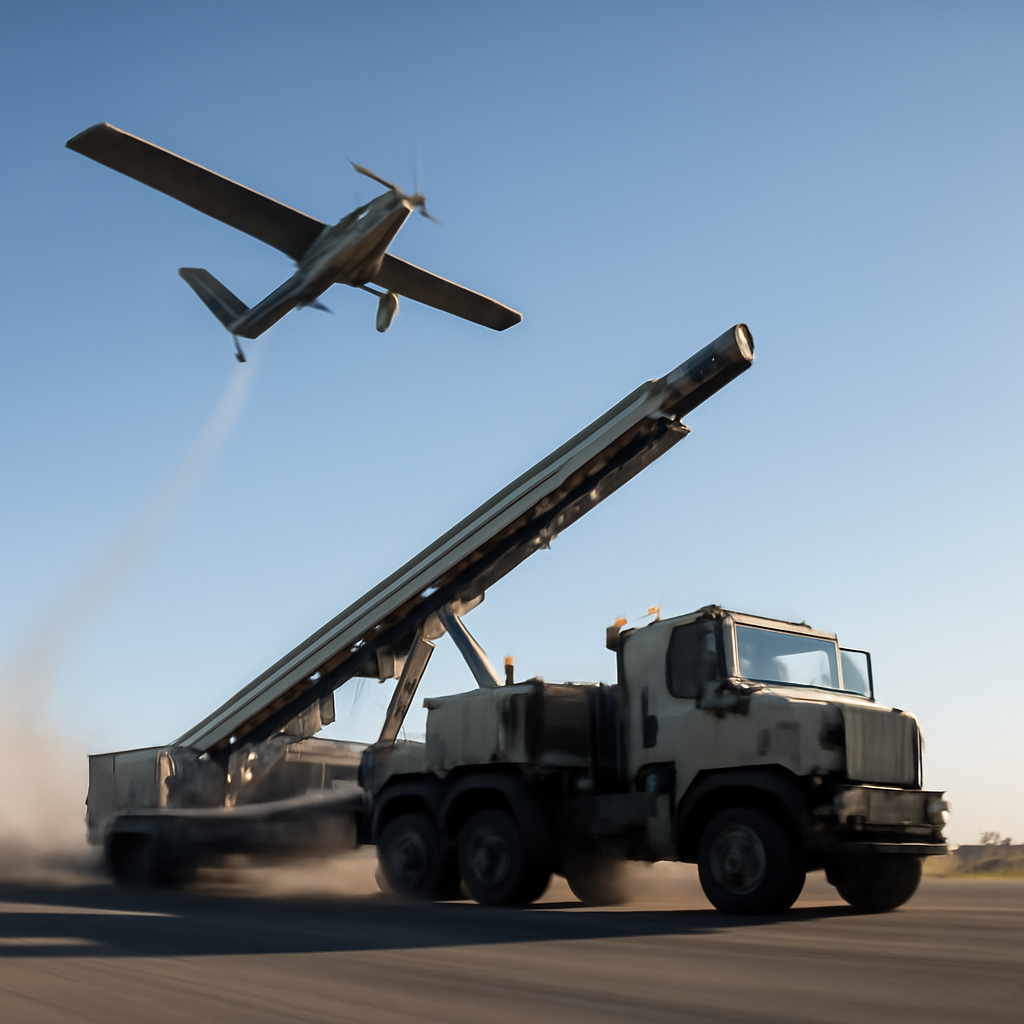
“Annual production of 2,000 of these containerized systems, collectively, is now being targeted,” reads a machine translation of a social media post linked to the Beijing Institute of Technology’s School of Mechanical Engineering.
A three-truck EMALS in motion: the footage and what it shows
Video that began circulating on social media and appears to originate from a post by the Beijing Institute of Technology’s School of Mechanical Engineering shows a propeller-driven drone launched from a modular, road-mobile electromagnetic aircraft launch system (EMALS) made up of three trucks. The drone is described in the footage as a high-wing monoplane with a v-tail and tricycle landing gear. Earlier public displays of the system showed a four-truck configuration paired with stealthy collaborative combat aircraft (CCA)-like drones or mockups.
The clips trace the trucks traveling separately in convoy, then joining together. Observers noted covers atop the trucks with hinges or large straps, a prominent locking point at the front of each vehicle, and an extreme all-wheel steering capability that allows the linked vehicles to turn in a roughly flat circle. The tight turning ability would permit the assembled catapult to be pointed into the wind before a launch — a necessary capability in confined operating areas, the footage suggests.
Containerized family: missiles, CIWS, radars, EW, and EMALS
The video and an accompanying graphic present the EMALS as part of a broader family of containerized weapons, sensors, and command systems exhibited earlier this year aboard the vessel Zhong Da 79. The graphic shows containerized versions that include launchers for land-attack and anti-ship cruise missiles, surface-to-air missiles, radars, electronic warfare suites, and command-and-control modules. It also depicts containers fitted with a single Type 1130 30mm close-in weapon system (CIWS) or two Type 726 defensive launchers, and a container containing a single EMALS catapult truck and another with a disassembled drone resembling the one launched in the video.

Audit-ready is a season. It shouldn't be.
Evidence in spreadsheets, controls drifting between audits, frameworks multiplying on flat headcount. Nubivance runs continuous compliance on Rapid7 Cyber GRC - SOC 2, HIPAA, ISO 27001, PCI, CMMC.
End the scrambleWho participated and who did not appear on the list
The social media post credited more than 70 participating organizations and explicitly names China State Shipbuilding Corporation (CSSC), China North Industries Group Corporation (NORINCO), China Aerospace Science and Industry Corporation (CASIC), China Aerospace Science and Technology Corporation (CASC), China Electronics Technology Group Corporation (CETC), and the Aviation Industry Corporation of China (AVIC). Tiantao Technology — a company publicly discussing a modular, wheeled, ground-based EMALS since at least August 2025 — is not named on that list, though the article notes Tiantao has shown renderings of a visually different modular system and has claimed launch capability for drones up to roughly 2.2 tons (two metric tons).
Technical limits, logistics, and operational questions
The published material raises several technical and operational unknowns. The footage and associated reporting do not show how drones are loaded onto the truck-mounted EMALS, a detail that would affect launch tempo; one previously noted cycle concept would see trucks carrying drones drive up, lock into the rear of an existing track, and detach after launch. Power and logistical footprints required to operate a mobile EMALS on land or at sea are also not shown, and the reporting highlights uncertainty about how the system would perform when embarked on a ship not originally designed for flight operations — including whether the truck-mounted arrangement would be stable enough to launch aircraft from a pitching deck.
Modularity is presented as both a capability and a variable: modular segments could, in principle, scale the total track length (Tiantao has suggested configurations between roughly 20 and 60 meters), and electromagnetic catapults are noted as offering finer control and shorter reset times than steam systems. The reporting also emphasizes dispersal and concealment advantages — components and drones stored in shipping containers and the ability to break the system into multiple trucks to complicate targeting.
What this means for the PLA, Beijing Institute of Technology and defense groups, and ship operators
- People’s Liberation Army (PLA) operational planners: The system is framed as tailor-made for expeditionary scenarios, island-hopping campaigns, and operations in remote, high-altitude border areas where runways are scarce; planners would gain a mobile option to position a tier of airpower closer to operating areas.
- Beijing Institute of Technology and participating defense groups (CSSC, NORINCO, CASIC, CASC, CETC, AVIC): Public posting and demonstration aboard Zhong Da 79 underline active collaboration between academic research institutions and state-owned defense industry firms on containerized combat and sensor modules.
- Ship operators and expeditionary logistics planners: The ability to load containerized EMALS and other modules aboard a vessel such as Zhong Da 79 suggests a way to convert ships into multi-purpose platforms, but the reporting leaves open how stability, power generation, and launch sequencing would be managed at sea.
The video marks the first public showing of a Chinese modular, road-mobile EMALS actually launching a drone and situates that capability inside a wider program of containerized weapons and sensors that the Beijing Institute of Technology’s School of Mechanical Engineering and dozens of partners have been promoting. The demonstration underscores operational possibilities — rapid, dispersed launch capability from land or ad hoc ships — while leaving practical constraints about power, drone handling, and shipboard stability squarely unresolved.