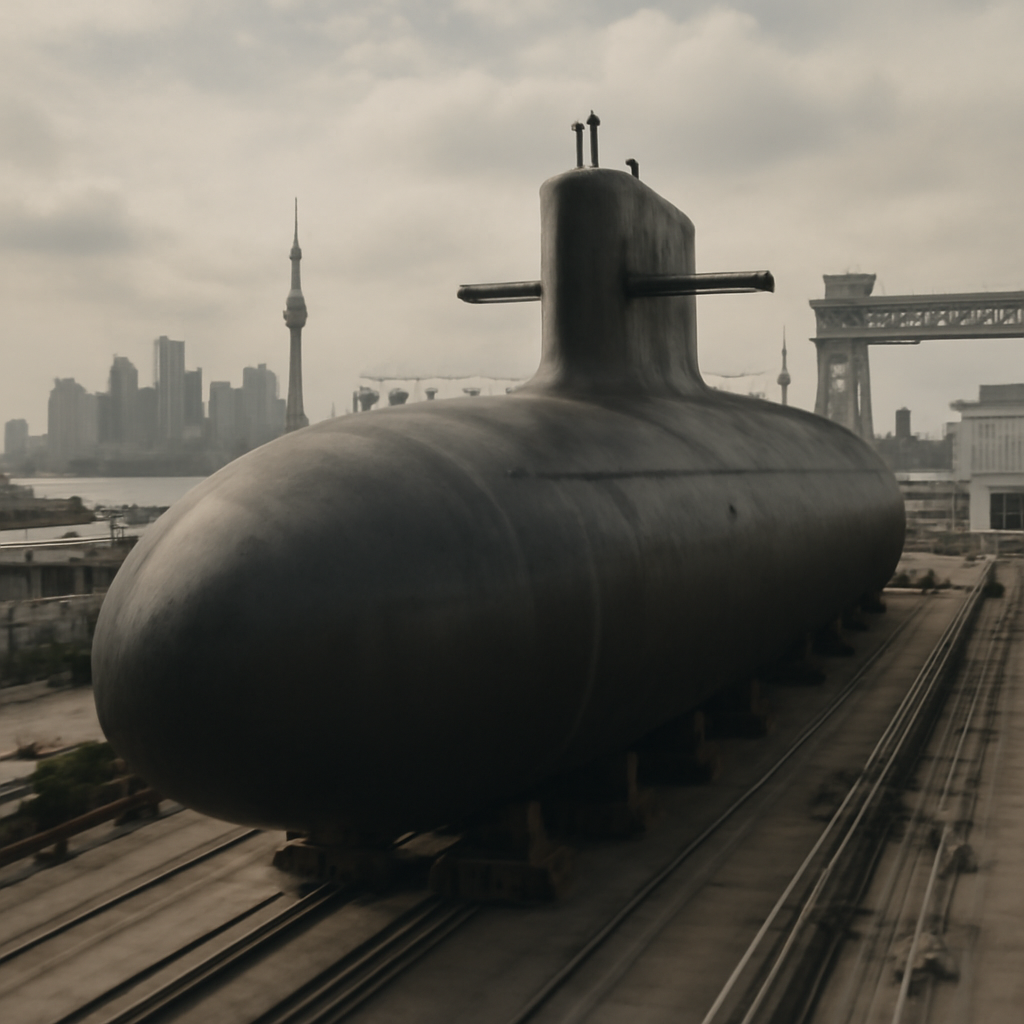
“From the imagery, the submarine does not have a traditional sail.”
Imagery from JN (Jiangnan) Shipyard, Shanghai — June 1, 2026
Satellite imagery acquired by TWZ and credited to Vantor (previously Maxar Technologies) shows a previously unreported large submarine at JN Shipyard in Shanghai on June 1, 2026. Naval News reported the boat first appeared at the shipyard toward the end of May. The name or formal designation of the vessel has not been reported.
Size and measured design features (H.I. Sutton assessment)
Undersea warfare analyst H.I. Sutton, writing for Naval News, assessed the hull at roughly 394 feet (120 meters) long and between 33 and 36 feet (10 and 11 meters) wide. That length is larger than common diesel-electric attack submarines and is longer than many modern nuclear fast attack designs cited in the reporting: the Type 093 SSN variants were noted at about 356 to 360 feet (108–110 meters) long and 36 feet wide, while the U.S. Virginia-class SSN length and beam figures included in the source are 377 feet (114.8 meters) and 34 feet (10.36 meters).

Audit-ready is a season. It shouldn't be.
Evidence in spreadsheets, controls drifting between audits, frameworks multiplying on flat headcount. Nubivance runs continuous compliance on Rapid7 Cyber GRC - SOC 2, HIPAA, ISO 27001, PCI, CMMC.
End the scrambleNotable design choices: no traditional sail; X-form stern
The most conspicuous detail in the imagery is the apparent absence of a traditional sail. The exact shaping of what is present atop the hull is not fully clear from the available view, but the lack of a conventional sail is unmistakable in the published imagery. The submarine also appears to feature an X-form rudder configuration at the stern — a feature the source documents first appearing on a Chinese submarine in 2024 and one now commonly associated, unofficially, with the next-generation Type 095 attack-submarine design. The vessel may also have a shrouded propulsor consistent with a pumpjet, which the source notes would favor quieter operation at higher submerged speeds.
Operational trade-offs: speed and stealth versus surface capability
The report lays out the familiar engineering trade-offs for low-profile, sailless hullforms: omitting a tall sail streamlines the hull, reducing drag and enabling better optimization for submerged speed, maneuverability, and potentially lower acoustic signature — attributes useful for high-speed transits and harder-to-detect operations. At the same time, the absence of a traditional sail removes the usual mounting point for periscopes and sensor masts, extendable communications antennas and snorkels, and space that can be used for countermeasure launchers or storage. The sail also serves as a key platform for navigation and situational awareness while running on the surface and for vertical replenishment (VERTREP) or local force protection; the source illustrates the sail’s operational importance with a photo of the U.S. Navy Los Angeles-class USS Santa Fe breaking ice during an Arctic exercise in March 2026.
Lineage: a 2018 JN demonstrator and a large UUV concept from CSSC
JN Shipyard previously launched a smaller low-profile submarine in 2018. H.I. Sutton estimated that earlier boat at roughly 150 feet (45 meters) long and about 15 feet (4–4.5 meters) wide; that design had a non-X rudder arrangement and an unshrouded propeller. The exact use and configuration of that demonstrator over the intervening years are not disclosed, but the report treats it as a possible testbed for the concept. Separately, at the 2024 Zhuhai Airshow, state-run China State Shipbuilding Corporation (CSSC) exhibited a model of an unusually large diesel-electric uncrewed underwater vehicle (UUV) whose broad hullform resembled the earlier JN sailless design. CSSC said the drone submarine concept could be configured for multiple missions, including attacking enemy vessels, laying mines, supporting special operations forces, or serving as a mothership for smaller UUVs. JN Shipyard is a CSSC subsidiary.
What this means for the PLAN, CSSC, and U.S. naval observers
- PLAN (People’s Liberation Army Navy): The reported attributes — large hull, streamlined profile, X-form stern and possible pumpjet — suggest a design trade toward higher-speed, lower-signature underwater transits and potentially seabed or blue-water roles rather than a traditional emphasis on surfaced operations.
- CSSC (China State Shipbuilding Corporation): The appearance of a large sailless hull at a CSSC yard aligns with the corporation’s prior public display of large UUV concepts and with JN’s earlier 2018 demonstrator, indicating continued institutional investment in low-profile hullforms and possibly in manned or optionally crewed variants.
- U.S. naval observers and analysts: The observed configuration — especially the absence of a sail and the presence of an X stern — will inform assessments of Chinese design experimentation and potential mission sets, and will be weighed alongside other recent launches, such as a more traditional-sail submarine reported launched at Bohai Shipyard that may be a Type 095.
The vessel at JN Shipyard adds a concrete data point to a pattern of Chinese shipbuilding experimentation with low-profile hullforms and uncrewed concepts. Whether the boat is crewed, optionally crewed, or designed as a very large UUV is not stated in the available reporting; what the imagery does show is a clear decision to depart from the long-familiar silhouette of a tall sail. That choice amplifies certain underwater advantages while constraining surface-facing capabilities — a trade the People’s Liberation Army Navy and China State Shipbuilding Corporation appear prepared to explore further.