"Well, there it is at last — the long‑rumored Chinese Expeditionary Mobile Base (ESB) finally crawls out of the shadows," the China Defense Blog reported after China State Shipbuilding Corporation published an official photograph of the vessel’s civilian variant.
China State Shipbuilding Corporation released an official photo
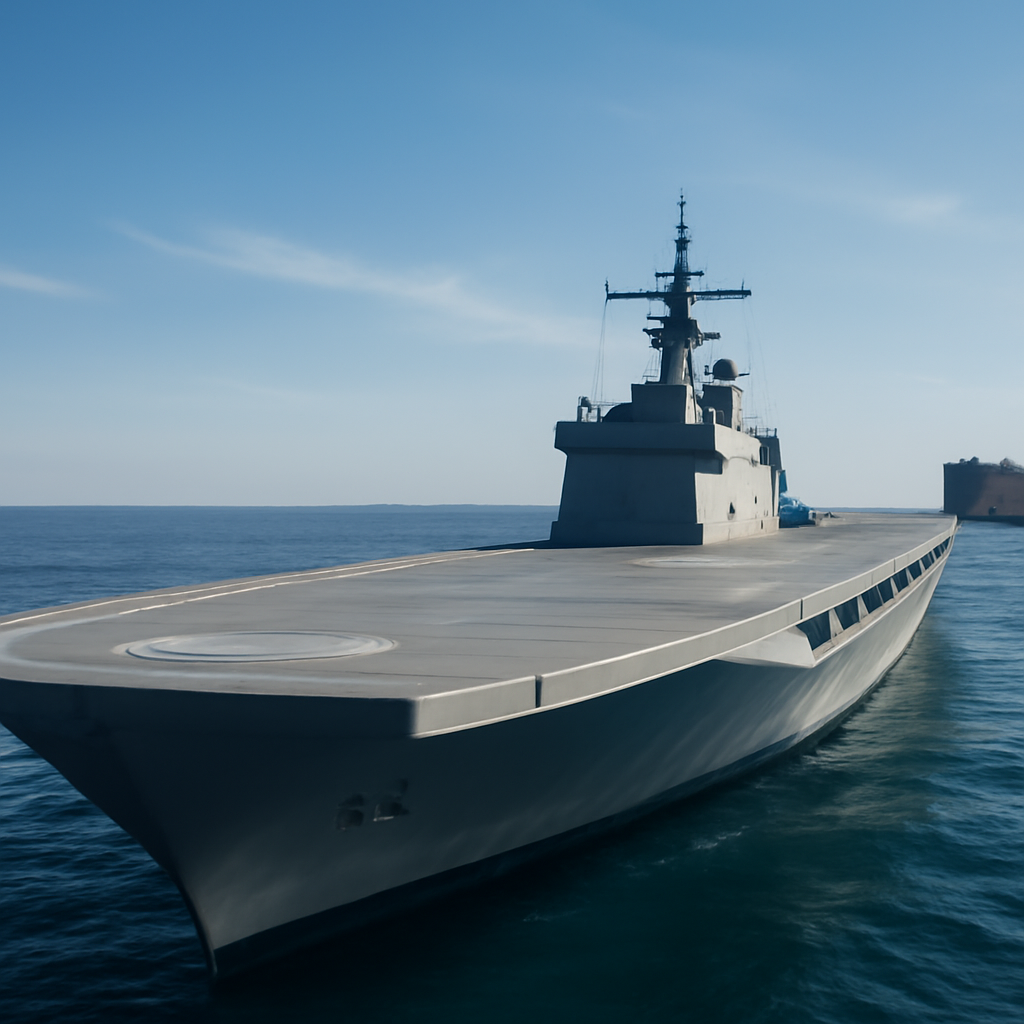
The photo, supplied by China State Shipbuilding Corporation (CSSC), shows a civilian version of an ESB concept. According to the blog, the platform is built on a civilian bulk carrier hull of roughly 10,000 tons — a detail that aligns with earlier online rumors. The image also includes what the author calls “a huge tanker under construction in the back.”
Design: civilian bulk carrier hull and two helicopter H spots
The unveiled ESB is described as a proof‑of‑concept fitted to a commercial hull rather than a bespoke military platform. The blog notes the vessel features two helicopter “H” spots — a limited aviation footprint compared with larger ESB designs. The emphasis in the source is on low‑risk, low‑cost experimentation using an existing commercial hull form.

Audit-ready is a season. It shouldn't be.
Evidence in spreadsheets, controls drifting between audits, frameworks multiplying on flat headcount. Nubivance runs continuous compliance on Rapid7 Cyber GRC - SOC 2, HIPAA, ISO 27001, PCI, CMMC.
End the scrambleHow this compares to USS Lewis B. Puller (ESB‑3)
The blog explicitly compares the Chinese concept with the U.S. Navy’s USS Lewis B. Puller (ESB‑3). It notes that the Puller “rides on an Alaska‑class tanker hull and is run by Navy civilian mariners.” The author cautions that China’s civilian‑hull ESB “isn’t a peer to the USS Puller,” describing the Chinese vessel as a smaller, cheaper trial balloon rather than an equivalent capability.
Operation Epic Fury and the renewed focus on naval logistics
The posting places this reveal in the wake of Operation Epic Fury, which the blog says unexpectedly made naval logistics a high‑profile topic among “professional naval officers, think‑tankers, and online armchair admirals.” In that debate, ESBs became central to discussions about sustainment and afloat support. The blog frames the Chinese development as part of a longer, quieter program of experimentation rather than a sudden shift in doctrine.
PLAN testing pattern and the "Chinese civilian sector" approach
The author argues that the People’s Liberation Army Navy’s (PLAN’s) usual practice — as characterized in the post — is to trial new concepts on commercial hulls: “test the idea on a civilian hull, get something in the water quickly, keep costs down, and if the experiment flops, quietly retire it.” The line is followed by a parenthetical correction that attributes the practice to the “Chinese civilian sector,” reflecting the author’s view that civilian yards and hulls serve as low‑risk testbeds for naval ideas.
What this means for professional naval officers, think‑tankers, and online observers
- Professional naval officers: will watch whether the two‑spot aviation deck and commercial hull limit or enable the kind of afloat support missions discussed during Operation Epic Fury; they were already engaged in logistics debates after that operation.
- Think‑tank analysts: will use the CSSC photo and the vessel’s 10,000‑ton bulk carrier basis to gauge intent and scale, comparing it explicitly to the USS Lewis B. Puller (ESB‑3) as a point of reference.
- Online armchair admirals and open observers: are already parsing the image for details — the two H spots, the commercial hull, and the large tanker under construction visible in the background — to assess whether this is a durable capability or a low‑cost experiment.
The public release by CSSC turns rumor into tangible evidence: a commercially derived ESB photo, a stated displacement on the order of 10,000 tons, and a modest aviation fit of two helicopter spots. By the blog’s account, the vessel reflects a deliberate, low‑risk approach to maritime experimentation — testing capability on a civilian hull before committing to larger, purpose‑built warships. Whether this platform matures into a sustained program or remains a short‑lived prototype is the central, unanswered question the image poses.