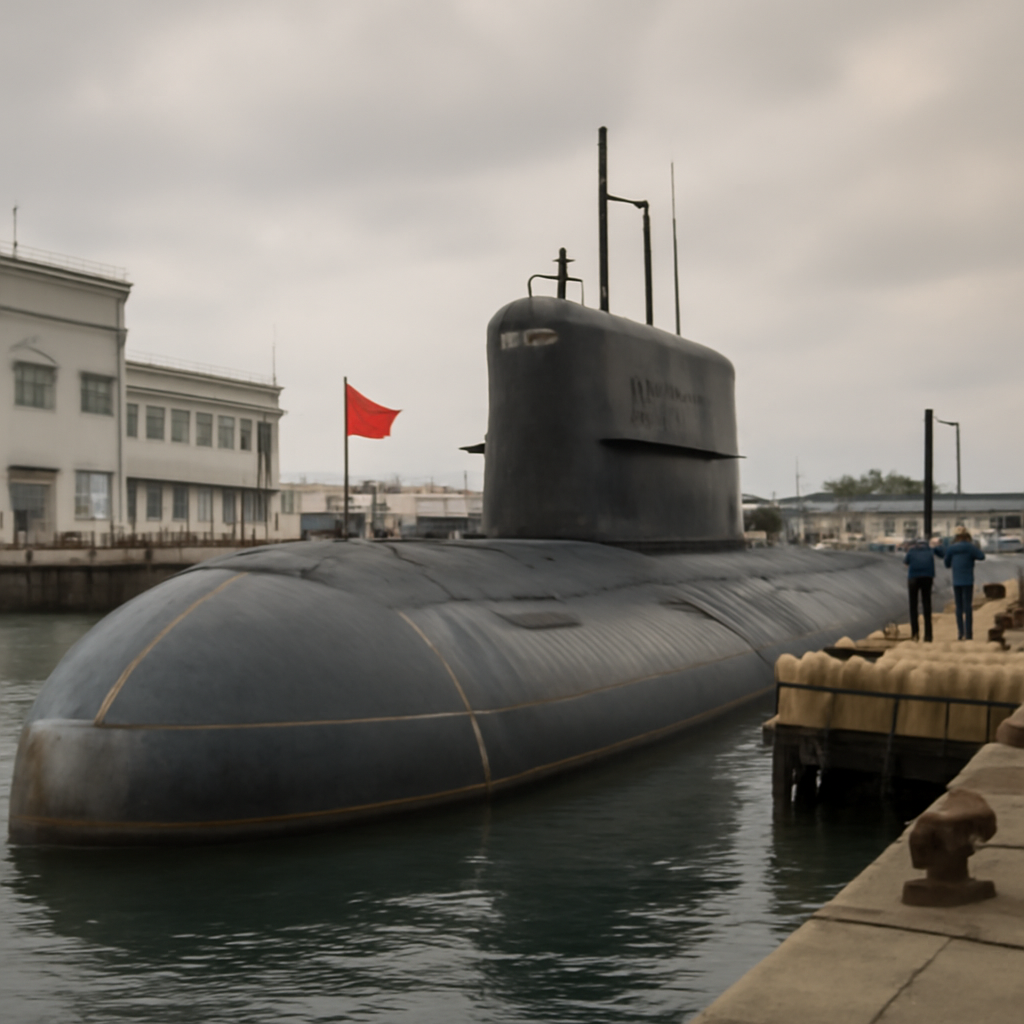
"Kilo 877EKM pennant 365 was imported from Russia, arrived in 1995, and decommissioned in 2021."
Kilo 877EKM pennant 365: service life, refits, and Sino‑ization
Kilo 877EKM pennant 365 spent much of its service life undergoing refits rather than extended operations. The boat arrived in 1995 and was decommissioned in 2021. During those refits the PLAN replaced Russian subsystems with Chinese communications and electrical equipment and installed a H/ZQQ‑5 photoelectric mast in place of the original optical periscopes. The source also highlights the PLAN's broader practice of prioritizing domestic subsystems even on foreign‑built platforms, noting an encrypted communication system and other Sino‑ization efforts across the fleet.
Counting the retirements: three confirmed Kilo exits
The public record, as compiled in the source material, identifies three categories of retired Kilo boats from China’s original acquisitions. The confirmed retirements are:
- 2 Project 877EKM boats (ordered 1993)
- 2 Project 636 boats (ordered 1997)
- 8 Project 636M Improved Kilo boats (ordered 2002)
Some retired Kilos are being preserved as museum pieces: at least one Kilo was slated to become part of the Zhanjiang Bay Cultural Tourism Base tourist attraction, underscoring that retired hulls are, for now, more often local exhibits than foreign fleet transfers.

Audit-ready is a season. It shouldn't be.
Evidence in spreadsheets, controls drifting between audits, frameworks multiplying on flat headcount. Nubivance runs continuous compliance on Rapid7 Cyber GRC - SOC 2, HIPAA, ISO 27001, PCI, CMMC.
End the scrambleMing‑class transfers to Bangladesh and Myanmar — sustainment vs capability
The PLAN has transferred retired Ming‑class boats abroad: two Type 035G Ming‑class submarines went to Bangladesh and one Type 035B Ming‑class boat to Myanmar. The source argues there is a plausible reason for this pattern. Although the Kilo is "clearly the superior submarine" on paper, a former PLAN Ming may be easier for countries such as Bangladesh or Myanmar to operate because the Ming sits "entirely within a Chinese logistics, training, maintenance, and support ecosystem." By contrast, the Kilo remains fundamentally Russian in origin, bringing with it distinct sustainment challenges.
Operational and legal barriers to exporting retired Kilos
The source suggests three non‑exclusive explanations for why retired PLAN Kilos have not followed the Ming transfers into foreign service: they may be insufficiently attractive to other navies; too complicated to support outside the PLAN; or blocked by contractual legal restrictions. Modern arms contracts often include end‑user and third‑party transfer restrictions that prevent resale without the original supplier's consent. The author searched for details in the original Sino‑Russian Kilo contracts but "found nothing publicly available that addresses this question." That absence does not disprove the existence of Russian approval rights, but it leaves open the possibility that Moscow could retain a say in any future re‑export.
What this means for the PLAN, Bangladesh, and Myanmar
- The PLAN: The source frames a clear shift in how the PLAN values platforms — not as standalone weapons but as nodes in an integrated combat system. Platforms that cannot be effectively integrated into satellites, maritime patrol aircraft, over‑the‑horizon radars, unmanned systems, shore commands, and surface combatants risk being retired even if their hulls are not chronologically old.
- Bangladesh and Myanmar: For recipient navies, logistical simplicity matters. The source suggests that the Ming transfers may be more operationally useful to these states than a second‑hand Kilo, because Ming boats fit the Chinese maintenance and training ecosystem more readily.
- Museum planners and domestic audiences: The conversion of at least one Kilo into a museum ship at Zhanjiang Bay demonstrates a domestic choice to preserve retired vessels for public display rather than pursue foreign resale.
Conclusion: capability, compatibility, and the calculus of retention
The larger lesson in the source material is thematic rather than technical: the PLAN evaluates a platform by how well it contributes to an integrated strike package. As the author puts it, "A Kilo operating alone is still a capable submarine. A Kilo that cannot fully participate in the PLAN's integrated combat architecture is just another aging platform taking up pier space." The Kilos filled a gap when China's indigenous submarine programs were struggling, provided operational experience, and likely influenced later Chinese development — but their future in PLAN service, export potential, or retirement as museum pieces ultimately depends on compatibility with a networked combat approach and, possibly, contractual constraints beyond Beijing's sole control.