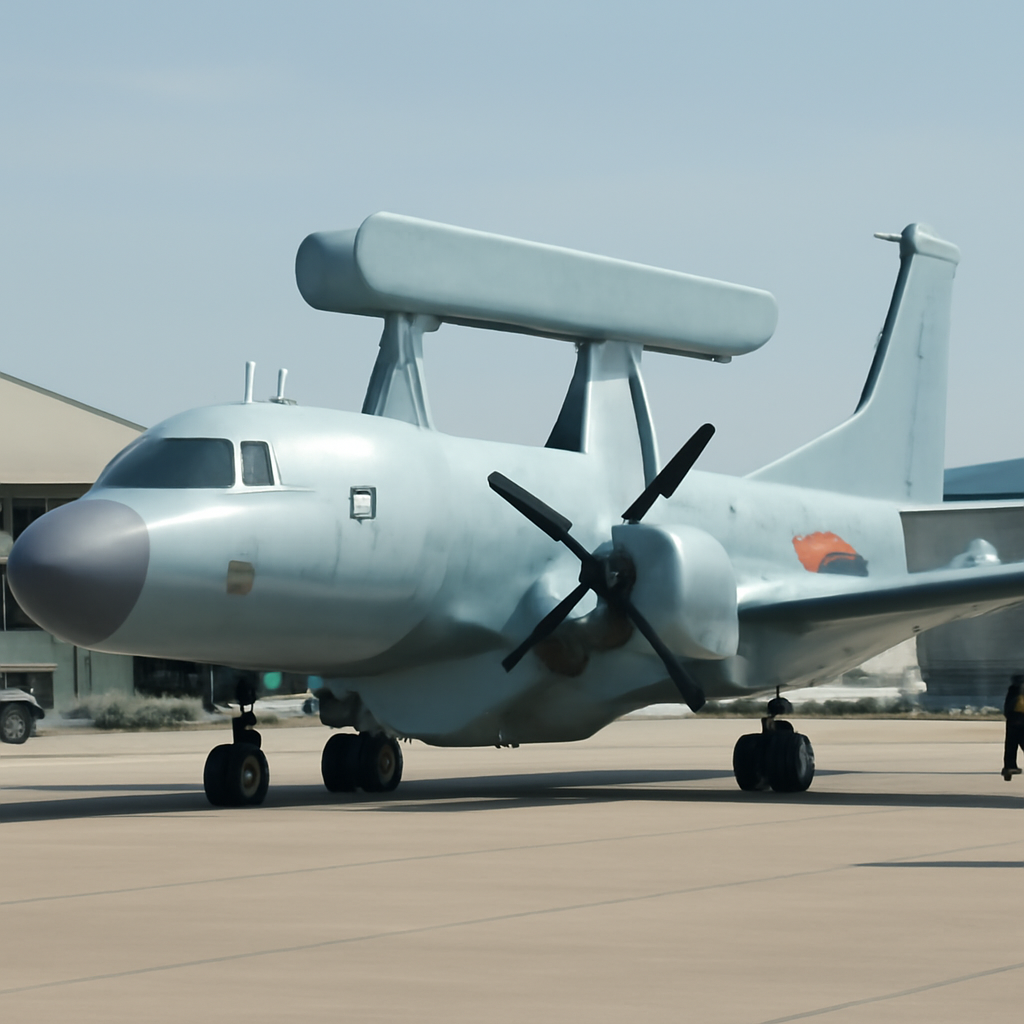
"These are but three recent examples that illustrate the steady pace of new crewed special mission aircraft revealed to the public over the last few years," the reporting notes, summarizing a visible surge in Chinese airborne ISR and electronic-warfare types.
Three recent reveals — GX-19, Y-9PT (GaoXin-18), and Y-9GR
In early June, images of a previously unseen Chinese airborne early-warning and control (AEW&C) aircraft—likely the GX-19—circulated on the Chinese internet. That followed December 2025 photos of a new special-mission aircraft provisionally designated Y-9PT (GaoXin-18), which resembled the U.S. AC-130J gunship, and May 2026 pictures showing the Y-9PT airborne for the first time, signaling concrete progress in testing. Separately, first public images of a multirole electronic warfare platform, the Y-9GR, appeared in April 2025, with subsequent test-flight imagery released later. Taken together, those three types are emblematic of a broader, visible expansion in China’s crewed special-mission fleet.
AEW&C expansion: quantity, diversity, and new airframes
The People’s Liberation Army Air Force (PLAAF) and the People’s Liberation Army Navy – Air Force (PLAN-AF) have significantly increased airborne early-warning capacity over the last decade. The KJ-500 has become a workhorse for both services, and China is introducing two distinct Y-9–based AEW&C variants while developing a larger, turbofan-powered, Y-20–based KJ-3000 intended as a replacement for the KJ-2000. Simultaneously, China is introducing the carrier-borne KJ-600. According to the reporting, the PLA has become one of the largest operators of AEW&C platforms—behind only the U.S.—and fields the most modern and diverse fleet in any region.

Audit-ready is a season. It shouldn't be.
Evidence in spreadsheets, controls drifting between audits, frameworks multiplying on flat headcount. Nubivance runs continuous compliance on Rapid7 Cyber GRC - SOC 2, HIPAA, ISO 27001, PCI, CMMC.
End the scrambleElectronic warfare as a strategic priority
China has emphasized electronic warfare through multiple approaches: fighter-derived electronic-attack jets and a family of Y-9–based EW variants. Public unveilings in 2021 and 2024 showed dedicated electronic-attack derivatives of the J-16 and J-15, the latter explicitly capable of carrier operations on China’s carriers. The Y-9 family includes the multipurpose Y-9DZ (spotted routinely in Japanese and Taiwanese ADIZs since 2023), the Y-9JB electronic-intelligence aircraft, the Y-9G theatre suppression aircraft (entered service in 2019 to replace the Y-8G), the Y-9LG (seen during Sino-Thai Falcon Strike 2024), and the Y-9GR (first observed April 2024). These platforms provide the PLA with ELINT, SIGINT, jamming and geolocation capability, and, in some configurations, synthetic-aperture radar and imagery collection in the same airframe.
Platform commonality, range limits, and basing choices
Most new special-mission types are built on the Shaanxi Y-9 turboprop platform, which replaced older Y-8–based types. The Y-9’s WJ-6C turboprops, six-bladed propellers, and higher cruise altitude give a roughly 10,000 lb higher maximum takeoff weight and improved speed, range and sensor horizons. China’s approach favors rapid, iterative design and fielding: each emergent type or variant incorporates improved sensors and subsystems, and many new builds are multipurpose to consolidate missions and reduce sortie counts.
Range remains a constraint. The reporting states Chinese special-mission aircraft cannot yet reach Guam, much less Hawaii or the continental United States, because of primary aircraft range limits and a general lack of aerial-refueling capability—though some recent variants are fitted with inflight-refueling booms to extend range and on-station time. To extend reach without longer-range platforms, China routinely operates these aircraft from outposts in the South China Sea—Woody Island in the Paracels and Fiery Cross, Subi, and Mischief reefs in the Spratlys—permitting routine monitoring of surface, subsurface, air and shore activity across nearby littorals.
How the PLAAF, Japan and Taiwan, and the U.S. and its allies will respond
- PLAAF and PLAN-AF: Will continue to integrate multipurpose Y-9 derivatives, fighter-based EW jets, and larger Y-20–class AEW&C into joint “informationized warfare” concepts, using improved airborne nodes to collect, analyze, and disseminate electronic-order-of-battle intelligence within China’s near seas.
- Japan and Taiwan (regional militaries): Have already encountered Y-9DZ and other platforms in their ADIZs; they can expect a more persistent, layered PLA airborne ISR presence enabled by shorter sortie requirements from multipurpose types and by South China Sea forward basing.
- U.S. and its allies: Face a PLA fleet that has closed gaps in quantity and, in some areas, capabilities; the PLA’s emphasis on diverse AEW&C and EW nodes complicates regional situational awareness contests, even as PLA operations remain focused on the Yellow, East and South China Seas and the Western Pacific.
China’s special-mission-aircraft expansion is not a single technical leap so much as an accelerating industrial practice: iterative upgrades to trusted airframes, rapid fielding of both dedicated and multipurpose variants, and a deliberate basing strategy to multiply reach. The central open question—implicit in the reporting—is how far that combination of platform diversity, multipurpose design, and selective aerial-refueling adoption will push the PLA’s operational reach beyond its current near-seas focus.
https://thediplomat.com/2026/06/chinas-special-mission-aircraft-boom/