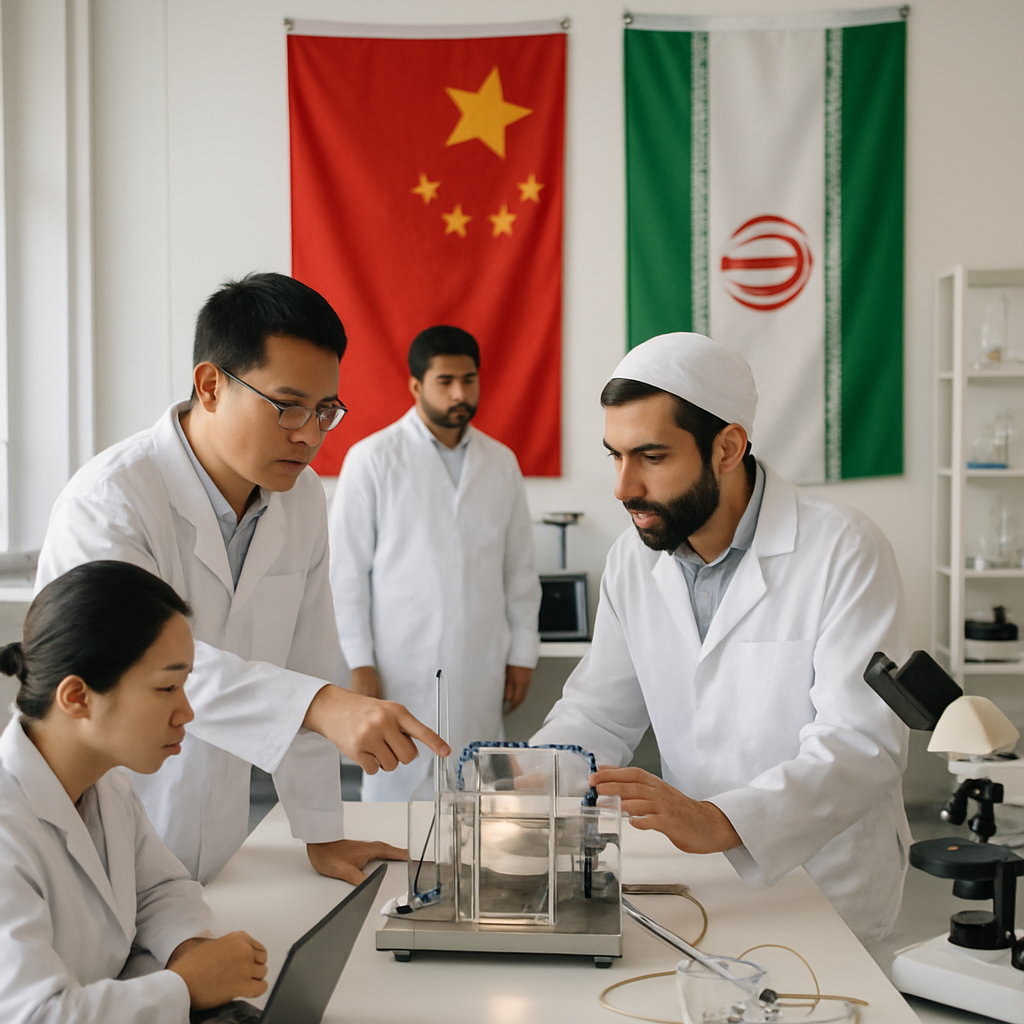
The CDUT now covers more than 180 Chinese civilian and military research institutions, and the latest update adds new detail on a string of China–Iran research links over the past 15 years.
Government-to-government pacts: 2016 and 2017 agreements
The update documents formal agreements signed directly between Iranian government agencies and leading Chinese research institutions. In 2016 the Chinese Academy of Sciences signed an agreement with Iran’s Office of the Vice President for Science and Technology to pursue collaboration in nanotechnology, renewable energy, cognitive science and biotechnology—and, in a 2025 update to that agreement, artificial intelligence. In 2017 the Iranian Space Agency established a contractual partnership focused on microsatellite development with Beihang University.
University exchanges and targeted training: Tsinghua, Sharif and doctoral students
Bilateral government engagement facilitated university-level ties. In 2013 a delegation of top Iranian ministers of science and technology announced that top Iranian universities would send 50 doctoral students to Tsinghua University for training in nanotechnology, aerospace and the cognitive sciences. Tsinghua has continued engagement with Iranian universities; in 2025 a delegation from Sharif University of Technology visited Tsinghua University’s Institute for AI International Governance.

The cyber insurance questionnaire just landed. Now what?
SOC 2, HIPAA, insurance renewals - someone has to own security strategy. Nubivance provides fractional CISO leadership without the full-time salary.
Get a security leadDual-use focus areas: nanotechnology, aerospace and AI
The CDUT additions emphasise fields with dual-use potential. Nanotechnology and aerospace are called out for well-documented dual-use applications, while the 2025 mention of AI is noted for its potential gains across surveillance, autonomous systems and missile guidance. The update is careful to state that "whether these collaborations have yielded militarily significant outputs remains difficult to assess from open sources," a limitation that the tracker’s institution-level records aim to mitigate.
Scale and pattern: limited China–Iran output versus rapid China–Russia growth
ASPI’s update characterises the overall volume of China–Iran joint research as low. For many Chinese institutions in the tracker, the researchers found little to no evidence of significant joint dual-use research with Iranian counterparts; for some institutions, the only joint work in critical or dual-use technology was a single publication. That pattern stands "in sharp contrast" to China’s ties with Russia: ASPI’s 2025 CDUT update showed China–Russia joint research programmes grew dramatically since 2019, with most Chinese universities in the tracker having at least some connection to Russian research institutions.
What this means for universities, governments, and companies
- Universities: The tracker gives university administrators a way to examine an individual institution’s research record, defence affiliations and known Iranian partnerships so they can weigh risks before accepting students, hosting collaborations, or entering formal agreements.
- Governments: Regulators and research-security officials can use the refreshed sanctions sweep—covering nine sanctions and restriction lists from the United States, Canada, Japan, Belgium, the European Union and Taiwan—to better target export controls and screening of partnerships.
- Companies: Corporates and procurement teams monitoring supply chains and partnerships will find the institution-level detail useful for due diligence and investment screening, especially where a Chinese institution has documented ties to Iranian government agencies.
The CDUT refresh also includes a comprehensive update to sanctions information across the tracker and navigational improvements intended to surface risk-relevant information. The tracker is described as a tool to support export control compliance, research security assessments, international academic partnerships, due diligence, investment screening and informed public debate; it draws notable international traffic from the United States, Japan, Hong Kong, Australia, Canada, Britain, Germany, Singapore, France, Taiwan, the Netherlands and India.
ASPI’s update offers a modest but concrete set of institution-level entries showing how China and Iran have pursued collaboration in technologies with dual-use potential. As the update puts it, the pattern may reflect "lack of capacity on the Iranian side or a cautious approach from the Chinese side"—enough engagement to build relationships and signal solidarity, but limited in scale. Whether those documented ties have produced militarily significant outputs remains difficult to assess from open sources; the CDUT’s value is in letting users interrogate the institutional detail rather than relying on headline claims.
Read the original ASPI analysis: ASPI’s China Defence Universities Tracker: China–Iran research ties