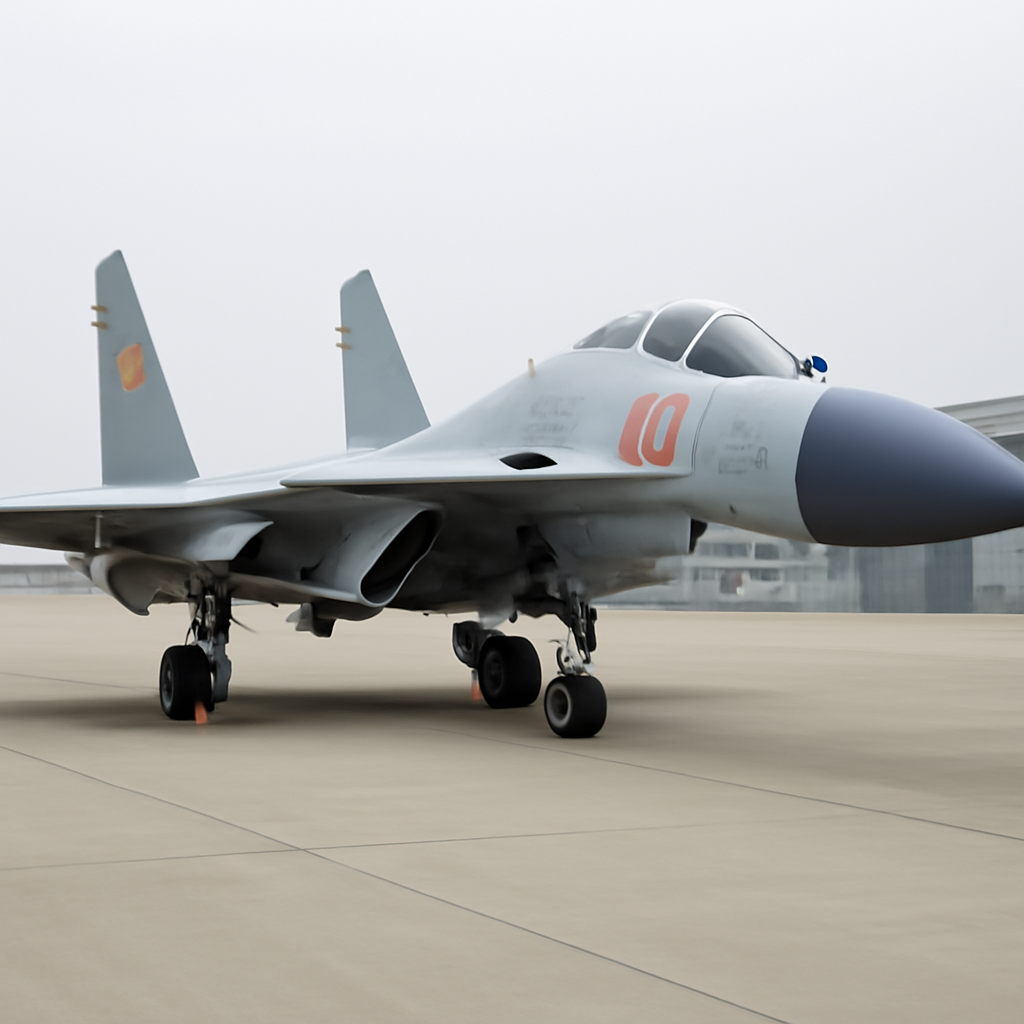
"If anything, the J‑15 is the least surprising case in the entire PLAAF/PLAN fighter lineup," the China Defense blog wrote, and the line captures the central fact the post presents: the J‑15 — nicknamed the "Flying Shark" — remains a Flanker derivative that retains its original Russian-pattern internal cannon.
The J‑15 and its Russian-pattern internal cannon
The brief post is built around one visible continuity: the J‑15 keeps the original Russian-pattern internal cannon common to Flanker-family fighters. That single technical point is presented not as an anomaly but as confirmation of a broader design approach. The aircraft's nickname, "Flying Shark," appears alongside the observation that its internal weapon arrangement follows the established Flanker pattern.
Flanker derivative lineage and design continuity
Describing the J‑15 as a Flanker derivative frames the aircraft first and foremost by lineage. In the post's telling, that lineage largely determines what remains unchanged: the basic airframe and the internal cannon arrangement. The blog presents this continuity as unsurprising, implying that derivatives commonly preserve core structural and weapons placements even as other systems evolve.

Audit-ready is a season. It shouldn't be.
Evidence in spreadsheets, controls drifting between audits, frameworks multiplying on flat headcount. Nubivance runs continuous compliance on Rapid7 Cyber GRC - SOC 2, HIPAA, ISO 27001, PCI, CMMC.
End the scrambleChina's pattern: indigenize engines, avionics, EW suites
The post places the J‑15 in a wider trend the author sees across Chinese hardware development: "China indigenizes almost everything except the basic airframe. Engines, avionics, EW suites," the entry notes. That triad — engines, avionics, electronic warfare (EW) suites — is cited explicitly as the areas that are typically replaced or domestically developed while the airframe itself remains in the original form. The blog presents this as a familiar pattern rather than an isolated design choice.
What this means for the PLAAF/PLAN, and Chinese defense engineers
- PLAAF/PLAN: For the People's Liberation Army Air Force and the People's Liberation Army Navy aviation elements named in the post, the immediate implication is operational continuity. Operating a Flanker-derived platform with a familiar internal cannon arrangement allows doctrine, training, and logistics built around that airframe to remain relevant even as other systems change.
- Chinese defense engineers: For the engineers and manufacturers driving indigenization, the post highlights a pragmatic division of labor — retain a proven airframe while focusing development effort on engines, avionics, and EW suites. The blog frames those subsystems as the primary targets for domestic replacement or upgrade.
The post's compact argument is as much about pattern recognition as it is about a single aircraft. By holding up the J‑15 as "least surprising," the author invites the reader to see the aircraft as a representative example rather than an exception. The observable choice to preserve the Flanker-derived internal cannon while pursuing indigenous subsystems is presented as an engineering and procurement logic repeated elsewhere in Chinese military aviation, at least according to the blog.
The material leaves a pointed, practical question in its wake: if engines, avionics, and EW suites are the primary focus of indigenization, how long will the basic airframe remain the one major element consistently carried forward? The post doesn't answer that; it simply records the current state and the pattern that produces it.