Thirty‑nine Type 59D / ZTZ‑59D main battle tanks have already been delivered to Cambodia out of a planned 93, a striking tally that underlines how long the Type 59 continues to circulate on the international market.
Delivery snapshot: Cambodia has received 39 of 93 Type 59Ds
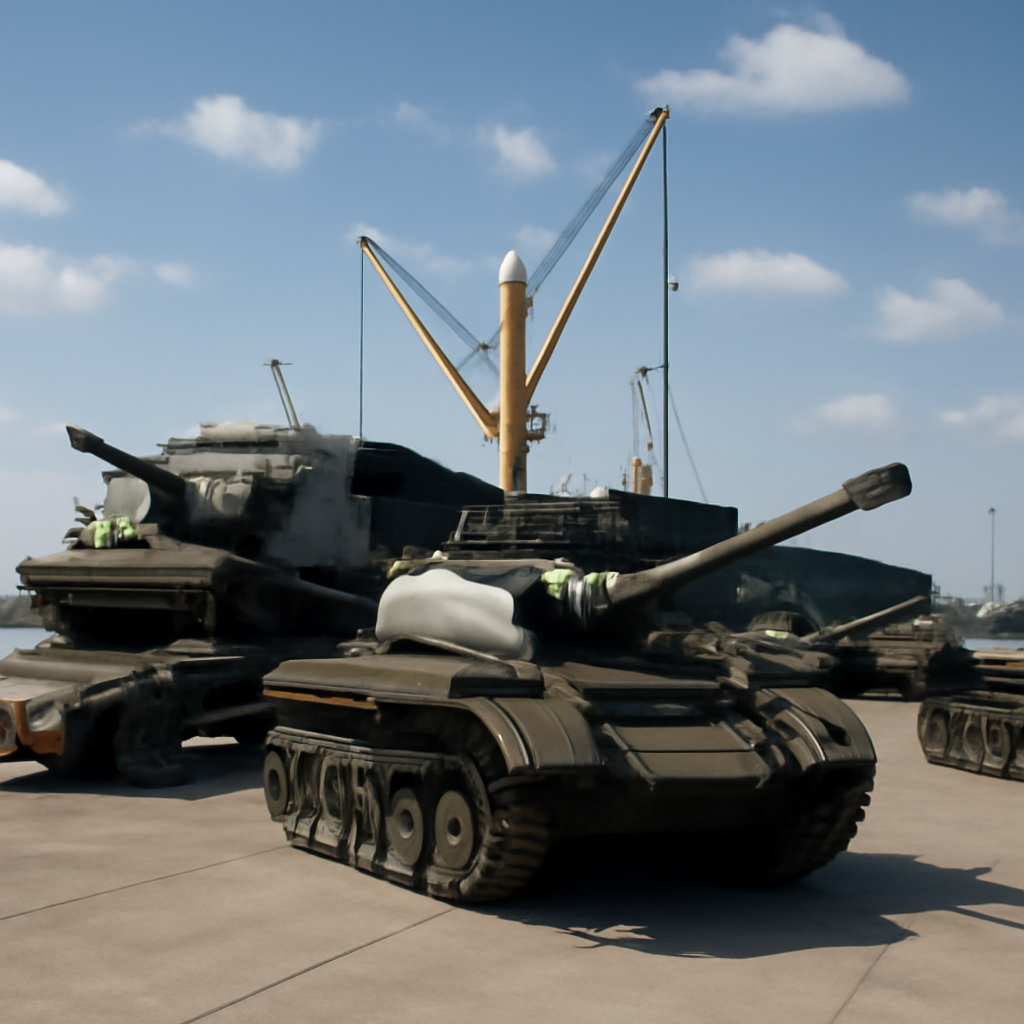
Photos surfaced on May 25 showing several Type 59D / ZTZ‑59D tanks being loaded for export. Those images correspond with reporting that “China has delivered 39 T‑59D tanks to Cambodia,” a claim published in a news item cited alongside the photos. The figure—39 of a planned 93—frames the current state of the transfer: a substantial tranche completed, with more deliveries still planned.
The Type 59 family, remade and exported
The Type 59’s long export life is visible in multiple lines of development and refurbishment mentioned in the record. Liaoning Poly Special Vehicle Co., Ltd. recently introduced the Type 59G‑125 for foreign buyers: an upgraded rebuild that features a redesigned turret, composite armor, a 125mm ZPT‑98 smoothbore gun, and a modernized engine. That variant is powered by a 730‑horsepower 12V150ZLC engine, a notable increase over earlier Type 59 powerplants such as the 520‑horsepower Model 12150L V‑12 liquid‑cooled diesel.
Past export and rebuild programs cited in the material include large projects such as a reported Bangladeshi rebuild program converting 300 existing Type 59s into a Type 59G configuration, and the platform’s recurring nickname in commentary—”Forever Type 59”—that underscores its persistence in service and on export lists.

Audit-ready is a season. It shouldn't be.
Evidence in spreadsheets, controls drifting between audits, frameworks multiplying on flat headcount. Nubivance runs continuous compliance on Rapid7 Cyber GRC - SOC 2, HIPAA, ISO 27001, PCI, CMMC.
End the scrambleSupplier profile: Liaoning Poly Special Vehicle Co., Ltd.
Liaoning Poly Special Vehicle Co., Ltd. is identified as the company offering the latest Type 59G‑125 export variant. The firm is described as a private enterprise tracing its roots to the former PLA Factory No. 6409, established on May 17, 2006, with an initial workforce of 80 employees. Its market push with a modernized Type 59 variant illustrates how legacy designs are being reworked for contemporary customers rather than simply retired.
Regional dynamics: a possible China‑supplied tank duel with Thailand’s VT‑4s
The Cambodia deliveries are noted against a recent episode of cross‑border tension with Thailand, during which the Thai Army publicly rolled out NORINCO VT‑4s. Commentators framed the prospect of a future clash—if one were ever to recur—as an unusual matchup: Type 59D/ZTZ‑59D versus VT‑4, “a Chinese‑supplied tank duel, Southeast Asia edition.” The source also recalls a historical parallel where both sides in the Iran–Iraq War fielded thousands of Chinese‑supplied Type 59s and Type 69s, producing mirror‑image armored formations. That precedent is invoked as a reminder that China has previously seen its tanks show up on both sides of a conflict.
What this means for Cambodia, Thailand, and Liaoning Poly Special Vehicle Co., Ltd.
- Cambodia: The Royal Cambodian armed forces are the immediate recipient of 39 delivered Type 59D tanks within a broader plan for 93 units; these deliveries increase Cambodia’s inventory of modernized Type 59 variants and reflect continued military procurement ties noted in earlier equipment transfers and donations.
- Thailand (the Thai Army): Having rolled out NORINCO VT‑4s during recent border tensions, the Thai Army is the most directly compared neighbor; commentators point to a potential juxtaposition between VT‑4s and the newly delivered Type 59Ds should tensions re‑emerge.
- Liaoning Poly Special Vehicle Co., Ltd.: As the supplier marketing the Type 59G‑125 and a company that traces its lineage to a former PLA factory, Liaoning Poly stands to capture export demand by offering upgraded versions of a well‑known platform, leveraging substantial modernization—turret, armament, armor, and engine—to make the decades‑old design marketable today.
Conclusion: the Type 59 endures. With photos from May 25 and a corroborating news item documenting 39 delivered tanks, the platform remains both a living export product and a political symbol in Southeast Asia’s military choreography. Whether the remaining 54 vehicles of the planned 93 are delivered, and how regional militaries reckon with the juxtaposition of Type 59Ds and VT‑4s on their borders, are immediate, concrete developments to watch.