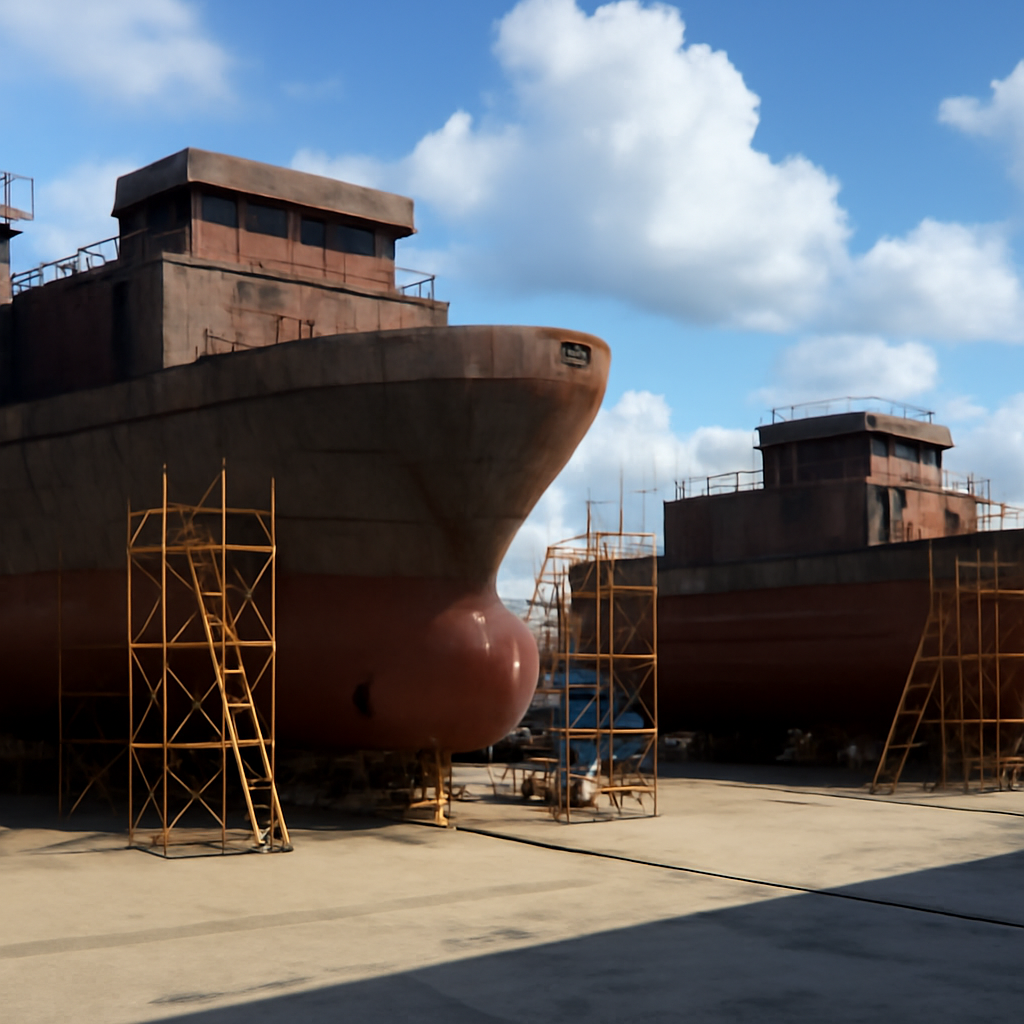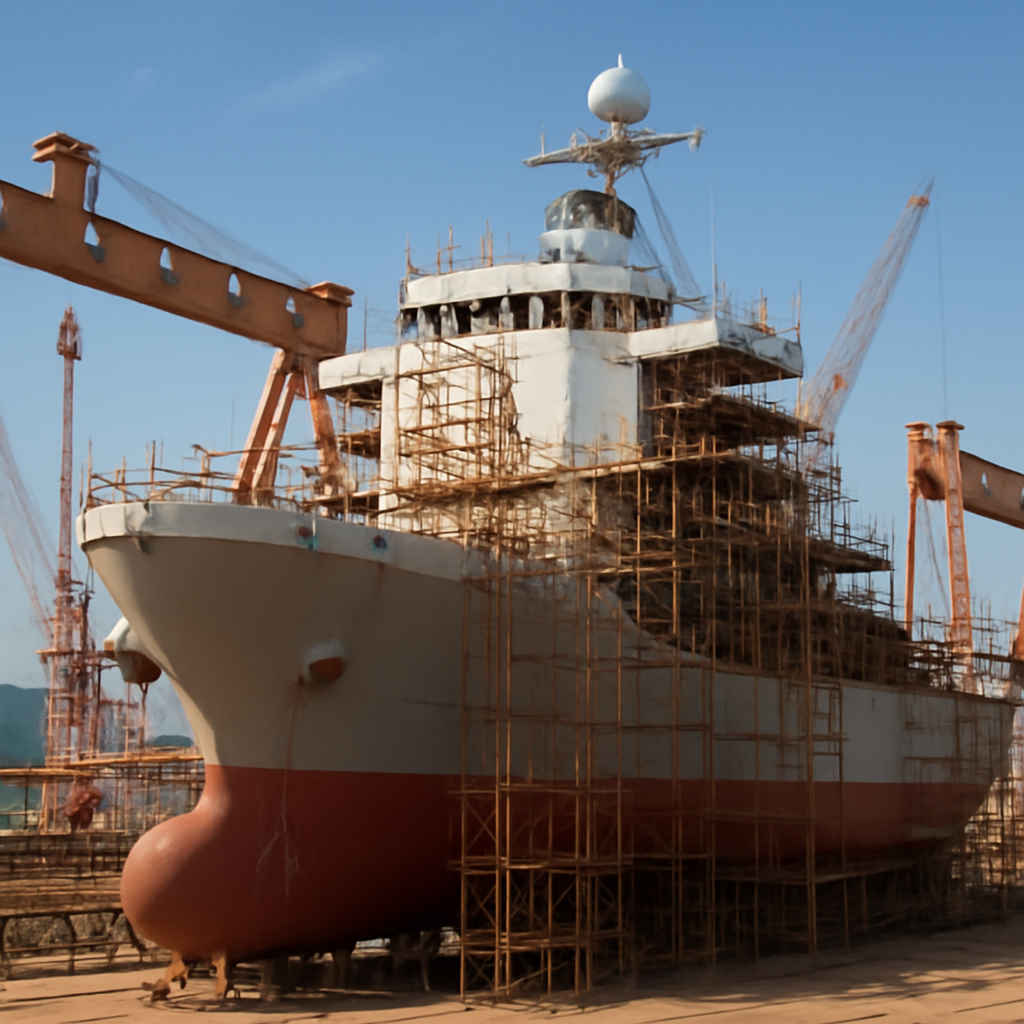
Photos show a second UUV mothership under construction in Guangzhou, and it is clearly not the same design as the first UUV mothership previously spotted in Shanghai.
The Guangzhou and Shanghai UUV motherships
Images circulating on Chinese social media depict a UUV mothership in a fairly advanced stage of construction in Guangzhou. Scaffolding and temporary supports remain around the bridge structure, but the hull and superstructure differ noticeably from the vessel earlier observed in Shanghai. The two ships are not the same design; the Guangzhou hull is an independent and distinct build rather than a repeat of the Shanghai prototype.
Performance, cost, and scale: the procurement triangle
The mothership program aligns with a procurement logic the blog post frames as a balance among three priorities: performance (meeting requirements), cost (buying and sustaining), and scale (how many can be built and how quickly). The piece argues that while performance attracts headlines and cost draws the attention of finance officials, scale often determines outcomes in conflict—an equation the author summarizes as “Performance, cost, and scale are not competing ideas. They are simply three parts of the same equation.”

The cyber insurance questionnaire just landed. Now what?
SOC 2, HIPAA, insurance renewals - someone has to own security strategy. Nubivance provides fractional CISO leadership without the full-time salary.
Get a security leadParallel prototypes as a deliberate approach
The appearance of two different mothership designs is presented as consistent with a recurring pattern in Chinese military procurement: build one or two working prototypes, gather operational experience, refine the design, then shift to larger production if the concept proves successful. The author uses past ship programs as examples: the original Type 054 produced only two hulls before transitioning to the much more numerous Type 054A, and the Type 052C lead pair (170 Lanzhou and 171 Haikou) preceded refinement and wider adoption in the Type 052D series, which grew into a fleet of more than 35 hulls with more under construction.
Parallel development across firms and the role of civilian industry
The post notes China often allows multiple organizations to pursue parallel technical solutions. The recent maiden flight of StarAir’s SA218 — one contender among several for a future basic trainer intended to replace the CJ-6, alongside competitors such as the TA-20 — is cited as an analogous case. The author emphasizes that modern Chinese firms (for example, Chengdu and Shenyang and other AVIC subsidiaries) are vertically integrated entities capable of design, testing, development, and manufacture, producing “competition within a highly coordinated industrial system.”
That industrial base, the post argues, changes the calculus: where shipbuilding capacity is abundant and supplier networks are extensive, building multiple prototypes is less an inefficient redundancy and more a way to accelerate learning. Once a design is judged mature, Chinese industry can scale production rapidly across civilian and military sectors — a dynamic linked in the post to the concept of Military-Civil Fusion. Examples cited include the civilian automotive industry supporting programs such as the Mengshi family, the commercial drone ecosystem contributing to UAV development, and commercial shipyards feeding naval construction.
Navalized 122mm MRLs aboard LCMs and the persistence of "good enough" systems
Two photographs recently shared online appear to show 122mm multiple rocket launchers mounted aboard a PLA Army Landing Craft Medium (LCM) from the Southern Theater Command. The craft resembles a downsized Type 073 landing ship medium, but attention has focused on the rocket mounts themselves. The post connects that imagery to an earlier experiment: the Type 053H frigate Jiujiang (Hull 516), which mounted five 25-round 122mm multiple rocket launchers and was decommissioned in 2017.
Jiujiang’s MLR configuration carried 50×5 (250) tubes with a max effective range of 20 km (30 km with extended-range rockets), weighed 5,000 kg, and had elevation and firing characteristics specified in the original post. The blog argues that rather than a discarded curiosity, rocket-equipped landing craft may reflect a capability that “never went away” — a pragmatic retention of functional equipment under the maxim quoted in the post: “New equipment costs money. Existing equipment is already paid for.” The result: a small but persistent use of navalized rocket systems where removal would be costly and the logistics chain already exists.
What this means for the PLAN, the PLA Army, and China’s defense industry
- For the PLAN: multiple prototypes provide options — the Shanghai and Guangzhou motherships may be competing concepts, complementary platforms, or sequential steps toward a production design; the service can gather operational lessons before committing to scale.
- For the PLA Army: the photographs of LCMs with 122mm MRLs suggest the Army may retain or quietly continue experiments with navalized rocket mounts rather than abandon older but still-serviceable capabilities.
- For China’s defense industry: the pattern described rewards parallel development inside vertically integrated firms and rapid scaling when a concept matures, leveraging civilian construction capacity, shipyards, and supplier networks under the umbrella of Military-Civil Fusion.
Two different UUV motherships under construction, and rocket launchers still mounted on landing craft, are small, concrete datapoints. Together they sketch a procurement philosophy: tolerate redundancy early to speed learning, keep what works because it is already paid for, and — if a concept proves its value — exploit an industrial base able to turn a design into mass production. Whether the Guangzhou and Shanghai motherships end up as rivals, partners, or predecessors of a single production variant, they fit a recognizable pattern in recent Chinese procurement: prototype, test, refine, and scale.