Hudong‑Zhonghua Shipyard, Changxing Island, Shanghai
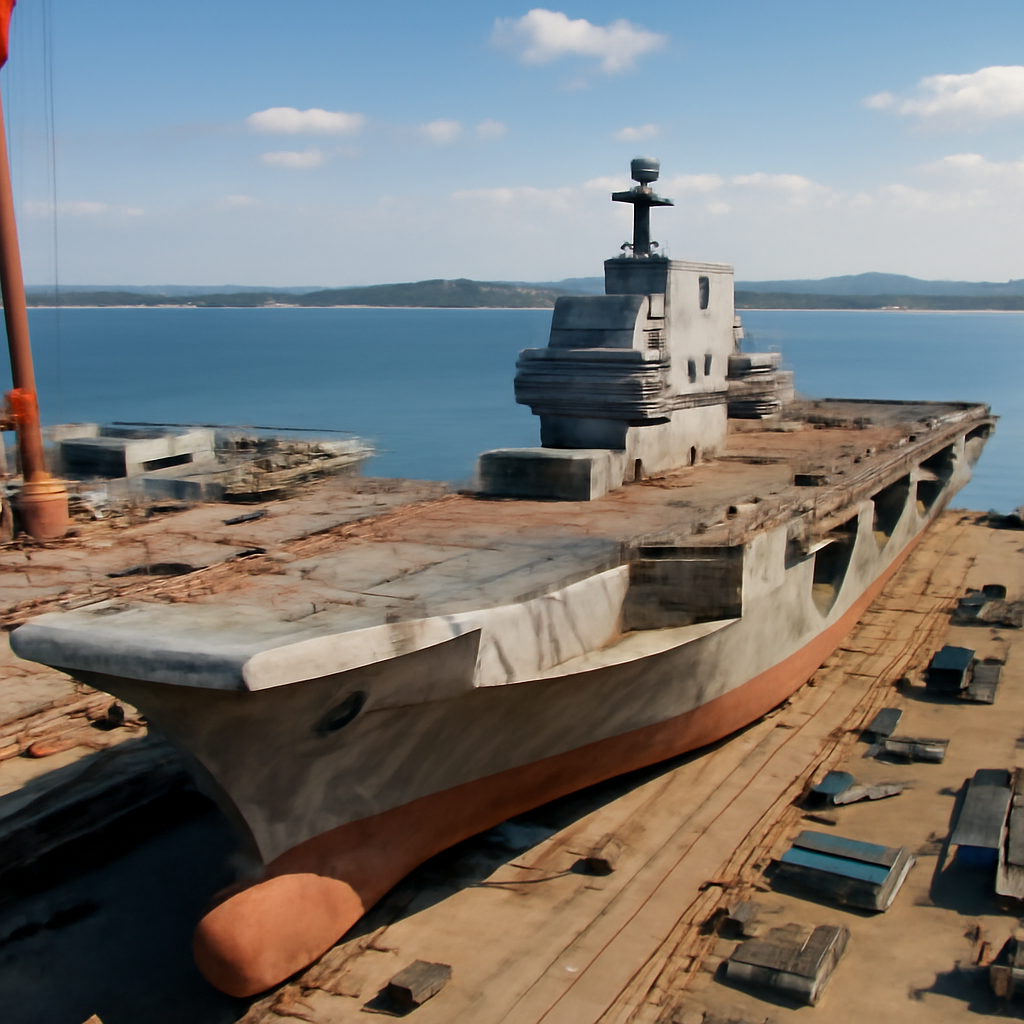
A distinct, boxy vessel has been taking shape at Hudong‑Zhonghua Shipyard on Changxing Island in Shanghai since at least April 2026. TWZ obtained a satellite image of the hull taken on September 10, 2026, from Vantor; additional imagery circulated online shows the ship later painted gray, a finish the reporting links to likely future service with the People’s Liberation Army Navy (PLAN). The yard is known to build both naval auxiliaries and commercial designs, and the new hull is now visible above the ways.
The ship's measurable size and visible systems
The vessel measures roughly 669 feet (204 meters) long and about 98 feet (30 meters) wide — dimensions, the reporting notes, that are roughly comparable in basic length and beam to China’s Type 071 amphibious warfare ship but with a much taller superstructure. Imagery from September 10 shows a stern opening into a well deck and a large, rectangular cradle‑like platform immediately behind the ship. That platform is roughly 164 feet (50 meters) long and features an arch‑shaped structure at one end, two teardrop‑shaped features at the other, and six pillars — three per side — between them.

Audit-ready is a season. It shouldn't be.
Evidence in spreadsheets, controls drifting between audits, frameworks multiplying on flat headcount. Nubivance runs continuous compliance on Rapid7 Cyber GRC - SOC 2, HIPAA, ISO 27001, PCI, CMMC.
End the scrambleLaunch and recovery: the cradle, well deck, and the twelve struts
Three features in the imagery drive most technical inferences. First, the cradle‑like platform’s teardrop shapes and overall form are consistent with a semi‑submersible design that would assist stability and hydrodynamic guidance when towed or lowered into water. Second, the well deck opening visible at the stern suggests more traditional launch‑and‑recovery through the hull is possible. Third, six large struts rising from the top of the stern are each paired with a shorter strut — a total of 12 struts — which independent analyst H.I. Sutton and the reporting say could be used either to lower a platform beneath the hull or to move payloads between decks internally.
Operational roles suggested by imagery and expert assessment
Taken together, the cradle, well deck and strut arrangement point to a vessel designed to carry, launch and recover very large uncrewed underwater vehicles (UUVs) and possibly crewed midget submarines. Sutton’s public assessments cited in the reporting argue the PLAN is pursuing larger UUVs and that road mobility — sufficient for smaller systems up to about 20 meters such as the AJX‑002 and HSU‑100 paraded in Beijing — becomes impractical for extra‑extra large UUVs (XXLUUVs). The ship could let multiple large UUVs be carried inside an extended superstructure and then launched or recovered one at a time via the cradle or through the well deck.
The reporting also points to a broader potential mission set beyond routine uncrewed operations: cable cutting, seabed retrieval, undersea espionage, submarine rescue, salvage and deep‑sea science are among the roles explicitly mentioned. Comparisons in the reporting note Russia’s specialised mothership submarines and the U.S. exploration of cradle‑style launch and recovery systems, while stressing that a large, dedicated mothership for XXLUUVs in operational service would be a distinctive development.
What this means for the PLAN, naval analysts, and policymakers
- For the People’s Liberation Army Navy (PLAN): imagery and expert commentary in the reporting imply a practical need for dedicated port facilities and at‑sea deployment options to support XXLUUV testing, evaluation, and operations — capabilities that floating docks used to date cannot provide without tradeoffs, according to Sutton.
- For naval analysts and technologists: the ship’s enclosed, boxy superstructure and the cradle/semi‑submersible platform create a new object of study. Observers will watch whether the internal volume functions as hangars for multiple UUVs and how the strut system is used in practice to move large payloads between decks or beneath the hull.
- For policymakers and maritime regulators: the reporting highlights the blurred line between military and ostensibly civilian assets in China’s shipbuilding picture, and notes the operational value of an enclosed, weather‑shielded mothership for harsh environments including Arctic waters — an area where China is “working to be more engaged,” per the source.
The satellite record and expert readings increasingly support the conclusion that the hull rising at Hudong‑Zhonghua is, at minimum, intended to support very large submersible drones. Critical open questions named in the reporting remain concrete: will this be a one‑off experimental vessel or the lead ship of a class; how will the strut system be used in practice; and what operational patterns will emerge once joint sea trials and UUV deployments begin? The answers will arrive only as the ship moves from the ways into the water and into service — and until then, the imagery already in hand offers an unusually clear early look at how China is planning to operate larger undersea drones.