“So traditionally, for 25 years, we’ve been at war in the Middle East and that war was effectively fought in the parking lot of a giant gas station,” Robert Hein, Director of Maritime Operations for the U.S. Navy’s Military Sealift Command, said in April — an observation that frames why a single hulking supply ship under construction in southeastern China has drawn so much attention.
Longxue Island’s COMEC/GSI yard: the building site and its pedigree
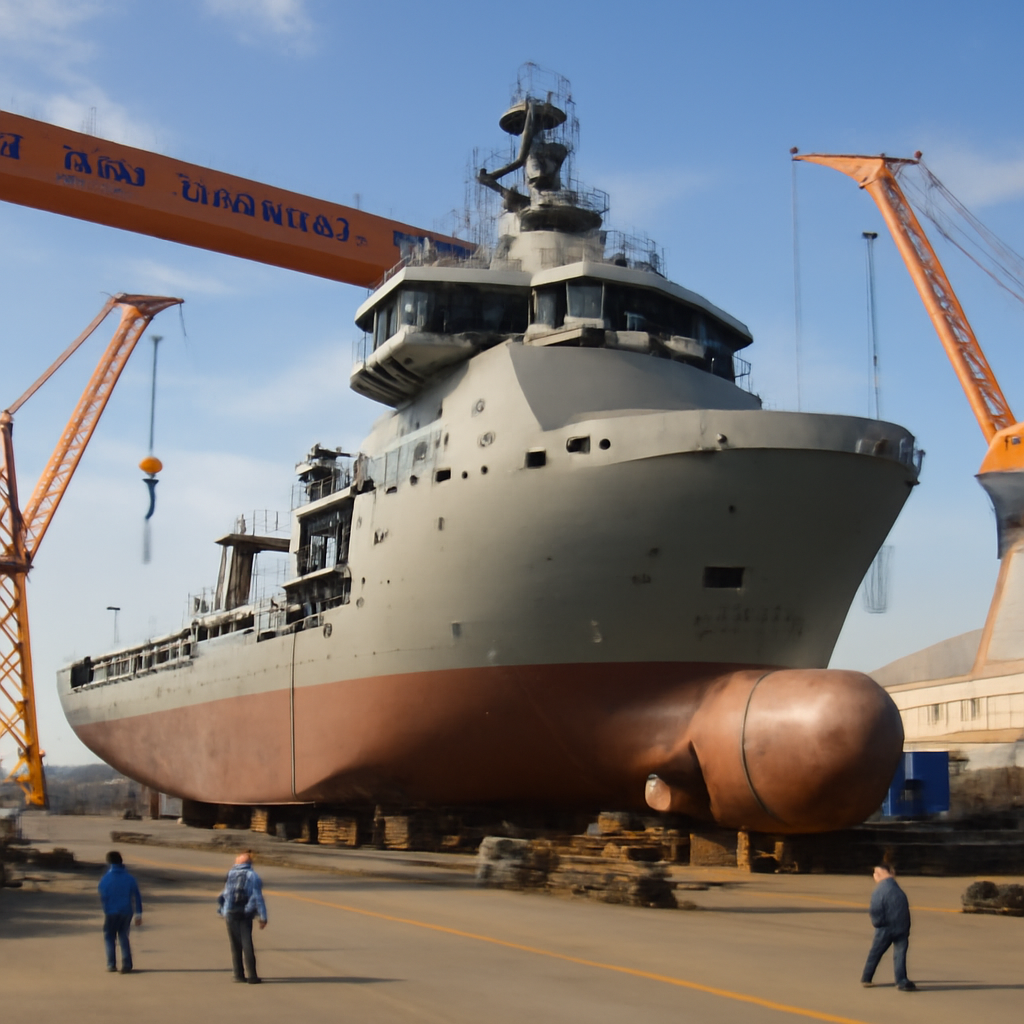
The hull is rising at a shipyard on Longxue Island, just southeast of Guangzhou, operated by a China State Shipbuilding Corporation (CSSC) subsidiary now called CSSC Offshore and Marine Engineering Company (COMEC), previously known as Guangzhou Shipyard International (GSI). Planet Labs satellite imagery shows the vessel under construction since at least February, with a clear view on July 2, 2026. COMEC’s public portfolio emphasizes large commercial hulls — oil and LNG tankers, heavy-lift vessels — but in recent years the yard has produced unusual designs with military or dual-use application: an apparent civilian “research carrier,” jack-up barges intended to connect for amphibious support, a stealthy trimaran drone ship, and domestically built Zubr-class hovercraft.
Dimensions and design: far larger than known PLAN replenishment ships
Measured from imagery, the new hull is approximately 885 feet (270 meters) long and about 121 feet (37 meters) across at the beam — notably larger than the People’s Liberation Army Navy’s (PLAN) existing Type 901 replenishment ship, which is about 787 feet (240 meters) long with a beam just under 102 feet (31 meters) and a reported full-load displacement near 45,000 tons. For further context, the U.S. Navy’s John Lewis class replenishment oilers are just under 746 feet (227.3 meters) long with a roughly 105-foot (32.2-meter) beam, according to the official fact sheet cited in reporting. Jane’s, in April, described the hull as “broad and slab-sided, with a full midsection optimised for volume rather than speed alone,” language consistent with large fleet auxiliaries designed to carry fuel, dry stores and ammunition.

Audit-ready is a season. It shouldn't be.
Evidence in spreadsheets, controls drifting between audits, frameworks multiplying on flat headcount. Nubivance runs continuous compliance on Rapid7 Cyber GRC - SOC 2, HIPAA, ISO 27001, PCI, CMMC.
End the scrambleVisible features consistent with an at-sea replenishment role
Satellite and yard photographs reveal a distinct layout: a forward superstructure with wide bridge wings and a mast, and a separate stern superstructure with exhaust stacks forward of it. The stern shows a large flight deck and a hangar with two openings — CSSC included a ground-level photo of that stern view in a May social-media post marking a change in solar terms. Planet imagery from July 2 also shows two large side openings in the right-side stern superstructure that might be for launching and recovering small boats or serve as crew apertures.
Crucially, a row of pillar-like vertical structures sits midway along the hull, placed close to both sides. Those elements align with what is typically fitted on vessels configured for underway replenishment and alongside refueling. The stern hangar and flight deck would support vertical replenishment by helicopter. What defensive armament the hull might receive remains unspecified; the Type 901, by comparison, carries four 30mm H/PJ-13 Gatling-type turrets for close-in defense.
Operational implications for PLAN carrier strike groups
The ship’s size and configuration point to a primary role: extending the reach and endurance of carrier strike groups and other large PLAN formations without dependence on friendly ports. The PLAN operates conventionally-powered carriers and escorts that require regular refueling and resupply — including fuel for carrier air wings in addition to propulsion fuel for surface escorts. The article notes that the carriers Liaoning and Shandong operate together with escorts and have been accompanied by Type 901 replenishment ships in the past, illustrating the logistics train needed for sustained operations.
That logistical need has received recent attention outside China as well: Hein’s remark and reporting on U.S. Navy “tanker treadmill” workarounds underscore how attacks on regional port infrastructure can force navies to shift greater loads to at-sea replenishment. The article also observes that America’s aircraft carriers are now all nuclear-powered, removing the need to refuel the carrier propulsion systems at sea, but not the need to provide fuel to embarked air wings and conventionally-powered escorts. The piece adds, as an aside, that China may now be in the process of building its first nuclear-powered aircraft carrier, though it treats that as distinct from the new replenishment hull.
What this means for the PLAN, the U.S. Navy, and CSSC/COMEC
- For the PLAN: A substantially larger replenishment vessel would increase at-sea sustainment capacity — more internal volume for fuel, munitions, spare parts and stores — supporting longer, farther-ranging carrier operations and other large platforms such as planned amphibious assault ships.
- For the U.S. Navy and planners: The build feeds into broader analyses of changing global naval logistics capacity; reporting cites an unclassified Office of Naval Intelligence slide (circa 2023) highlighting disparities in shipbuilding capacity that have attracted U.S. policy attention and efforts to expand production.
- For CSSC/COMEC and Chinese shipbuilding: The project underscores the Longxue yard’s evolving role in producing large, specialized or dual‑use hulls and the parent company’s capacity to lay down vessels that diverge from standard commercial profiles.
Satellite imagery and a CSSC yard photograph make clear that this is no routine commercial hull. The balance of shape, internal volume and replenishment-specific fittings seen so far strongly suggest the world’s largest dedicated naval replenishment ship is taking form. What remains unresolved — and will determine how the hull alters operational calculus — are the final capacity figures, self‑defense suite, and the ship’s integration into PLAN task forces. More detailed assessments should follow as construction progresses and further imagery and official disclosures appear.
https://www.twz.com/sea/china-is-building-a-monster-supply-ship-for-its-carrier-groups