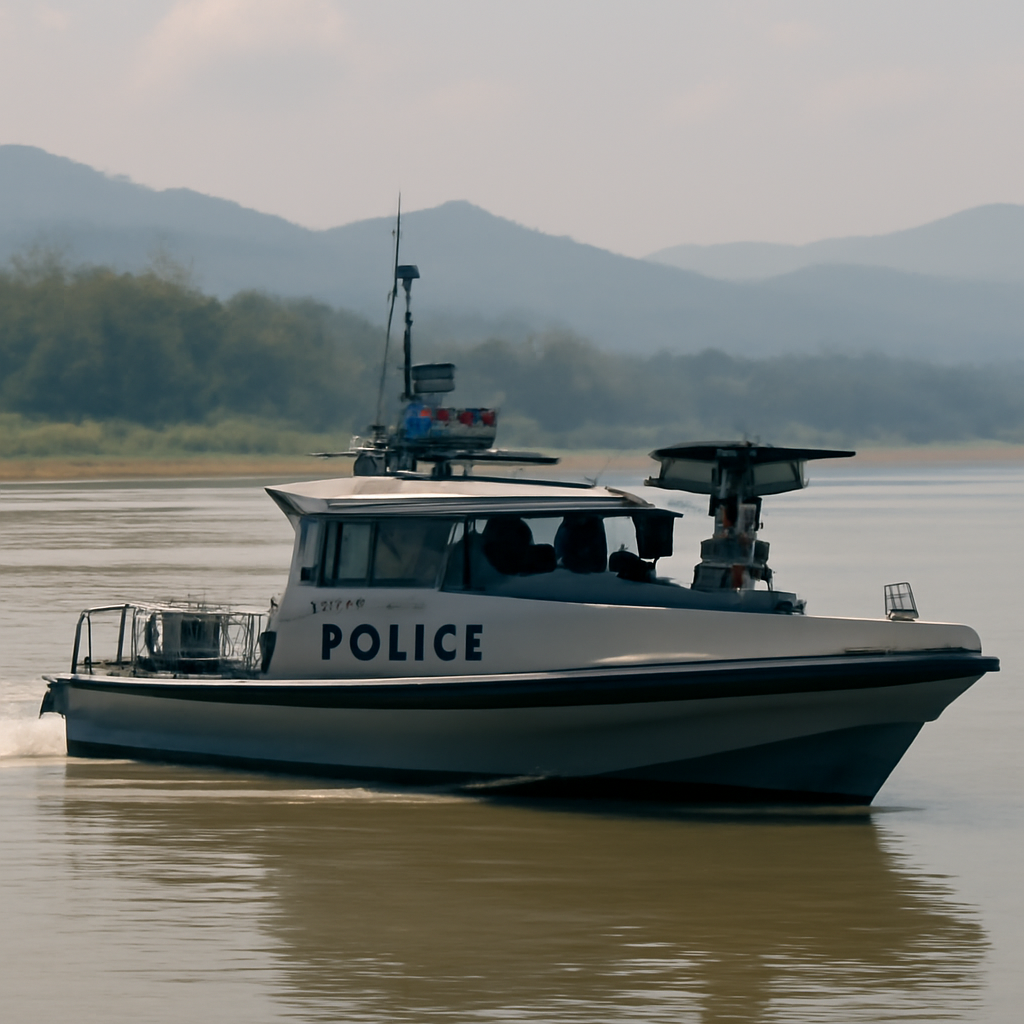
"On the Mekong, 'insufficient firepower phobia' is a diagnosable condition," wrote China Defense Blog in its report on a new generation of police boats now operating on the Mekong River. The line captures a concrete shift in equipment and posture: the riverine patrol that began as improvised escorts has, according to the same source, reached a fourth generation that includes remote weapon stations and a 15‑round rocket launcher.
The Mekong River Joint Patrol: mandate, participants, and routine
The joint patrols are a long‑running, four‑nation security operation involving China, Laos, Myanmar and Thailand, created after the October 5, 2011, massacre. The mission is described simply: keep the river open, safe, and uneventful. Typical patrols mix China’s Yunnan border police / PAP riverine units with Laotian, Myanmar, and Thai water‑police detachments. China provides boats, command elements and UAV overwatch, while the other three nations contribute local knowledge and manpower.
A Xinhua dispatch cited in the source reported the launch of the 159th joint patrol on Nov. 25, when three Chinese law‑enforcement vessels left Jingha port in Yunnan Province while Lao and Myanmar boats departed Muang Mo and Wan Pong ports. That patrol involved "over 100 law enforcement personnel and seven patrol vessels" and scheduled an information‑exchange meeting in Chiang Saen, Thailand, to analyze security in the Lancang‑Mekong drainage area.
Four generations of riverine craft: from converted ferries to purpose‑built gunboats
The evolution of the fleet is presented as four distinct generations. Gen‑1 (2011) were converted flat‑bottomed passenger ferries and cargo boats—roughly 20 meters long and 20 tons—armed only with a few machine‑gun mounts and basic radios. Gen‑2 (around 2015) moved to purpose‑built patrol craft with better engines, weather protection and stronger mounts. Gen‑3 (around 2019) added command‑and‑control compartments, improved ballistic protection and multi‑day accommodations. Each phase progressively professionalized the force away from make‑do conversions.

Audit-ready is a season. It shouldn't be.
Evidence in spreadsheets, controls drifting between audits, frameworks multiplying on flat headcount. Nubivance runs continuous compliance on Rapid7 Cyber GRC - SOC 2, HIPAA, ISO 27001, PCI, CMMC.
End the scrambleGen‑4 (2024–Present): remote weapon station and a 15‑round rocket launcher
The latest generation—labeled in the source as the "Type 055 of the Mekong"—is where the change in armament becomes pronounced. Photos and reporting show craft fitted with extensive communications, sensor and navigation arrays, a remote weapon station, and a 15‑round rocket launcher. The fourth‑generation hulls are described as larger, better protected and ergonomically arranged for multi‑day patrols. The China Defense Blog framed the change bluntly: "a river gunboat with a counter‑bandit MLRS."
Operational history and force posture: incidents that shaped deployment
The joint patrols were a response to violent incidents on the river. The four‑nation patrols began after the October 5, 2011 attacks that killed 13 Chinese sailors. Earlier January 2012 reporting documented attacks on Chinese and Burmese ships, including an incident in which armed assailants reportedly fired M79 rockets at vessels, one rocket exploding near a patrol ship, and related follow‑up by Chinese and Laotian police. State media items carried in the source also reported China deploying more than 300 armed police to the Mekong in the months after the October incident and using patrol boats to escort private cargo ships.
Those incidents are the practical origin story for the joint patrols and help explain why the fleet has been iterated repeatedly toward greater protection and heavier armament.
What this means for China’s Yunnan border police / PAP units, Laotian‑Myanmar‑Thai water police, and commercial shipping crews
- China’s Yunnan border police / PAP riverine units: The reported additions of remote weapon stations and rocket launchers indicate a continued investment in hardware and command-and-control capacity for transnational river patrols; China is the supplier of hardware, command elements and UAV overwatch according to the source.
- Laotian, Myanmar, and Thai water‑police detachments: The joint patrols rely on these forces for local knowledge and manpower, and the multilateral format includes regular information exchanges—Xinhua noted a planned meeting in Chiang Saen to analyze security and plan cooperation priorities.
- Commercial shipping crews: Historical reporting in the source shows that attacks on cargo ships in 2011–2012 disrupted services and raised crew concerns; the patrols’ progression toward heavier armament may be intended to reassure commercial operators that escorts are more survivable and better armed.
The Mekong River joint patrols have moved from improvised escorts to purpose‑built, heavily equipped riverine craft in little more than a decade. The introduction of remote weapon stations and an onboard 15‑round rocket launcher, at minimum, signals a tolerance for greater kinetic capability in a mission whose stated goal remains keeping the river "open, safe, and uneventful." The next visible test of this equipment is operational: whether these Gen‑4 craft will be deployed routinely across more patrols and how the four partners will coordinate use of such weapons in a multinational law‑enforcement setting.